Mailuu Suu
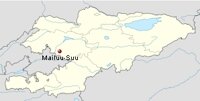
Mailuu Suu in Southern Kyrgyzstan
Back in 1962, one of the biggest factories in the former Soviet Republic that later became Kyrgyzstan opened its doors on 24th January: The Mailuu Suu Light Bulb Factory.
To be honest, although I have been in the region two or three times, I have always driven past and never stopped off.
The name Mailuu Suu means “oily water” and the River was given this name because oil was produced here at the turn of the nineteenth century. (The oil workers apparently helped to build one of the local Collective Farms.) In fact the relatively small deposits of oil and gas are likely to be one of the fields to be developed by the Russian firm GasProm.
Mailuu Suu lies in a side valley off the main Bishkek-Osh highway, (about 550 kilometers from Bishkek, 100 from the regional center of Djalal Abad and 150 kilometers from Osh – and 24 kilometers from the border with Uzbekistan), on the Northern slopes of the Ferghana Valley.
The city lies on the floodplain of the Mailuu Suu river at an altitude of between 800 and 900 meters above sea level. The population of about 23,000 is predominantly Kyrgyz, although there are also some Russians, Uzbeks and Tatars.
It always stuck me as odd that This should be chosen as the site for a major factory … the remoteness seems to be a direct contradiction of the Estate Agents’ principal of: “location, location, location“. According to the explanation I received from a consultant working on a project attempting to the rationalize the management of some of the largest enterprises in the country shortly after Independence, was that the Soviet Union had a responsibility to provide work for the population and when the Uranium mine in the vicinity was closed, they looked around to see what sort of factory they could open to provide the local population with employment opportunities.
Back in Moscow, they scanned their list of potential projects and saw that there wasn’t a source of light bulbs in the whole of Central Asia and so decided to open one here; (Mailuu Suu is still the only manufacturer of light bulbs in the region),
They tended to favour big factories which gave them economies of scale, hence the size of the factory which produces over 100 different types of light bulb and is supposed to have the capacity to produce some 300million units a year. It seems that Kyrgyzstan provides some 40 million light bulbs to Iran alone … that figure struck me as incredible.
The Kyrgyz government is looking to introduce savings and exploring the possible use of energy saving light bulbs at all state-financed institutions. This will require well over half a million light bulbs but there is confidence that the plant will be able to meet this demand.
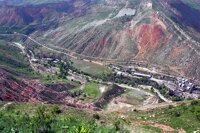
Abandoned uranium mills in Mailuu-Suu.
For a long time Mailuu Suu was a city with restricted access, (not only for foreigners but also for Soviet citizens as well), which was classified as “Secret” and was called “Mailbox 200”.
That was all down to the Uranium Mine and mill in the town. Deposits of the mineral was discovered in 1929 and some 10,000 tons of uranium oxide was mined and processed in the the two plants in the the town between 1946 and 1968. (Ore from other mines – including mines from East Germany – was also processed here.)
Apparently, it is remembered as a time of “abundance and prosperity”.
The mine has, however, an unfortunate legacy which has resulted in Mailuu Suu being ranked third in the list of the world’s most polluted places in a report by the New Yark based Blacksmith Institute in 2009 – after Chernobyl, (in the Ukraine – site of the nuclear reactor accident), and Dzershinsk, (in Russia – where toxic weapons were manufactures for over 50 years).
The mine and Uranium plants left some 23 unstable “tailing pits”, (dumps containing the materials left over after the process of separating the valuable fraction from the uneconomic part of an ore), and 13 other waste dumps in the hill above the town. Together they contain almost two million cubic meters of radioactive waste.
I say “unstable” because the land is subject to erosion which can expose some of the radioactive waste. A landslide in 1958 released about 6,000 cubic meters; a landslide in 1994 blocked the Mailuu-Suu River damaging a waste reservoir; a flood caused by a mudslide nearly submerged a tailings pit in 2002 and about 300,000 cubic meters of material fell into the Mailuu-Suu River near the uranium mine tailings after an earthquake in 2005.
This obviously has implications for the health of the local population. Uranium is a known carcinogen and mutagen, that can cause damage the kidneys, liver, and cardiac tissue. Decay of uranium produces radon gas, which has been found in elevated concentrations in the region. Radon is a carcinogenic which is believed to be the most significant cause of lung cancer other than smoking. Anyway, a 1999 study conducted by the Institute of Oncology and Radioecology reported that twice as many residents suffered from some forms of cancer, anemia and birth defects , than in the rest of the country.
Despite this, and the concern that people express, there has been relatively little migration away from the region. Several projects have been launched to help reclaim the tailing pits, and improve the road structure to help avoid future landslides. Because there are concerns about pollution of the water supply, special filters have been introduced. Programs have also been carried out among the local population to make sure that they are aware of appropriate techniques to adopt in terms of handwashing and food preparation.
As an aside: Mailuu Suu was in the news again this week … but not for a good reason. It was reported that as a result of investigations by the Procurator’s Office, a criminal case has been opened against the Mayor and others for “embezzlement” of money intended for the repair of city roads and the stadium, “abuse of office” and “negligence”.


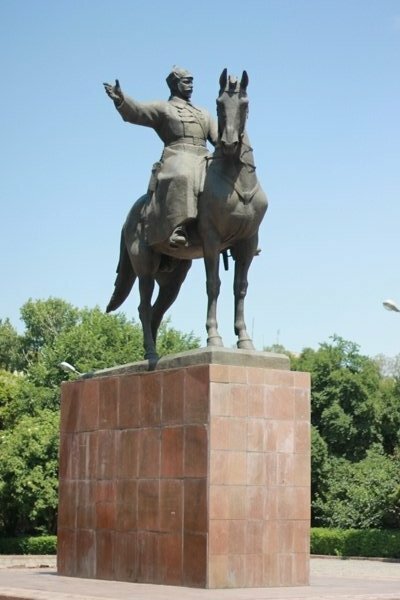
 Bishkek