Russian Cursive script makes me want to cry
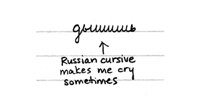
I have no idea what it says!
The other day someone posted a photograph on Facebook and I immediately moved my mouse pointer over the “Like” button. It’s not the first time I had seen this particular picture but it summed up my own feelings and experience so, so well.
Doctors are supposed to have handwriting which is virtually indecipherable … well, Russian cursive script is also, often completely unintelligible. It was difficult enough trying to learn Russian, which meant learning a totally different alphabet: the Cyrillic alphabet. Some of the letters are virtually the same as in the Latin alphabet that we use in English, but others have different sounds … and then there are those that are totally different. It doesn’t help that some letters may have two or more sounds associated with them – we have that in English as well – or that some have two or more different versions.
As it happens, that wasn’t a big problem in itself … at least not when it came to reading printed texts like books and magazines or film credits. The problems really started when it came to dealing with handwriting – especially when people used a cursive script.
Trying to make head or tail out of some people’s handwriting can be a really frustrating and maddening experience … and although I don’t think it has ever made me feel as if I want to cry, I certainly sympathize with the person who posted it.
In fact, the examples I usually when trying to make the same point are “millimeter” and milliliter” both of which appear as a dozen or so vertical lines.
These days we are used to seeing “printed” texts – even on computer screens where we read our emails and surf the internet. The fonts may be different but they have similarities and are designed to be easily read. They lack, however, the “personal touch” that handwriting can convey.
Today, 23rd January, is designated as National Handwriting Day in the United States; the purpose of which is “to alert the public to the importance of handwriting”. According to the Writing Instruments Manufacturers’ Association, (WIMA), who sponsor it, “National Handwriting Day is a chance for all of us to re-explore the purity and power of handwriting.”
Incidentally, January 23rd was chosen because it was the birthday of John Hancock … (President of the Second Continental Congress and of the Congress of the Confederation, first Governor of Massachusetts, and the first person to sign the United States Declaration of Independence, who signed it with a large, bold and prominent flourish. His signature is so prominent, in fact, that it well and truly stands out from all the rest. There is a story, I don’t know if it is true, after he had signed, a discussion broke out before the next signature could be added. Hancock eventually spurs everyone into action by declaring that only he can be accused of treason at the moment.
I am not sure that I would go as far as WIMA in asserting that “there is something poetic about grasping a writing instrument and feeling it hit the paper as your thoughts flow through your fingers and pour into words”, but it has to be admitted that handwritten notes and letters are much more personal, however, and carry a much stronger sense of personal commitment and convey a sense of relationship between writer and reader.
Handwriting is also supposed to convey something of the personality of the author … indeed the somewhat controversial field of study and analysis of handwriting called “graphology”, which dates back to the sixteenth or seventeenth century. It involves the examination of the pattern, form, movement, rhythm, quality, and consistency of the pen strokes in a given sample.
I say “controversial” , (some people go a lot further and call it “pseudo-scientific” … and the British Psychological society considers it to have “zero validity”), because, although many claims are made in support of it as a tool in the study of human psychology, and its apparent usefulness in the diagnosis of some diseases affecting the brain and nervous system, there seems to be conflicting evidence add be little research which backs these up – and, indeed, surveys into its usefulness as a potential tool in recruiting staff for particular types of position have tended to be negative.
WIMA point out that “handwritten documents have sparked love affairs, started wars, established peace, freed slaves, created movements and declared independence” and encourage people to make a point of putting pen or pencil to paper and expressing themselves, at least on this one day of the year.


 Bishkek