New Year, New Week … New Start
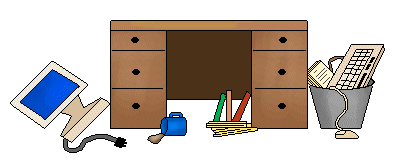
I doubt if my desk will ever be that clean!
I am not sure where the idea originated, but the designation of today as Clean Off Your Desk Day could have been with me in mind …
The date of Clean Off Your Desk Day changes every year because it falls on the second Monday of the year.
Apparently, in the States there is a book called Chase’s Annual Events, which lists special events such as this … I must see if I can get a copy, (apparently it’s now been sold and is published by McGraw Hill). Anyway, this particular special day was apparently created by Anne Chase Moeller, the daughter of Mr. Chase – yes, the publisher of this same book. It seems that she often helped out in her father’s office and shared his incredibly cluttered desk. In order to create a place where she could work, she would spread a cloth over his chaos and then do her work. When she finished, she would put her things away, including the cloth and leave.
At the end of 1982, she declared that he would clean off his desk at least once each year.
Naturally, being in the business, they entered National Clean Off Your Desk Day into the record book for the second Monday in January, and the rest is history.
It may be a bit early to start Spring Cleaning, but the idea seems to have been to provide an incentive to make a Fresh Start : New Year, New Week … New Start.
In a way, it is quite appropriate that the second Monday in January falls on the fourteenth – here it is known as Stariy Noviy God, or Old New Year.
I suppose that I ought to be ashamed about this … but I am renowned for the mess on my desk. As well as the ubiquitous computer, monitor, keyboard, mouse and printer … calendar/diary, notepad, stapler, hole punch and strangely misnamed “desk tidy” to keep pens, stock of paper clips, etc. … there is nearly always huge piles of papers – reports, agendas, printouts, charts … and so on.
I have a problem in that I am what is commonly known as a hoarder … I never really like to throw things away because you just never know when you might need it again.
I know, I know. I have newspaper cuttings and printouts from the internet, that I have collected over the past seventeen years, each one because I thought they might be interesting some day … about places in Kyrgyzstan, historical characters, shyrdaks, types of music, and so on and so forth. How often do I go back and look and look at them … if the truth: rarely.
Of course, hoarding implies that you have to have an efficient filing method so that you can actually find it again … and unfortunately, that’s not always the case … I know that I spend a fair amount of time searching for documents that I know are here somewhere … but where, exactly, did I put it?
As an aside: a recent study of 1000 people suggested that television viewers can spend two weeks of their lives searching for the remote control.
I have often said that there are always two things of which there is never enough: power points and storage space.
The first of these, electric power points, provide for one of the most frustrating experiences whether it is in the home, office, classroom or wherever: trying to find a power point to plug in some appliance. Most of them already have something plugged into them … and if you do find one that sits invitingly free, you discover that it is too far away for the flex attached to the appliance. So extension chords are called for … probably one with multiple sockets, (2, 3 or 4). This is not only unsightly, it can be dangerous; overloading the circuits, likely to be a fire hazard and providing a perfect trap for a trip.
When I moved into this office, there wasn’t that much I could do about the electric points … but I could do something about the storage space. I put in shelves, lot of them, and went through all the papers sorting them into categories … filing them accordingly. For a while, it worked well, but eventually I started to run out of shelf space. Piles of papers appeared on the side desk … and so it has continued.
In fact, I try to routinely go through the stuff on my desk … well, once a month … it’s part of my monthly routine. As it happens, few of those bits of paper ever get thrown away – most of the papers just get moved from one pile to another.
Regular readers of these postcards will know that I have a penchant for statistics and trivia, and will not be surprised at my delight in coming across a webpage with the following data:
- 85 – percent of workers who believe that a clean desk says that “someone is on top of things.”
- 48 – percent of workers who say they have messy desks and are “pilers” when it comes to their work space.
- 38 – percent of workers who say they have clean desks and are “filers” when it comes to their work space.
- 14 – percent of workers who say they are “tossers,” that they have clean desks but throw away almost everything.
- 40 – percent of workers who admit to “frequently” losing paperwork because of their messy desks.
- 57 – percent of men who admit eating meals or snacks at a dirty desk or work space.
- 43 – percent of women who admit eating meals at a dirty desk or workspace.
- Almost 21,000 – the number of bacteria per square inch on the typical worker’s desk.
- More than 25,000 – the number of bacteria per square inch on the typical worker’s phone.
- 49 – the number of bacteria per square inch on the typical office toilet seat.

My desk isn't this bad ...
Now, I know that there is a theory that “a tidy desk is an indicator of of a tidy mind“, whereas “a cluttered desk is a sign of a cluttered mind” … and from the above it will be obvious that I don’t necessary agree.
I don’t think, however, that I would go as far as to say that “a cluttered desk is a sign of genius“, as some people apparently do.
Although there are people who keep their desk top “clean as a whistle”, there are those who have piles on every flat space; there are those who file everything as soon as it arrives in their hands and those who “toss it” into a pile with similar things. To some people, a “clean desk” may be sending a signal that they are efficient at “getting their work done”, whilst for others there is a need for detailed information to be at hand to refer to at any moment.
It seems to me that it doesn’t really matter which approach someone adopts … what matters is “what works for them”; what is the most effective way for an individual to work. For that they need to be “organized”.
That doesn’t mean to give a blank cheque to those who, like me, have piles of papers of their desk to do as they please. My desk isn’t as bad as the one in the picture, (which I lifted, incidentally, from Melissa Burford’s blog when she wrote about Clean Off Your Desk Day back in 2010 … it’s thanks to her blog entry that I discovered the history of this day).
The trouble with a messy desk is that things get lost or overlooked, so some form of order is needed; an efficient filing system.
Systems are no good if they are not implemented properly. When I was younger we were taught a way of filing papers: In, Out and Pending. Anything new arriving on your desk and needing attention was In; things which had been dealt with and needed to be apssed to someone else for action or filing was Out; anything which was waiting for action, or further information was Pending. To be honest, I try to do this … but the Pending pile grows and hence my monthly “clean outs”.
These days, there is another approach: Keep, Toss or Move. When new papers arrive they should divided into these these categories: vital information that needs to be instantly filed – Keep; The papers that you are not sure about – that, maybe, need some extra work or that need to be passed onto someone else – Move; Everything else that is not important should be thrown away – Toss.
In theory, I do try to do this … but I have to admit that I am not as diligent or ruthless about it as, say, Bill Marriott – of Marriott hotels, who operates on a principle that “a piece of paper should only cross my desk once”. I don’t think I can go that far. To be fair, even the advocates of this system admit that it is not always possible to stick to it … sometimes things have to go into the “Pending” tray. They still maintain, however, that we need to be ruthless with this, and make sure that we have a “To Do” date to go with each one.
There is another reason why we need to keep papers … for reference. We might need the papers to refer to at some point in the future. Advocates of the “Keep Toss or Move” school of thought suggest that we should keep as little as possible. Sometimes what we have to keep is defined for us – for example, accounting documents – in Kyrgyzstan these have to be kept for seven years … and payroll data has to be kept, effectively, forever; (if the company closes, it has to be passed onto the state archives – peoples pension rights depend upon it).
In other cases, however, they say, for example, that we should ask if we really need to keep a whole document – or just part of it. Do we have that information anywhere else?, is it duplicated anywhere? … if so, it is safe, they say, to toss it.
They also say that we should ask ourselves if we will REALLY need the information it contains – it which case we have to keep it, or if we MIGHT need the information again at some point in the future. If it is a case of “MIGHT” then perhaps we should be bold and “toss” it.
Once again, although I see the logic behind this … and, remember, there is always a shortage of storage space/shelf space … I am not sure that I fully agree with this. Maybe it is part of my naturally conservative nature, or maybe it is a result of living here for so long and knowing that what is available today might not be available tomorrow. There have been many cases, for example, where I have seen something on a website … I remember it well but want to refer to it up again and go searching … only to discover that the site has gone down and the information lost.
Well, having said all that … I think that Anne Chase Moeller had a point … and I, for one, will be going through my paperwork and trying, (please note: “trying”), to clean my desk today. I have already started … but one of my “resolutions” was to try, (once again, “try”), and make a real effort to keep a tidier desk this year.
I hope I will have more luck with this resolution than the rest of the population with theirs … according to a report in the Daily Mail: just 10 per cent of people manage to keep their New Year’s resolutions for at least six months; just under half break their resolutions within a fortnight, (blaming a lack of will power).






 Bishkek