Wikipedia
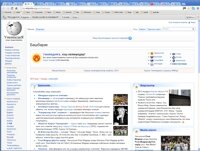
The Front Page of Wikipedia in Kyrgyz
Love it or hate it … “Wikipedia has drastically affected how we access and share information on the internet” … so says Justin Franco in his brief History of Wikipedia (in two and a half minutes”) on youtube.
Wikipedia was launched on 15th January , 2001, although it was based on a concept and technology of a “wiki” pioneered in 1994 by Ward Cunningham. (The idea of an on-line encyclopedia was first suggested a little earlier than that, but the main feature of Wikipedia, (that it should be “open source” – that is, it is available to the general public for use and/or modification from its original design ), was first proposed in 1999.
Currently it hosts over 24 million articles written in 285 languages with contributions from from over 28 million registered users. The first version was in English, (which now stands at over four million articles), but French, German, Catalan, Swedish, and Italian editions – began within months; between March and May. It is now one of the top five websites accounting for almost an eighth of all internet traffic.
One of the more recent languages is Kyrgyz, with over 20,000 pages and more than six and a half thousand registered users – although only about a hundred of them seem to regularly active in terms of making edits.
Half way through 2011 there were less than 2000 … at the start of 2012 there were just 4500 … now there are over 20,000. That’s seems pretty impressive … although it is true that some other languages are larger and have shown faster growth.
- The Tajik version has just over 10,500 articles;
- the Uzbek version, which also saw rapid growth in 2012 but has also been blocked by the government from time to time, has just over 70,000;
- the Kazakh version of Wikipedia saw the number of articles double in 2012 and now has just over 200,000. It is unique in that ti features three different scripts, Cyrillic, Latin and Arabic;
- the Russian Wikipedia has almost 950,000 and saw over 100,000 articles added last year. It is the 10th largest of the Wikipedia family
The growth spurt was triggered, at least in part, by a campaign here in Kyrgyzstan – including Wiki Week, held in May last year and sponsored by, amongst others, the Soros Foundation, which aimed to get groups to post articles on the encyclopedia.
This move was welcomed by the Commission on the State Language … although apparently it needs to review the information it already has to comply with the internal standards set by Wikipedia. That comment struck me as interesting because one of the criticisms that is often levied at the project is it can be moderated by ordinary internet users. The authors of articles in most encyclopedias tend to experts in their own field, specially commissioned to submit entries. This difference in approach has led some people to question the validity of the data presented in its pages, although some studies of the larger English and German language versions suggest that it is pretty reliable and “can be trusted”.
All that is well and good … but the Kyrgyz language version presents me (and I presume others) with a problem in that I don’t know Kyrgyz. Some of the articles are of specific relevance to Kyrgyzstan, (for example about Kyrgyz history and historical characters), and however interesting they might be … they are unintelligible to me … I have to get someone to translate them.
They are obviously more detailed, (that is they are longer and seem to contain more information), than their counterparts in the English and Russian versions, where they exist … I can at least scan the Russian version and where I have difficulty then Google Translate can come to my aid and I only need to resort to a human translator about certain convoluted passages.
I look forward to the time when Google Translate comes out with and supports the Kyrgyz language. There has been talk about it for some time and I believe a Beta version is undergoing trials … President Atambaev is keen on the project and I hope that means it will soon be widely available.
The fact that Google are possibly looking to place their Central Asia headquarters here in Kyrgyzstan must, I hope, be a positive sign indicating that this won’t be long in coming.
Meanwhile Here is Justin Franco’s video clip from youtube about the History of Wikipedia … in about two and a half minutes:







 Bishkek