Claudius Bombarnac and the TransCaspian Railway
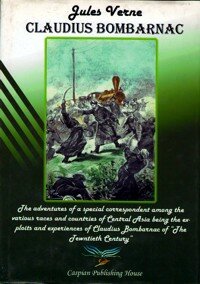
Claudius Bombarnac by Jules Verne
The name of Claudius Bombarnac might not ring a bell … but the name of his creator, Jules Verne, almost certainly will.
Jules Verne was a French writer who was a pioneer of science fiction, who was born 184 years ago; on 8th February, 1828.
His father was a mid-ranking magistrate who had married well into the family of a family of shippers and shipbuilders. As a boy, the young Jules devoured travel literature and in 1839 he ran away to sea on a boat bound for the East Indies. Caught by his father’s agents he was returned to Nantes where his made him promise that in future he would travel only in his dreams.
Famous for books like Around the world in 80 days, Journey to the Center of the Earth and 20,000 Leagues under the Sea, he also wrote a number of other less well known tomes, and Claudius Bombarnac is one of those. Described as an adventure novel, it is a little different from some of the more well known novels although, along with Around the World in 80 Days, it formed part of a series which are collectively known as the Extraordinary Voyages.
Claudius Bombarnac, the hero of the novel, is a reporter is assigned by the London based journal Twentieth Century to cover the travels of the Grand Transasiatic Railway which runs between Uzun Ada, in present day Turkmenistan and Peking, in China. The railway doesn’t exist, and didn’t exist when Verne wrote the novel, but there were plans for one. Just like Phineas Fogg, (in Around the World in 80 Days), it seems that Jules Verne accepted reports of a rail link that was not yet complete.
In the book, Verne describes his hero’s journey through Georgia and present day Azerbaijan, a ferry journey from Baku to Uzun Ada and then describes his various stopovers, in places like Samarkand, Bukhara and Tashkent … vivid descriptions, even though the author never set foot in the region.
Accompanying Bombarnac on his journey is an interesting collection of characters, including one who is trying to beat the round the world record and another who is a stowaway. Claudius hopes one of them will become the hero for his reports, so that his story won’t be just a “boring travelogue”. As it happens, there is little chance of it being that. A special car, guarded by troops, is added to the train and is said to be carrying the remains of a great Mandarin. Unfortunately the train must travel through a large part of China that is controlled by unscrupulous robber-chiefs and before the journey is over, Claudius not only finds his hero but is involved in intrigue and high adventure.
When I read it, I found the novel interesting, and wondered what he used for his sources when describing far away places that he had never seen, or if he was relying solely on his imagination. It would probably have been safe for him to do that; after all, few of his readers would have been there and known the difference.
In some ways more interesting was the idea of the Transcaspian Railway. This was the brainchild of Ferdinand de Lessepe, who was famous for engineering the Suez and Panama Canals, and in the 1870s he conceived the idea to link European Russia with China. The Chinese were already wortking on a network linking Peking to Kashgar, (which was not to be completed until the late 1990s) and Russia had a branch line to Orenburg, near the border with present day Kazakhstan. All that was needed was a line to connect the two.
As it happened, turmoil with uprisings among the Kazakh tribes meant that Lessepe had to give up on his original plan and he began to research other potential routes. This led him to the small port of Uzun Ada on the Caspian and the newly conquered cities of Samarkand, Tashkent and Dushanbe.
The Russian Governor, General Kaufman, approved the plan, although he was probably more interested in providing logistical support for the Imperial army which was facing local resistance to Russian rule than in recreating a railway along the route of the Great Silk Road. Certainly, Lord Curzon, who was to go on to become British Viceroy of India and Foreign Secretary, saw the military potential of the railway and the implications for British interests in Asia, calling it a “threat”.
Construction started in 1879 under General Skobolev, one of the “giants” in the history of Russian Turkestan. Kaufman had changed the Western terminus from Uzun Ada to the more practical deep water port of Krasnovodsk and the line from Krasnovodsk to Samarkand, through Ashkabad, Merv and Bukhara, was completed by Skobolev’s successor, Annenkov, in 1888. Further progress, however, was not smooth and it took another ten years to reach Andijan and Dushanbe. The bridge over the Oxus River, (Amu Darya), was not completed until 1901.
The railway had a big impact on opening up the region to economic development, and was exploited to good effect by Frunze during the Civil War following the 1917 Revolution.
With the complettion of the rail link from Urumchi to Kashgar, the Chinese in particular have expressed an interest in reviving the concept and discussions are currently underway for a new China-Kyrgyzstan-Uzbekistan Railway. Both of the other nations have also expressed an interest in developing the link, but it looks as if China will be the major party when it comes to financing and completing the project.
There were a number of options for the route, but the current plans see the railway climbing up to the Torugart Pass and then descending through the Naryn oblast to the Ferghana Valley and thence over the border to Uzbekistan where it link up with the existing network.
Let’s hope it doesn’t take as long to come to fruition as as the original.





 Bishkek