Relics – St. Matrona
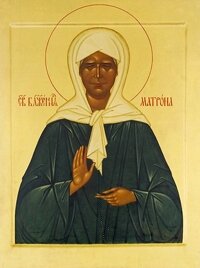
Saint Matrona of Moscow
The Orthodox Church seems to be getting more active – or at least I am hearing of more events.
One of the reasons ius that some of our staff are devout Orthodox Christians who not only attend Church on Sundays and High Holidays, but take their faith very seriously … and knowing that my degree is in Theology, we often end up in strange conversations.
Anyway, they told me that they may be late today … as they are going to the reception of some relics being lent to the dioceses, (relics of St. Matrona of Moscow and of Prince Peter and his wife Fevronia). Knowing how services here can start late, (and go on almost interminably), I am not really expecting them to arrive in the office much before lunch …
I was intrigued however, as to who this unlikely trio might be.
Another time I will tell the story of Peter and Fevronia – a love story which dates from the sixteenth century like that of Romeo and Juliet, but in the meantime – here is the story of St. Matrona.
Saint Matrona was born in 1881, into a poor family in a village in the Tula region of Russia, (about 300 kilometres South of Moscow). She was the fourth child and her parents thought of handing her over to an “orphanage”, (a children’s home which catered for underprivileged and illegitimate children of the neighbourhood), which was sponsored by a local Prince.
Her mother, however, changed her mind as the result of a dream in which a white bird with empty eye sockets alighted on her breasts. When Matrona was born, it was discovered that she was blind with empty eye sockets. Her mother took this as a sign from God and resolved to keep the child, whatever the cost.
According to tradition there were other signs … for example, the infant had a raised birthmark in the form of a cross and at her baptism, the priest saw a sweet smelling cloud above her as he placed her into the font.
Apparently Matrona bore her disability with humility and patience although the local children treated her unkindly, playing pranks on her – hitting her with nettles and even placing her in a pit to see how would climb out. As a result, she didn’t really mix with the local children very much.
Her family were devout and they would often attend church together … if Matrona was missing, then her mother knew where to find her: at her usual place by the door in the Church. Apparently she knew the services and hymns by heart and when the rest of the family were sleeping she would somehow take the family icons down from their place on the wall and hold conversations with them.
From an early age began to display an extraordinary gift of insight, discerning sicknesses (and “secret sins” – “even thoughts”) in the many people who visited her, could sense approaching danger and predicted both natural disasters and social upheavals.
From the age of seven, (or eight – the sources don’t seem to agree on this point), she also showed a gift for “healing” people. News of her abilities spread far and wide and people flocked to see her … from her own village, the surrounding villages and from all over the region, begging her to pray for them … and taking comfort from her words, her prayers and the “holy water” which she blessed, they would leave food and gifts for her and parents. In a way, far from being a burden with her infirmity, she turned out to be the family’s main breadwinner.
Around the age of fourteen, she made a pilgrimage to the great holy places in Russia along with a devout benefactress. When they arrived at Kronstadt to receive the blessing of St. John, they became lost in the crowd and the holy man cried out, “Matrona, come here! She will be my heir, and will become the eighth pillar of Russia.”
When she turned seventeen, however, Matrona became lost the use of her legs. For the rest of her life – over fifty years – paralyzed and unable to walk, she lived in rooms in the various homes and apartments where she found shelter, surrounded by with icons and sitting cross legged on her bed, receiving all who came to seek divine consolation through her presence – sometimes as many as 40 a day.
Apparently, she never doubted that this was God’s will and never complained but, on the contrary, “thanked the Lord”.
When she was still a teenager, Matrona predicted the Bolshevik Revolution in Russia. She is supposed to have described in detail how churches would be desecrated and plundered, how believers would be persecuted, and what a bloody struggle would unfold for the land.
Two of her brothers were staunch communists (and for that, read “atheists”) and were upset by the constant flow of needy and sick seeking counsel and ministrations – especially being aware of the official attitude of the authorities to religion. So, at the age of 40, in 1925, she left her village and settled in Moscow. She moved frequently, especially after her mother’s death in 1945, always managing, (like Colonel Bailey in Tashkent and Paul Nazaroff hunted throughout Uzbekistan and Kyrgyzstan on his way to Kashgar), to keep one step ahead of the authorities. Even when the faithful were being sent to the GULAGs, no-one ever betrayed her. There is a story that one day a policeman arrived to arrest her but she advised him to return home as quickly as possible, promising him that she would not escape. When the man arrived home, he discovered that his wife was on fire (!), and was just in time to take her to the hospital.
She fasted constantly, slept little, her head resting on her chest. People from far and wide, (not just the Muscovites), of all ages and conditions, would come visiting to ask for her advice and her prayers. In this way she truly became the support of afflicted people, especially during World War II. To those who came to ask her for news of their relatives in battle – well she reassured some and others she counseled to hold memorial services.
Sometimes she would speak directly, but at other times she spoke in “parables”, exhorting supplicants to keep the Church’s laws, to marry in the Church and to regularly attend Confession and take Communion. When the sick and possessed were brought to her, she placed her hands on their heads, saying several prayers or driving the demons out with authority, (always insisting that she was doing nothing of herself but that God was healing by her mediation).
When asked why the Church was undergoing such great persecutions, she replied that it was because of the sins of the Christians and their lack of faith. “All the peoples who have turned away from God have disappeared from off the face of the earth,” she said, “Difficult times are our lot, but we Christians must choose the Cross. Christ has placed us on His sleigh, and he will take us where He will.”
She is said to have predicted her death, three days in advance … giving instructions for her funeral. She also predicted that several years after her death her grave would be a place of pilgrimage, and indeed it has become one.
Then, died in her sleep on April 19, 1952, which is her Saint’s Day.
Her relics were removed from her grave on March 8th, 1998 and she was canonized a year later. Now some of her relics will rest for a while in Bishkek.
As I said, another time I will tell the story of Peter and Fevronia – a love story which dates from the sixteenth century like that of Romeo and Juliet.




 Bishkek