Turar Ryskulov

Evening Bishkek - the capital's main newspaper
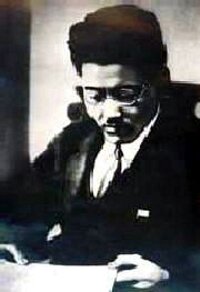
Turar Ryskulov, Soviet politician
Yesterday, I came across an article in the Vecherniye Bishkek newspaper, (Evening Bishkek – the cities largest newspaper), about Turar Ryskulov, a Soviet politician who held many important posts in the fledgling Soviet Union before he was executed in 1938. It was quite a long article, and in Russian, so it took me a while to read it.
The article was about Turar Ryskulov, a Kazakh who was born on 26th December, 1864, in the village of East-Talgar volost’ in the Semirechensk Province or the Russian Empire … (now called the Talgar district of Almaty Oblast in Souther Kazakhstan).
Although I could see that the date was the reason for the story appearing now … I had to wonder why a Kyrgyz newspaper should chose to commemorate the anniversary of a Kazakh politician … and for that reason I read on.
In fact the author of the article also seemed to have that thought at the back of his mind, because he also posed it: ”And what, in fact, is the importance of Turar Ryskulov to Kyrgyzstan? ”
This was after he had given a brief outline of Ryskulov’s significance in history, (in glowing prose), and listing his official positions:
- In 1919, he became chairman of the Muslim Bureau of the Communist Party of Turkestan;
- then became head of the Central Executive Committee of the Turkestan Autonomous Soviet Socialist Republic, (Turkestan ASSR);
- he was Stalin’s deputy at the Commissariat of Nationalities of the Russian Soviet Federative Socialist Republic, (RSFSR);
- the chairman of the Council of People’s Commissars of the Turkestan ASSR – effectively the Prime Minister in 1922-4, (It is important to remember that Turkestan referred to the whole area now covers Turkmenistan, Uzbekistan, Kyrgyzstan and Southern Kazakhstan);
- serving as the authorized representative of the Comintern in the Mongolian People’s Republic in 1924-5, (it is said that it was his suggestion to call the capital Ulan Bator); and
- in 1937 he held the high office of Deputy Chairman of the People’s Commissars of the RSFSR.
Even I have to admit that this is not a bad list for a village boy.
Although he was born, grew up and attended the boarding school in Merck in Southern Kazakhstan, at the age of 15 he came to Pishpek, (as Bishkek was then called), to study in the Agricultural School in the city, graduating in 1914.
Whilst he was in Pishpek he met many members of the Kyrgyz elite who went on to play a prominent role in developing the concept of Kyrgyz statehood, such as Abdykerim Sydykova; Imanaliev Aidarbekov (the first head of the “independent” Kyrgyz state – was a fellow student of Ryskulov’s); Ishenaly Arabaev and Tasha Khudaybergenova.
He then went to study at the Tashkent Pedagogical Institute for two years.
He was also involved in the general uprising of 1916 when the indigenous peoples throughout Central Asia rose up against the Tsarist Empire. In 1926 he was to write an account of the uprising: “The Kazakhs and Karakirgizes uprising in 1916.” (In those days “Karakirghiz“ was the term used to describe what we call the Kyrgyz people.)
In 1917 he organized the ”Bukhara” society (a Revolutionary Union of Kazakh Youth) in Merka.
Everyone seems to agree that Turar Ryskulov enjoyed great prestige among the people, and was one of the most prominent and influential leaders in Central Asia at the time. An outstanding organizer and leader on a large scale which was demonstrated when during a terrible famine broke out in Turkestan in 1918-1919 as a consequence of the revolution and civil war. The actions of the Central Commission for the fight against hunger, which he chaired, saved more than a million people in Turkestan from “certain and imminent death”. It is said that it was only after receiving his letters that the Central Committee of the Communist Party of the Soviet Union, (CPSU), decided upon the issue of food aid to Kazakhstan. For this feat alone, he is still highly revered in the memories of the peoples of Central Asia.
The article admits that he was a Bolshevik – but stresses that he was not a careerist like some of his contemporaries … and it is said that was differentiated from the other members by his “members humanism, integrity and views on the national question”, all of which “irritated many people”.
Despite this, his talent was appreciated by his contemporaries. Fir example, Mikhail Frunze, (for whom Pishpek was renamed in 1926), wrote in a memorandum addressed to Lenin: “Among the local people, two stand out – and Ryskulov and Khodzhaev, followed by the masses. But the former is not only the mind, but also a remarkable character. ”
As the leader of the Muslim Turkestan Bureau of the Communist Party, he often raised the question of the unity of the Turkic ethnic groups Turkestan arguing that the Turkic peoples of Turkestan were a single people, which but the course of history had shattered, and that Turkestan was their common home.
It was his views on the “nationalities question”, which radically went against the official party line and led to him being was accused of “Pan Turkism” by no less a person than Stalin himself, which was to be his downfall … and the main theme of the article.
In 1920, Ryskulov had initiated the establishment of the Communist Party of Turkic and Turkic Soviet Republic, which led to further criticism and accusations of nationalism. However, the author of the article says that he was never a “nationalist” or a “shirker” and did not participate in the “anti-party” or “anti-Soviet” conspiracies and intrigues.
It is important to remember that, at the time, the Uzbeks, Kazakhs, Kyrgyz, Turkmen, Karakalpaks, Tajiks, and other peoples of Turkestan, Khiva and Bukhara, had not yet formed a national identity. The people identified predominantly with religion, their tribes or clans and, at best, the Turkic ethnic group as a whole. In June 1920, he sent a telegram advising “about the inadvisability of organizing three republics: Uzbek, Kyrgyz and Turkmen.” His vision was apparently that of a multi-national Federal Republic of Turkestan … something which Russia could not allow.
If he had succeeded, then this would be a state of some with a population of 80-100 million people, with great integration potential, natural resources, a single economy and a huge potential, which could play a significant role in world politics.
As it happens, he lost the argument to those who favoured the creation of a smaller state based on the traditional mountainous homelands of the nomadic Kyrgyz.
It is claimed that those in authority above him were afraid to leave him as the chairman of the Turkestan Republic, believing that it would be separated from Russian Turkestan – something which Russia could not allow. The Bolsheviks also disbanded Regional Committee of the Muslim Bureau of the Communist Party of Turkestan headed by Ryskulov’s classmate, Syddykov – for the same reason, it is claimed.
He also played a vital role in transforming the economy of the Central Asian republics which, he said, “still bears traces of the colonial policy of Tsarist Russia”, as well as that of the Russian Federation and Mongolia. The construction of the Great Turkestan-Siberian railway was one of his initiatives, linking industrial centers with coal mining regions and the oil and gas in Western Kazakhstan with the metallurgical complex in Karaganda and the nonferrous metallurgy industries of Eastern and Southern Kazakhstan.
Ryskulov’s enemies in the Stalin’s totalitarian regime “envied” him for his active and tireless activity, openness, honesty and resolution . They eventually succeeded in getting him declared an “enemy of the people” and he was executed, (shot, apparently, in the head), on 10th February 1938. (Syddykov was executed the same month and Abdrakhmanov died in November the same year.)
In 1956 he was posthumously rehabilitated.
Ryskulova was a prolific writer with more than 200 works on all aspects of political, social and economic development, (including the “nationalities question” and that account of the 1916 rebellion). He wrote openly about the fate of his native Kazakhs suffering from the unprecedented famine, which was the result of the “reckless” policies of Goloschekin; of the Mass migration arising from the terrible famine; the collectivization which deprived the nomadic Kazakhs of their main source of livelihood – livestock; the terrible famine of 1932-1933 and the Kazakhs being placed on the verge of disappearing from the face of the earth as a people.
It is claimed that much of what he achieved later in life was grounded in his training whilst studying during his formative years, here in Bishkek.
There is a village in Kazakhstan, one of the main streets in Almaty and one of the Universities in Almaty named after him in Kazakhstan. There is a statue of him here in Bishkek.
For the record: the text of his account of the 1916 uprising is available on the internet, in Russian.


 Bishkek