Air Crash Investigation
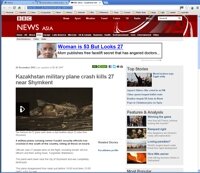
The report of the Kazakh plane crash on the BBC website
A few years ago, my Cable TV used to show a wide variety of programmes in different languages: Russian and Kyrgyz, of course, but also English, French, German, Turkish and Japanese … even Italian and Spanish from time to time. The obviously did some market research and decided to cut most of these from their basic package and opt for Russian language versions of channels like National Geographic and the Discovery Channel.
Now, I can receive only one English language channel: CNN … I could get others like the BBC channels if I chose a more expensive package … but I thought, “Why bother?”.
To be honest, I do miss some of the programmes that used to be on National Geographic channel, (although I can still watch them, they are now all in Russian which takes a lot more effort so I tend to channel hop through them). In particular I used to enjoy Air Crash Investigation and Seconds from Disaster.
In a way, I felt a sense of guilt watching them; it was a bit a bit voyeuristic … and masochistic. The sense of of guilt was tied up with getting some sort of satisfaction from what was a disaster, especially for those who lost their lives or their loved ones. The programmes told the stories as the events unfolded and then went through the investigative process to see what lay behind each “accident”, to see where blame could be laid – but, much more importantly, so that lessons could be learned to try and avoid any repetition.
Well, it’s not been a good week for air travel … two stories in particular caught my attention:
- Tourist plane crashes in Burma - on the website of the Guardian newspaper
- Kazakhstan military plane crash kills 27 near Shymkent - on the BBC website … although it also was reported on a wide range of other sited.
To be honest, my first thought on reading about the incident in Burma was – “Tourists? … in Burma?”, sorry, that should be Myanmar. Apparently so … although it has been ostracized for so long, (there used to be heated debates on the internet about whether it was “right” to go there and, by doing so, appearing to support the military regime), the country is supposed to be opening up to tourism and this is one aspect. According to the report: “A flight packed with tourists crash-landed on a road in central Burma on Christmas Day, killing at least two people and injuring 11, officials said“. The plane was carrying 71 people, including 48 foreign passengers, from the capital Mandalay to Heho in one of the provinces and the gateway to a popular tourist destination.
The airline described the incident as an “emergency landing” but it seems that the plane hit some electricity cables and crashed into some rice fields, killing a motorcycle rider on the ground as if came down. The authorities say, however, that the pilot “mistook” the road for the runway due to bad weather – fog.
Bad weather appears to have played a role in the Kazakh crash as well. A military plane carrying 27 people, (20 passengers and 7 crew), on a flight from the capital Astana to Shymkent which is not far from the borders with both Uzbekistan and Kyrgyzstan. One of the passengers was the Acting head of the Border Guards, who has not long been in post.
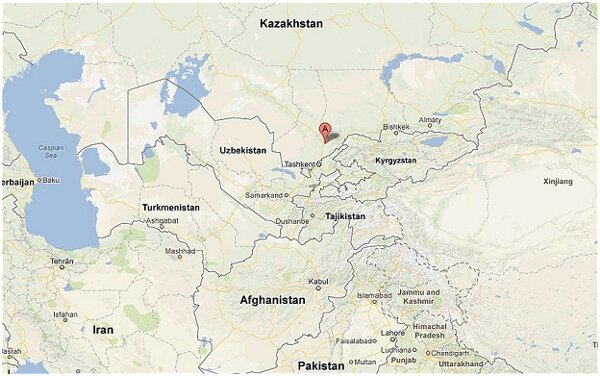
The plane crashed 20 kilometres (12 miles) from Shymkent airport, marked with an A on this map of Kazakhstan : GOOGLE MAPS
The plane was descending in atrocious weather conditions – everyone in all the reports I have seen seem to agree on that fact – and disappeared from radar screens before plummeting into the ground some 20 kilometers from the airport … causing a loud explosion.
This week has also seen the anniversary of an incident in Osh last year, when a plane turned over and caught fire … fortunately, (and luckily), no-one died in that incident.
When I first came here and started working in tourism, I was able to say that the local airlines had a relatively good record … at least as far as fixed wing aircraft were concerned, although there had been a number of incidents involving helicopters.
A couple of incidents, (the one in Osh last year and a flight to Iran that turned back to Bishkek but never made it to the airport), mean that I can’t say the same now. There have also been a number of other “minor” incidents: the wing of one plane clipping the wing of another which was parked on the ground; the plane carrying President Putin back to Moscow from a summit, having fuel problems … and so on.
Most of the Ministries of Foreign Affairs in Western countries advise their nationals against taking local flights because it is not certain that safety procedures are followed adequately. All Kyrgyz airlines have been banned from European air space for the same reason – although the operators claim that they have upgraded their systems and asked for the situation to be reviewed.
Because none of the Kyrgyz airlines fly to the States, the FAA, (Federal Aviation Authority), doesn’t assess them and says it carries no official data on the airlines – but I think it is probably fair to assume that they would not allow a Kyrgy airline to operate in America if it was banned from Europe.
To be fair, a lot of the planes are old – inherited from the local branch of Aeroflot after Independence … but some new planes have been bought, or leased, and the local airlines are trying to expand their network of routes.
Last year, the Kyrgyz government chose to ban some of the older planes from Kyrgyz airspace – causing a problem on some of the internal flights – because only those older planes could operate on some of the regional airfields.
Oddly enough, also during the week, I cam across a “quiz” about air travel which included questions like:
- Where should you sit on a plane to maximize your chances of surviving a crash?
-
- in the front
- in the middle
- in the back
The answer is, apparently, is at the back – according to some statistical research published in Popular Mechanics in 2007.
- When is a plane most likely to crash?
-
- when flying long distances over water
- during mid-air turbulence
- during takeoff and landing
The answer is, apparently, during take off and landing – the vast majority of plane crashes occur during take off, the initial climb to cruising altitude, the descent and approach to the runway and the landing. Pilots even have a phrase which these use to describe these crucial moments: “Plus Three/Minus Eight” – the first three minutes after take off and the last 11 before landing. In fact all of the incidents I have referred to above took place during take off or landing.
- What is the most common cause of death after the initial impact?
-
- fire and smoke
- trampling
- falling objects
The answer is, apparently, that most deaths after impact are caused by fire and smoke … the best thing to do if involved in an accident to leave the cabin as quickly and calmly as possible,
- How long is the “golden” time window after a crash when you are most likely to make it off the plane alive?
-
- 90 seconds after impact
- 3 minutes after impact
- 12 minutes after impact
The answer is, to maximize the chance of survival, passengers should exit the plane within 90 seconds after the crash … after this period, the risk of death from smoke and fire becomes much greater.
- How many rows should you be from an exit row to give yourself even odds of making it off of the plane after a crash?
-
- within one row
- within five rows
- within seven
The answer it seems is within five rows … analysis of crash statistics shows that people in these seats have a 50-50 chance of exiting the plane in time in an emergency evacuation … “those seated further away face less appealing odds”.
- What’s the most important thing you can do to maximize your chances of surviving a crash?
-
- be prepared
- wear a kevlar vest
- help the people around you stay calm
The answer is, according to the FAA, the most important thing you can do to improve your odds of surviving a crash is to be aware and prepared for an accident to happen. This includes knowing where the exits are and having a plan for rapid evacuation. In other words … listen watch and pay attention to those little talks that the stewards and stewardesses give at the start of the flight … and read the information card. One of the things the show is the bodily position to adopt in the event of an emergency, in order to maximize your odds of survival: Lean forward and press your head against the seat in front of you. (This will help to counteract the force of rapid deceleration by pressing your head against the seat back in front of you. It also helps to wrap your hands around the back of your head to prevent your arms from flailing.)
As it happens, I found the quiz quite easy – that is, I got of the answers right … which wasn’t difficult because I had seen so many episodes of Air Crash Investigation … but I found particularly interesting was that just one in 1,200,000 flights ends in an accident … now that strikes me as pretty good odds. What’s more, contrary to the commonly held belief, the vast majority of plane crashes – more than 90%, have at least one survivor and, more than 95% of people involved in an air crash actually survive. Indeed, according to American statistics, the odds of dying in a plane crash are 1 in 11 million, whilst the odds of dying in a car crash are closer to 1 in 5,000.
Of course, I would like to know more about those statistics and how they got them … (they seem to be based on flights in America not Central Asia), and we shouldn’t let ourselves get “bogged down” in the figures and whether they are appropriate or not. The most important thing, it seems to me, is that we shouldn’t let those odds make us feel too complacent … or else it will be like the paradox of the “unexpedcted hanging“.
We need to learn the underlying message: be aware of your circumstance and be prepared for any eventuality in order to maximize our chances of survival whether its a question of flying, driving, walking the city streets at night, conducting a business … or whatever.






 Bishkek