Konyets Sveta … or just the end of an era?
According to some reckonings, yesterday was supposed to mark the end of the of the world: Konyets Sveta.
The date is regarded as marking the end of a 5125-year-long cycle in the Mesoamerican Long Count calendar used by the Mayans. Apparently various other astronomical alignments and numerological formulae were also proposed in support of this eschatological prediction, though none have been accepted by mainstream scholarship.
Well, the fact that you’ve received this postcard is a sign that it never happened.
Actually, Modern-day Mayans, many of whom still live throughout Central America where the Mayan empire was based, don’t believe that the world will end on 21 December 2012, and archaeologists have found evidence that points to the fact that Mayan astronomers postulated events that would occur after the fateful date.
The Vatican seems to agree with them, stating that apocalyptic theories based on the 2012 conjecture were “not even worth discussing”. Mind you, the Christian church doesn’t have a particular record when it comes to predicting the end of the world and the “second coming”: with dates suggested between 120AD, 400, 793, sometime between 799 and 806, 800, 848, 992, 1000, 1033, 1186, 1260 … and so on; Charles Wesley suggested 1794 and his brother John opted for 1836; The Jehovah’s Witnesses thought it was going to happen in 1914, 1915, 1918, 1920, 1925, 1941, 1975, 1994 … and so on.
Science hasn’t done so well, either … the appearance of Halley’s comet in 1910 led to a variety of doomsday predictions; a similar situation accompanied the appearance of the Hale Bopp comet in 1997; there was the conjugation of the planets in 1919 led to more failed predictions and again in 1987 … and so on. This time however, NASA took the unusual step of issuing a video, (ten days early), trying to debunk the various theories that have been advanced as being without any basis or foundations in science.
Despite this, some people apparently took the claim seriously, (according to the BBC some have actually been so concerned that they have considered suicide), and it made a nice storyline for Glee. Others seized the opportunity presented, for example to boost tourism, particularly in Belize, El Salvador, Guatamala, Honduras and Mexico. There have been outbreaks of Apocalypse Fever in Brazil, China (where about 500 people were arrested for “spreading false rumours”), France, Russia. Turkey and even in the United States.
Here in Kyrgyzstan we have had a host of jokes along the theme of Konyets sveta ne budet, and posters erected with the heading Konyets Sveta!, one by a political party declaring that they had fulfilled their promises.

As seen on Facebook
I was amused to see a photo on facebook of pylons agains a darkened sky with the text superimposed: “On December 21, all power companies should shut off the power for 10 minutes just to make people flip out.” The trouble is that here in Kyrgyzstan, I don’t think they would have noticed …
Ironically, the word Svet in Russian takes on many different meanings, including light and electricity, (power) … Konnets sveta could also be taken to mean “the end of light” or “the end of electricity” – “the end of power”.
As it happens is also the Day of Energetics, here in Kyrgyzstan and several other countries in the CIS – Russia marks the day on the third day in November. This is another one of those “professional holidays” which are so common in the countries of the former Soviet Union; this one is dedicated to workers in the Energy industry: generating, transmitting and distributing electricity and thermal energy … to mark their contribution to the economic development and maintenance of the daily life in the country- providing comfort in “homes, schools, hospitals and offices”, (not forgetting factories, … or anywhere else). The holiday was first marked in 1966 and each year workers in the energy industry celebrate and many are granted awards, diplomas and gifts.
At least we can hope that there will be enough energy to heat the homes, schools, hospital;s and offices of Kyrgyzstan. Although orders have been given to deprive or limit power consumption by certain places of entertainment, (cinemas, night clubs, saunas, etc.), so that there will be enough to do so … large areas of Bishkek are still suffering power outages and having the gas cut off, and some have no electricity either.
My office and apartment are right in the city centre so we have been fairly lucky … although we’ve suffered a few power cuts, most of them quite short, (just a couple of hours), and so caused only limited inconvenience … but one lasted for almost ten hours. As it happened overnight, it shouldn’t have been too much of a problem – but as the power didn’t come back on until almost half past ten, I lost about about four hours of work, (I tend to start at six and the first three or four hours are the most productive as I get fewer interruptions), and that put me out for the rest of the day. I thought I would be able to catch up working through the evening, but before five o’clock came … the lights went out again. They stayed off until 2:30 in the morning … so Thursday was a bad day as well!
I am told that the power cuts were due to an “accident” and not part of a rolling outages designed to save energy, which helps me feel a little better but it doesn’t compensate for the frustration felt.
According to one of the opposition parties, 90% of the city is without gas and 50% without electricity - an official announcement made later in the week said that ALL private houses had been cut off from the gas supply, whilst those living in apartment blocks were still receiving gas.
The logic behind that is quite simple: those living in the “private sector”, that is in separate houses – not apartment blocks, tend to have alternatives available to them, for example: wood or coal burning stoves.
There have also been appeals across the country asking the population to economise in it’s use of energy: The electricity generating company supplying Bishkek asked consumers to use alternative sources of energy for heating and cooking, (that is coal and wood burning stoves – although that particular option is not available to many of us), using energy saving devices, (i.e. light bulbs), and not using large appliances between eight and nine in the morning or seven and nine in the evening.
I know several families that have had their gas cut off and, as their homes are heated by gas, are having to find alternative ways of keeping warm in temperatures that have fallen down to -20! That’s quite a drop considering that the 6th of December set a monthly record high of 19° – which presumably explains why the Prime Minister said that winter “came unexpectedly this year” … adding, to be fair, “as always”.
To make matters worse, the Ministry of Emergency Situations kicked the week off with a storm warning – with temperatures possibly falling as low as -25! … or even to -30!!, and later another announcement warning of possible avalanches – recommending that drivers maintain a distance between vehicles of 500m (?!) The the long range weather forecast for January is also not encouraging – although it looks as if the month will be “dry” it will also be colder – about 3 degrees below average.
It’s certainly been bad, but at least it is not as bad as in Siberia! Apparently, someone n Novosibirsk poured the contents of a pot of boiling water from one of the top floors of his apartment block whilst the temperature was something like minus 41 … and it froze; turning into into a cloud of frozen droplets!
All this has led to calls for the Minister’s resignation, a call to the Prime Minister to report to the Parliament on the situation, (interestingly, although there were a row of high ranking officials – the chairman of Kyrgyz Gas was apparently noticeable … for his absence) and even the suggestion that there should be a criminal investigation into the affair. One of the Deputy Prime Ministers to run of to Kazakhstan for urgent talks about the crisis. According to the reports, (I am sure that Kazakh reports may put a different spin on it – apparently, they are moire than willing to supply the gas … at a cost! Although that would mean a price hike, they seem to be saying that it would just be at “international levels”.), after threats of legal action and sanctions for “breach of contract” agreement was reached and arrangements made to reconnect consumers to the gas supply.
It’s a long process and took several days. That led to and outburst cries of Oorah!, (I think you can probably guess a translation for that one), from all and sundry.
There was even, what I took to be, an impassioned plea by the Mayor of Bishkek – that he and the council cannot be held responsible for the shortcomings of the operations of private companies – the electricity, gas and Heating enterprises. The Ministry and the municipal authorities, however, have been busy. Ice began to build up on the city’s rivers, (Ala Archa and Alamedin), and some homes were flooded … and others were clearly under threat. The army was brought in and sappers set off controlled explosions to break the ice up and then the Ministry and council workers started moving it all to enable the free flow of the water that hadn’t yet frozen. The authorities have also been putting salt and sand on the streets to help keep them clear for traffic – over 170 tons so far this season.
The parliamentary deputies have even suggested selling KyrgyzGas to Gazprom for the princely sum of one dollar. That led to some wry comments in the social media about the company being over valued but didn’t really take on board that there were some conditions behind the generous “offer”: a proviso about cancelling some of the outstanding debt … and that they invest in the modernization of the existing pipeline, and guarantee an uninterrupted supply. Apparently, however, they’ve agreed to the deal … they actually want to buy all the shares – 100% … promising to invest something like $640 million dollars in the next three to five years.
They have also suggested closing schools and sending children home because of the cold. According to the Mayor, somewhere between 30% and 40% are heated by Gas – but the kids that the kids attend has a coal fired boiler … but they’ve run out of coal and so, apparently, several classes have already been cancelled … but I am confused because the kids tell me that the term has been extended a few days, right up to the eve of the New Year holiday.
Another idea they have come up with is to build storage facilities, (Gas Tanks), for each town sufficient to hold two to three weeks supply … now there’s a memory from my youth – I haven’t seen a Gas Tank for years and, at first, it took me a while to work out what was meant when I read the article. Anyway, I wonder who is going to pay for that? Apparently, Uzbekistan has some, even though they have stocks of natural gas. One of them is actually located in Batken and some people for Kyrgyzstan to reclaim it.
After three days without gas, a group of residents called a rally and gathered in the main Ala Too Square … writing slogans in the snow like “Where is the Gas” … but they only managed to muster ten protesters … and then had to call off the call off the meeting … due to the cold. It wasn’t the only protest, but I think that the journalist who claimed that Bishkekers, (or should that be Bishkekians?), were taking to the barricades. (I fear that may yet come later).
According to Vechiniye Bishkek, (Evening Bishkek – the city’s biggest newspaper), one person’s protest, apparently an “emotional and uncomplimentary” post on Odnoclassnikiy, (Classmates, the Russian equivalent of Facebook), got him a certain amount of attention – with lots of comments and an approach from the “competent authorities” who tried to persuade him to take the post down … he refused. I hope that I don’t get a visit from them about this postcard, after all I am simply reviewing the events of the week – good and bad.
The electricity cuts are down to maintenance work and parts of the system “burning out”, (a transformer caught fire at the beginning of the week and the Fire Department couldn’t put it out because there was no water), or suffering catastrophic failures. It’s hardly surprising – as the consumption is consistently rising. The system is designed to produce a certain amount of power per day, (called the “norm”), but that’s being exceeded … by one and a half times in the North of the country – and three times here in the capital.
Uzbekistan has cut off their supply of gas to Kyrgyzstan and the Kazakh”s have cut theirs by half, which has led to the current a crisis, (supposedly due to debts and the problem of supplying their own consumers). I suppose one could call it Konyets Gaza … and the shortage means that both enterprises and private homes were being cut off.
A lot of homes in the chastniy sector, (comprising of small houses rather than apartment blocks), are heated by gas, so when the gas is cut there is a corresponding rise in pressure on the electricity grid. When they could be found, (apparently the telephones are continuously “busy”, or at least “off the hook”"), officials have come forward with optimistic forecasts – the weather is expected to improve; the situation over gas supplies will be resolved … and so on.
In fact the authorities were fairly quite for quite a while … causing one Western commentator to tweet the question: “Why hasn’t the KG gov organised emergency shelters for vulnerable people with no gas and electricity?”. When they did speak it was to say that the current situation will be resolved before “konyets nedaily” – the end of the week … but they also sounded waning bells as far as I understood it … what is becoming the the regular cycle of cold temperatures, gas shortages, power outages and people shivering, is likely to continue for some time – at least until the power stations come on stream.
It can’t help that the number of consumers is also increasing. In the 47 settlements around Bishkek, for example, the municipality discovered some 6500 buildings had gone up “illegally”, and they’ve now got to decide what to do about it. The population of Bishkek has roughly doubled since the collapse of the USSR, (no-one knows for certain exactly how many people live in the city and its environs), but the power system is basically the same … not only twenty years old, at least, but half of what is needed today, (or worse).
It was reported early in the week that at least eight people had died – frozen to death – and I saw lots of comments on social media from people trying to cope with the shortages. It is said that “necessity if the mother of invention” and people are definitely showing their ingenuity. In one case, in the absence of gas, someone used an electric iron as a hot plate and I have even heard a story, which I find hard to credit, of one family which tried to boil some water over candles (!)
I got a shock one day, when I went out from the office and saw steam rising from the cellar where the heating pipes are located. ”That’s unusual,” I thought to myself and decided to go and investigate … and sure enough, I discovered that the pipes carrying the hot water from the city’s central heating station had sprung a leak … hot water was spurting from a small hole and the floor was already wet. Fortunately, from the small amount of water on the floor, it seems that I got to it fairly soon after the leak had sprung.
I suppose it wasn’t exactly good timing that an article appeared complaining about the state of the city’s street lighting. The council claim that they need about 104 million som to maintain the 30,000 street lights - that’s about 3500 som each – but the budget allocates only 50 million. They also complain that they don’t have a suitable repair shop and equipment … much of which dates back to the Soviet period – over twenty years ago. They try to make ends meet and even use energy saving bulbs, but the bulbs burn out and they have a debt to the electricity company of almost 20 million som.
As it happens, most of the city’s street lights were turned off on Thursday in order to save power and avoid the city exceeding the limit that had been imposed … only some of the main streets were lit. Also, the traffic lights at a dozen of the city’s intersections were turned off.
In the meanwhile – Iran is apparently considering the prospect of investing in the coal industry here in Kyrgyzstan … and, by the way, the price of coal has gone up … “due to the increased demand and the complexity of getting it delivered”. When I saw a headline that a criminal investigation had been started connecting with the theft of coal I assumed it was somebody exploiting the situation and inflated prices … (One of the political parties, for example, has decided to “exploit” the situation by arranging free distribution of a “limited” amount of coal to needy families) … apparently, however, it was somebody forging documents to smuggle coal into Uzbekistan.
In other news, (yes, other things have been going on, even if the energy crisis has dominated the news and everyone’s attention this week), one of the deputies has called upon the government to take action over child labour … claiming that one in three children is working, (mainly in tobacco, rice and cotton production), whereas, in Africa it is only one in four and in the rest of Asia, one in eight.
Another initiative from the Deputies is a proposal to close three of Kyrgyzstan’s embassies abroad, (in Malaysia, Turkmenistan and Belarus), in order to save money. We don’t do much business with these countries and an embassy is an expensive luxury. It’s interesting that only a couple of weeks ago there was a lot of attention given to Turkmenistan an several investments opportunities here in Kyrgyzstan were explored. I’m not sure how Roza Otunbaeva might think about the embassy in Kuala Lumpur – having served there as Soviet Ambassador.Also, I think that threatening to close the embassy in Minsk might be easily misunderstood!
One deputy also complained why the Kyrgyz ambassador in China rented an apartment that cost USD4000 a month – can’t he economise when the country is in a state of crisis? The Foreign Minister pointed out that the Deputy was mistaken and that it was only USD3000 a month (!)
The Accounts Chamber, the Kyrgyz version of the Audit Commission, has been named the most corrupt organization in Kyrgyzstan – and questions were raised about the legality of it’s operations. One Deputy recommended referring the matter to the Prosecutors’ Office for an investigation. One of the grounds for concern seems to be that several employees of the agency don’t seem to do any work (!) whereas another seemed to check an inordinate number of cases. All this led to the head of the agency thanking the deputies for their analysis of the situation (!) and saying that she was confident that she could “clean up” the agency.
In the budget for next year, they’ve asked for 10 million soms for uniforms, which raised a few eyebrows … mind you they claim that their vehicle and computers haven’t been upgraded for years.
Talking of corruption, it was reported that a survey revealed that 70% of businesses face corruption – in particular paying tax inspectors to “conceal” violations. I think we may have found a reason why Starbucks doesn’t operate here … but Google is apparently opening an office here – so it will be interesting to see how they navigate system of tax administration here.
The same survey results suggested that the shadow economy is equivalent to almost 40% of GDP. More than half of the businesses in Kyrgyzstan hide their income because of the high tax rates – 45-50% actually admitted it in a survey (! – less than 10% of those surveyed said they considered it to be a crime), and 46% said that they did so because of the lack of political stability (?!)… other excuses quoted were “meaningless official business registration”, the “weak” punishments if you get caught … and 10% responded with “because everyone else is” (!)
A new draft law on the Kyrgyz language has ha people up in arms. This would require that all government officials must work in Kyrgyz – there will be examinations and they will face fines for not knowing the language; all reports and official documents will have to be prepared in the Kyrgyz; Scientific and technical have t be produced in Kyrgyz only – any amendments to existing documents which are in Russian will have to be made in Kyrgyz; Simultaneous translation from Kyrgyz into Russian will no longer be obligatory at state events; Documents cannot be issued in Russian alone and Laws will be developed in Kyrgyz – not in Russian and then translated.
It has also been suggested that the law would effectively bar representatives of the minority ethnic groups from any official position and drive them out of government, making Russian’s status as an “official language” would be undermined. What was surprising was that the bill was supported by many deputies who are not exactly “renowned” for their fluency in Kyrgyz, including some who championed the status of Russian during the Parliamentary elections. There are also implications for future migration, (an important issue here – about 900,000 people have left the republic since Indepence in 1991 and about 25% of the population currently live and work abroad, sending remmitances back to their families), and constitutional questions over issues like court procedures – in what language could a witness give evidence?; under international treaties certain cases in the domestic (family) courts have to be conducted in Russian … and so on.
The controversy led the Prime Minister to try and put minds at ease by saying that he doesn’t support the bill, that the country is not prepared for the measure and, anyway, the language an official speaks is not as important as his professionalism, and if it is passed then the government will have to find a pragmatic program for its implementation.
Ironically, Bishkek was playing host to a conference dedicated to developing and supporting Russian throughout the CIS.
All this has led to claims that “much of Kyrgyzstan was gripped by a virulent nationalism” … especially “after 2010’s ethnic violence between Kyrgyz and minority Uzbeks in the country’s south. The overt anger and hostility have shown signs of abating, but this draft legislation is only the latest initiative that looks, by design or coincidence, set to further marginalize Kyrgyzstan’s once-vibrant minority communities.”
Those claims were given additional impetus later in the week by a paper from Chatham House, “Averting Violence in Kyrgyzstan: Understanding and Responding to Nationalism” … which criticised the international community for ignoring, (or at least, playing down), this element ion Kyrgyz society.
Another long standing problem concerns Kumtor which has been presented with a bill for 152 million dollars for “environmental damage” in five cases. In an initial response, the management of the company said that it “claims and believes” the allegations claims are either exaggerated or without foundation; that the company operates in accordance with Kyrgyz law and meets, or exceeds, both Kyrgyz and international standards of environmental, safety, and health protection. Further, that the activities raised in the claims, (particularly the main one which represents the bulk of the 152 million) were approved “at all times” by the appropriate Kyrgyz authorities and are specifically referred to in documents which are submitted and approved by Kyrgyz authorities each year. It will be interesting to see how this developes.
Ironically, this week also saw the announcement that Kumtor, together with Fauna and Flora International, have launched a wildlife diversity programme in Issyk Kul oblast, (where the Kumtor gold mine is located), worth a quarter of a million dollars, (70,000 being provided by Kumtor).
As a sign of the “new era”, Kyrgyzstan assumed the Presidency of the CSTO, (the Collective Security Treaty Organization – including Armenia, Belarus, Kazakhstan, Kyrgyzstan, Tajikistan and Russia … Uzbekistan has officially suspended its membership), on Wednesday. The summit that took place in Moscow when the handover took place discussed a wide range of issues, including: Uzbekistan’s withdrawal from the organization, (which didn’t go down well with Belarus in particular); moves to improve the security system; to develop the CSTO military component in the period up to 2020 and the situation in Afghanistan.
I suppose it was all part of the deal but the arrangements over the Russian airbase have been settled – signed, sealed and delivered. Now, the arrangements for the four Russian bases on Kyrgyz territory – not just the airbase in Kant, which was a CSTO base anyway – are are united under one treaty … but there was no mention of the American transit centre at Manas.
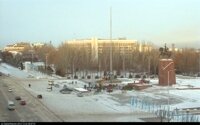
Click on the picture to go to the Ala Too webcam
Another sign of the changing world is that I got a message from Australia this morning, telling me that New Year Tree erected in the main Ala Too Square appeared to have fallen over. He’d seen in on the broadcast webcam from Ala Too Square. Interesting that I get news about what is going on in Bishkek from Australis – a sign of the times that we live in … I wonder if it had a result of Konets Sveta (?)
Oh, and for the record, today is also:
- The Feast of Zarathushtra …
- The day the Orthodox Church honour the mother of the Virgin Mary …
- It’s Mathematics Day in India – commemorating the birthday, in 1922, of Srinivasa Ramanujan …
- The anniversary of the first postage stamps issued in Russia in 1857 … and the fall of Ceaucescu in Romania in 1989 …
- The anniversary of the death of Theodore Rousseau and Beatrix Potter
to mention just a few things that we might want to celebrate or commemorate having survived the apocalypse.
Let’s hope and trust that this does turn out to be the start of a new era … a better era that the one we are leaving behind. usually, at this time of the time of year we send messages wishing friends and family a Merry Christmas and a Happy New Year … we look back and review the events of the previous year and resolve what we will do differently in the year ahead. This year we can look back over, not just a twelve month period, but an era that lasted 5125 years … what would resolutions will help us shape a better world on that sort of time scale?
All that remains, I suppose, is to wish you all a Happy Christmas – or whatever festival you celebrate at this time of the year … assuming it wasn’t Konets Sveta - in which case, please accept my condolences!
_______________________________________
Postcard from Bishkek: the weekly postcard that I send out as an email also gets posted on the website ianbek.kg each week – and there are other postcards which don’t get sent out. This week, for example, there has been the following postcards:
- Silk Road Lodge panoramas - the newly renovated Business centre and Conference Room- 16/12/12
- The employment experience - a frustrating experience at a conference, but there’s always the possibility of seeing something in a new light – 17/12/12
- Doves and pigeons … - they are fairly common birds but full of interesting aspects of our history and culture – 1/12/12
- Slippery Roads - one of the features of winter weather – 18/12/12
- International Affiliations: - to commemorate the anniversary of Kyrgyzstan joining the WTO in 1998, I took a look at some of the organisations to which Kyrgyzstan has aligned itself – 20/12/12
- Graffiti - Street art, (that is “grafitti”), has come to Kyrgyzstan – 21/12/12
It is now possible to follow me on Facebook, (where I have specific pages for Celestial Mountains and ianbek … and also links.kg and Kyrgyz Diary), and on twitter, (@Bishkekpostcard and @celestialMTC ).





 Bishkek