Doves and pigeons …
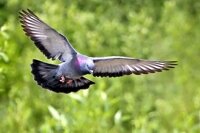
Wild Pigeon in flight
I was intrigued to see news reports recently about some workmen who were renovating a house in Britain and came across a pigeon in the chimney … not just any old pigeon, but a messenger pigeon with a coded message written on thin rice paper and attached to its leg. It seems that the bird was carrying a secret message from an agent in France back to his superiors during the Second World War and seems to have got waylaid on his flight … meaning that the message was never delivered.
What was particularly intriguing about the story was that when the message was eventually delivered, some years late, the code breakers at GCHQ had to admit that they had met their match … they couldn’t decode it. Well, that’s if you believe them … with all the modern techniques and computer power available to them, a simple code written in the middle of the last century dumbfounded them – or was that a case of double bluffing … or simply that no-one had the time of inclination to get down to it.
Anyway, they turned to public for help, making an appeal for anyone who could make headway in deciphering the message … and sure enough, interpretations came flooding in … well, that is. someone manage to make sense from the groups of characters scrawled onto the paper.
Pigeons have a long history of interrelationship with mankind. They have a distinguished record of use in the military – especially during the two world wars, for carrying messages. Thirty two pigeons were awarded the Dickin Medal for war contributions to the war effort.
Their service took advantage of their remarkable “homing” abilities, being able to navigate their way back to their roost from wherever they happen to be released … which is also utilized in the sport of Pigeon racing.
They have also served as a food since ancient time, in Roman, Jewish, French, Middle Eastern Chinese and Indonesian cuisine. Mrs. Beeton included recipes for Roast Pigeon and Pigeon Pie in her famous cookbook. They are kosher in Jewish tradition and they were the only kosher birds that were considered suitable for korban, or offerings, for those who could not afford a more expensive animal and their are Bible stories connecting pigeon sacrifices – including that of Jesus’s parents sacrificing doves at his circumcision.
The Bible also tells that Noah sent out a dove – which is basically the same bird – after the great flood in order to determine if the waters had receded. The term “Dove” is also used as a term of endearment in the Song of Songs.
According to the song, on the second day of Christmas, the beau gave his true love two turtle doves … and a partridge in a pear tree.
… and so on
I said that the dove was basically the same bird … the terms dove and pigeon are used practically interchangeably. The word Dove is usually used to describe the smaller species whilst “pigeon” is used to describe the larger ones.
Together they comprise the family of Columbidae, which includes some 310 different species. They are found all over the world … except, that is, for the driest parts of the Sahara, Antarctica and the Arctic. It’s no surprise, therefore, that are to be found in Kyrgyzstan.
In fact, there are ten species that are found here:
| English name | Latin name | Notes |
| Common Wood Pigeon | Columba palumbus | A migrant bird that breeds in the forested areas of the country. |
| Western Stock Pigeon | Columba oenas | A migrant bird that breeds in the Western Tien Shan. Some have been known to winter in the Ferghana valley. |
| Pale-backed Pigeon, Eversman’s Pigeon, Yellow eyed Pigeon | Columba eversmanni | A migrant bird that has been known to breed, (but rarely), in the steep mountain valleys of Talas, Chui and Ferghana. It is actually hunted in Kyrgyzstan although it is apparently listed in the Red Data Book of Kazakhstan. |
| Rock Pigeon | Columba livia | A resident of Kyrgyzstan – found throughout the country |
| Hill Pigeon | Columba rupestris | A resident found in the mountainous areas of the country – although it can travel during periods of migrations |
| Snow Pigeon | Columba leuconota | A rare resident found in the mountains in the Southern Ferghana valley – so rare in fact that it has been listed in the Red Data Book of Kyrgyzstan. |
| Eurasian Collared Dove | Streptopelia decaocto | A resident dird found throughout the country. |
| European Turtle Dove | Streptopelia turtur | A migrant bird that breeds throughout the whole country. |
| Oriental Turtle Dove | Streptopelia orientalis | A migrant bird that breeds throughout the whole country |
| Laughing Dove | Streptopelia senegalensis | A resident that is found throughout the country. |
To be honest, I was surprised to see that some of the species were listed in the Red Data Book, but it seems that something like 10 species of Columbidae have become extinct since about 1600 – including the Passenger Pigeon … and the Dodo.
In the wild, Doves and Pigeons build relatively flimsy nests from sticks and other debris, which may be placed in trees, on ledges, or on the ground … so the elaborate Dovecotes and Pigeon Lofts built by men for their domesticated cousins are pretty substantial affairs.
In the nests the female will lay a pair of eggs and both parents take care looking after the eggs and the young, “squabs“, (for example, producing “crop milk” to feed them, secreted from special cells in the lining of their crop), until they leave the nest anywhere between a week and four weeks after hatching.
Pigeons and Doves vary considerably in size; from the New World Ground Dove which can weigh as little as 22 grams to the New Guinea Crowned Pigeon which can weigh in at 2.4 kilograms.
Most of the pigeon species which are evident here seem to measure about 15cms long, with short bills and legs. They bob their heads like other pigeons – which is apparently connected with their vision. The wings are large and the wing muscles, which comprise about a third of their weight, are extremely strong giving them considerable power and manoeuvrability in flight.
They also vary considerably in plumage. I hadn’t realised this and assumed that they were more or less white, (doves), or grey, (pigeons). Here they come in a wide range of colours from the usual white and grey to brown and even brown and white “piebald”. The ones that congregate in the yard outside my office at the moment, for example, are small and brown.
Many species have a speckled pattern on their chests, and there are a number of Kyrgyz legends about this. They nearly all boil down to the same story … although the characters and some of the details of the context change. In one case, for example, the story is about a man who has a surplus of camels and a deficiency of goats – so he sets about exchanging one for the other … whilst in another it is a dispute between a woman and her daughter-in-law … but one element of the story that they all seem to have in common is that in the course of an argument someone throws a die which is used to make patterns in the lepyoshka, traditional flat bread. They turn into a Turtledove and fly away … and carry with them, down to this day, the mark of the die on their speckled breast.
Near to Bishkek there are two waterfalls that carry the name Golubiniy Vodapad: Pigeon’s Waterfall.
One is in the Alamedin Valley … and the other in the Tash Bulak Gorge, (Belagorka or Sokuluk Valley):
The Alamedin valley is one of the most striking features of the Kyrgyz Krebet, just South of Bishkek. The village of Koi Tash, 30 km from Bishkek, is the confluence of four roads: one from the capital; another which climbs to the West over the ridge, past Golubiniy Waterfall (Pigeon’s or Dove Waterfall) to Kashka Suu in the Ala Archa valley; a third to the East towards Issyk Ata, and the fourth leading up to the main Alamedin valley. The canyon narrows and the stream, one of the main rivers flowing through Bishkek, cascades down to the Chui plain.
Tash Bulak (“Stone Spring”) is a village sitting astride the Sokuluk river which flows through alpine meadows and woodland with many varieties of wildlife. The village is still known to many locals by it’s Soviet name Belagorka, and it was the site of a very successful collective farm. Nowadays the village is not as prosperous but is still quite attractive with decorated houses. It can serve as the starting point for several walks. Nearby is the Golubiniy Waterfall, (Pigeon’s waterfall – not to be confused by its more famous namesake in the Alamedin valley), which plummets over the steep cliffs. There is a trail over the mountains to the Kochkor-Suusamyr road, which used to be used to drive sheep over the mountains, but it hasn’t been used in recent years and is generally impassable now.




 Bishkek