| ADB - Asian Development Bank : The ADB is a multilateral development finance institution dedicated to reducing poverty in Asia and the Pacific. Established in 1966, it has 64 members, mostly from the region. The headquarters is in Manila, and there are 26 other offices around the world. : www.adb.org |
 - The Asian Development Bank
|
| CIS - Commonwealth of Independent States : The CIS was created in 1991 as the Commonwealth of Slavic States – but two weeks later was enlarged to encompass 11 members states – all of them the republics of the former USSR. Georgia became the 12thmember in 1993. The headquarters is in Minsk, Byelorussia. :www.cis.minsk.by |
 - The Commonwealth of Independent States
|
| CTBT - The Comprehensive Test Ban Treaty : The Comprehensive Test Ban Treaty (CTBT) is one of the most complex treaties ever written. Kyrgyzstan is one of the 176 countries to have signed the treaty – but they have not yet ratified it. : www.ctbto.org |
|
| EAPC - Euro-Atlantic Partnership Council : The Euro-Atlantic Partnership Council was set up in 1997 to replace the North Atlantic Cooperation Council established in 1991. It meets once a month at the level of ambassadors; there are sessions of foreign and defence ministers once a year, and sometimes of heads of state at NATO Summits. It provides a general opportunity for political negotiations on all aspects of NATO-Partner cooperation, for example Partnership for Peace (PFP) activities. : www.nato.int/issues/eapc |
 - Euro-Atlantic Partnership Council
|
| EBRD - European Bank for Reconstruction and Development : The European Bank for Reconstruction and Development was established in 1991 when communism was crumbling in central and eastern Europe and ex-soviet countries needed support to nurture a new private sector in a democratic environment. Today the EBRD uses the tools of investment to help build market economies and democracies in 27 countries from central Europe to central Asia. The headquarters are in London. : www.ebrd.org |
 - European Bank for Reconstruction and Development
|
| ECO - Economic Cooperation Organization : The Economic Cooperation Organization (ECO), is an intergovernmental regional organization established in 1985 by Iran, Pakistan and Turkey for the purpose of promoting economic, technical and cultural cooperation among the Member States. It succeeded the Regional Cooperation for Development (RCD) which existed between 1964 and 1979. In 1992, the Organization was expanded to include seven new members, namely: Islamic Republic of Afghanistan, Republic of Azerbaijan, Republic of Kazakhstan, Kyrgyz Republic, Republic of Tajikistan, Turkmenistan and Republic of Uzbekistan. The headquarters is in Tehran. : www.ecosecretariat.org |

|
| EurAsEc - Eurasian Economic Community : The Eurasian Economic Community is an international economic organization, (founded by Belarus, Kazakhstan, Kyrgyzstan, Russia and Tajikistan), for the elaboration of common external policy, common tariffs, prices and other components of common market. The headquarters are in Moscow. : www.evrazes.com |
 - Eurasian Economic Community
|
| FAO - Food and Agriculture Organization : The Food and Agriculture Organization of the United Nations was established in 1945 and leads international efforts to defeat hunger. The headquarters is in Rome : www.fao.org |
 - Food and Agriculture Organization
|
| IAEA - International Atomic Energy Agency : The IAEA was set up as the world’s “Atoms for Peace” organization in 1957 within the United Nations family. The Agency works with its Member States and multiple partners worldwide to promote safe, secure and peaceful nuclear technologies. The headquarters is in Vienna. :www.iaea.org |
 - International Atomic Energy Agency
|
| IBRD - International Bank for Reconstruction and Development (World Bank) : The World Bank was established in 1944 and is a vital source of financial and technical assistance to developing countries around the world. It is not a bank in the common sense. It comprises of two unique development institutions owned by 184 member countries—the International Bank for Reconstruction and Development (IBRD) and the International Development Association (IDA). Each institution plays a different but supportive role in our mission of global poverty reduction and the improvement of living standards. The IBRD focuses on middle income and creditworthy poor countries, while IDA focuses on the poorest countries in the world. Together they provide low-interest loans, interest-free credit and grants to developing countries for education, health, infrastructure, communications and many other purposes. There are 184 members. The headquarters is in Washington. :www.worldbank.org |
 - World Bank
|
| ICAO - International Civil Aviation Organization : Provisionally established in 1945 as the International Civil Aviation Organization founded (a specialized agency of the United Nations) it. There are 189 member states. The headquarters is in Montreal. :www.icao.org |
 - International Civil Aviation Organization
|
| ICCt - International Criminal Court (signatory) : The International Criminal Court The Court is the first ever permanent, treaty based, international criminal court established to promote the rule of law and ensure that the gravest international crimes do not go unpunished. It is complementary to national criminal jurisdictions and is governed by The Rome Statute of the International Criminal Court which was established on 17 July 1998, when 120 States participating in the “United Nations Diplomatic Conference of Plenipotentiaries on the Establishment of an International Criminal Court” adopted the Statute. The Statute entered into force on 1 July 2002. Anyone who commits any of the crimes under the Statute after this date will be liable for prosecution by the Court. The headquarters is in the Hague. : www.icc-cpi.int |
 - International Criminal Court
|
| ICRM - International Red Cross and Red Crescent Movement : The International Red Cross and Red Crescent Movement is the world’s largest humanitarian network, with a presence and activities in almost every country. The Movement incorporates the Geneva-based International Committee of the Red Cross (ICRC) and the International Federation of Red Cross and Red Crescent Societies (the International Federation), as well as National Societies in 178 countries. The headquarters are in Geneva. : www.redcross.int |
 - International Red Cross and Red Crescent
|
| IDA - International Development Association (World Bank) : The World Bank was established in 1944 and is a vital source of financial and technical assistance to developing countries around the world. It is not a bank in the common sense. It comprises of two unique development institutions owned by 184 member countries—the International Bank for Reconstruction and Development (IBRD) and the International Development Association (IDA). Each institution plays a different but supportive role in our mission of global poverty reduction and the improvement of living standards. The IBRD focuses on middle income and creditworthy poor countries, while IDA focuses on the poorest countries in the world. Together they provide low-interest loans, interest-free credit and grants to developing countries for education, health, infrastructure, communications and many other purposes. There are 184 members. The headquarters is in Washington. : www.worldbank.org |
- World Bank
|
| IDB - Islamic Development Bank : The Islamic Development Bank is an international financial institution. The purpose of the Bank is to foster the economic development and social progress of member countries and Muslim communities individually as well as jointly in accordance with the principles of Shari’ah i.e., Islamic Law. There are 55 members and the headquarters are in Jeddah. :www.isdb.org |
 - Islamic Development Bank
|
| IFAD - International Fund for Agricultural Development : The International Fund for Agricultural Development (IFAD), a specialized agency of the United Nations, was established as an international financial institution in 1977 as one of the major outcomes of the 1974 World Food Conference. There are 164 member states. The headquarters is in Rome. : www.ifad.org |

|
| IFC - International Finance Corporation : The International Finance Corporation (IFC) promotes sustainable private sector investment in developing countries as a way to reduce poverty and improve people’s lives. A member of the World Bank it shares the primary objective of all World Bank Group institutions: to improve the quality of the lives of people in its developing member countries. It was established in 1956, and is the largest multilateral source of loan and equity financing for private sector projects in the developing world, promoting sustainable private sector development There are 178 members and the headquarters are in Washington. :www.ifc.org |
 - International Finance Corporation
|
| IFRCS - International Federation of Red Cross and Red Crescent Societies : The International Federation of Red Cross and Red Crescent Societies is the world’s largest humanitarian organization, providing assistance without discrimination as to nationality, race, religious beliefs, class or political opinions. Founded in 1919, the International Federation comprises 183 member Red Cross and Red Crescent societies, a Secretariat in Geneva and more than 60 delegations strategically located to support activities around the world. There are more societies in formation. The Red Crescent is used in place of the Red Cross in many Islamic countries. The headquarters is in Geneva. : www.ifrc.org |
- International Red Cross and Red Crescent
|
| ILO - International Labour Organization : The International Labour Organization is the UN specialized agency which seeks the promotion of social justice and internationally recognized human and labour rights. It was founded in 1919 and is the only surviving major creation of the Treaty of Versailles which brought the League of Nations into being and it became the first specialized agency of the UN in 1946. There are 178 member states. The headquarters is in Geneva. : www.ilo.org |
 - International Labour Organization
|
| IMF - International Monetary Fund : The International Monetary Fund—also known as the “IMF” or the “Fund”—was conceived at a United Nations conference convened in Bretton Woods, New Hampshire, U.S. in July 1944. The 45 governments represented at that conference sought to build a framework for economic cooperation that would avoid a repetition of the disastrous economic policies that had contributed to the Great Depression of the 1930s. Currently there are 184 members. The headquarters are in Washington. : www.imf.org |
 - International Monetary Fund
|
| Interpol - International Criminal Police Organization : Interpol is the largest international police organization in the world. It was set up in 1923 to facilitate cross-border criminal police cooperation and today has 184 member countries spread over five continents. It supports and assists all organizations, authorities and services whose mission is to prevent or combat international crime. The headquarters is in Lyon. : www.interpol.int |
 - International Criminal Police Organization : Interpol
|
| Intelsat - International Telecommunications Satellite Organization : Intelsat is a global communications leader providing Internet, broadcast, corporate network, telephony and hybrid space/terrestrial solutions around the globe via capacity on over 20 satellites. Intelsat have supplied global satellite solutions to public sector and government agencies in approximately 200 countries and territories for 40 years, helping them build communications infrastructures on a local, regional and global scale. They have been privatized into a company and are an industry pioneer and innovator of technology enabling the world to share many of man’s crowning achievements, including Neil Armstrong’s first steps on the moon. For nearly four decades, leading telecommunications companies, corporations and broadcasters in more than 200 countries have relied on Intelsat satellites and staff for quality connections, global reach and reliability. The Headquarters are in Washington. :www.intelsat.com |
|
| IOC - International Olympic Committee : The International Olympic Committee was founded on 23 June 1894 by the French educator Baron Pierre de Coubertin who was inspired to revive the Olympic Games of Greek antiquity. It is an international non-governmental non-profit organisation and the creator of the Olympic Movement. The primary responsibility of the IOC is to supervise the organisation of the summer and winter Olympic Games. The headquarters is in Lausanne. : www.olympic.org |
 - International Olympic Committee
|
| IOM - International Organization for Migration : Evolving from a European initiative established in 1951, the IOM is committed to the principle that humane and orderly migration benefits migrants and society. There are 116 members and the headquarters is in Geneva. : www.iom.int |
 - International Organization for Migration
|
| ISO - International Organization for Standardization (correspondent) : ISO is a network of the national standards institutes of 156 countries, on the basis of one member per country, with a Central Secretariat in Geneva, Switzerland, that coordinates the system. A correspondent member is usually an organization in a country which does not yet have a fully-developed national standards activity. Correspondent members do not take an active part in the technical and policy development work, but are entitled to be kept fully informed about the work of interest to them. : www.iso.org |
 - International Organization for Standardization
|
| ITFC - the International Islamic Trade Finance Corporation, which was formed to consolidate the trade finance business that was formerly undertaken by various prpgrammes and institutions within the Islamic Development Bank (IDB) and seeks to improve the economic situation and livelihoods of people across the Islamic world. : http://www.itfc-idb.org |
- Islamic Development Bank
|
| ITU - International Telecommunication Union : The Union was established in 1865 as an impartial, international organization within which governments and the private sector could work together to coordinate the operation of telecommunication networks and services and advance the development of communications technology. There are 189 members. The headquarters is in Geneva. : www.itu.int |
 - International Telecommunication Union
|
| KP - Kyoto Protocol : The Kyoto Protocol or Kyoto Protocol to the United Nations Framework Convention on Climate Change is an international treaty on climate change. It is actually an amendment to the United Nations Framework Convention on Climate Change (UNFCCC). Countries which ratify this protocol commit to reduce their emissions of carbon dioxide and five other greenhouse gases, or engage in emissions trading if they maintain or increase emissions of these gases. The objective is the “stabilization of greenhouse gas concentrations in the atmosphere at a level that would prevent dangerous anthropogenic interference with the climate system”. Kyrgyzstan is one of the 157 countries that have ratified the protocol – they have acceded to it (one of the stages of ratification). : http://unfccc.int |
|
| MIGA - Multilateral Investment Guarantee Agency : As a member of the World Bank Group, MIGA’s mission is to promote foreign direct investment (FDI) into developing countries to help support economic growth, reduce poverty, and improve people’s lives. The headquarters are in Washington. : www.miga.org |
|
| NAM - Nonaligned Movement (observer) : The Non-Aligned Movement is a Movement of 115 members representing the interests and priorities of developing countries. The headquarters is in Jakarta. : www.nam.gov.za |
 - Nonaligned Movement
|
| NPT - Non Proliferation Treaty : The NPT is a landmark international treaty whose objective is to prevent the spread of nuclear weapons and weapons technology, to promote co-operation in the peaceful uses of nuclear energy and to further the goal of achieving nuclear disarmament and general and complete disarmament. The Treaty represents the only binding commitment in a multilateral treaty to the goal of disarmament by the nuclear-weapon States. Opened for signature in 1968, the Treaty entered into force in 1970. A total of 187 parties have joined the Treaty, including the five nuclear-weapon States. More countries have ratified the NPT than any other arms limitation and disarmament agreement, a testament to the Treaty’s significance. Kyrgyzstan ratified the treaty in 1994. :http://www.un.org/Depts/dda/WMD/treaty/ |
|
| OIC - Organization of the Islamic Conference : The Organization of the Islamic Conference (OIC) is an inter-governmental organization grouping fifty-six States. These States decided to pool their resources together, combine their efforts and speak with one voice to safeguard the interest and ensure the progress and well-being of their peoples and those of other Muslims in the world over. The headquarters is in Jedda. : www.oic-oci.org |
 - Organization of the Islamic Conference
|
| OPCW - Organization for the Prohibition of Chemical Weapons : The Organisation for the Prohibition of Chemical Weapons (OPCW) is the international organisation that was established in 1997 by the countries that have joined the Chemical Weapons Convention (CWC) to make sure that the Convention works effectively and achieves its purpose. There are 175 members. The headquarters is in The Hague. : www.opcw.org |
 - Organization for the Prohibition of Chemical Weapons
|
| OSCE - Organization for Security and Cooperation in Europe : With 55 States drawn from Europe, Central Asia and America, the OSCE is the world’s largest regional security organization, bringing comprehensive and co-operative security to a region that stretches from Vancouver to Vladivostok. It offers a forum for political negotiations and decision-making in the fields of early warning, conflict prevention, crisis management and post-conflict rehabilitation, and puts the political will of the participating States into practice through its unique network of field missions. The headquarters is in Vienna. : www.osce.org |
 - Organization for Security and Cooperation in Europe
|
| PCA - Permanent Court of Arbitration : The century-old Permanent Court of Arbitration (PCA) was established by the Convention for the Pacific Settlement of International Disputes, concluded at The Hague in 1899 during the first Hague Peace Conference. The Conference was convened at the initiative of Tsar Nicolas II of Russia “with the object of seeking the most objective means of ensuring to all peoples the benefits of a real and lasting peace, and above all, of limiting the progressive development of existing armaments.” The most concrete (and therefore important) achievement of the Conference was the establishment of the PCA: the first global mechanism for the settlement of inter-state disputes. The 1899 Convention, which provided the legal basis for the PCA, was revised at the second Hague Peace Conference in 1907. There are 104 members. The headquarters is in The Hague. :www.pca-cpa.org |
 - Permanent Court of Arbitration
|
| PFP - Partnership for Peace : The Partnership for Peace (PFP) programme of NATO (The North Altlantic Treaty Organization) is chiefly aimed at defence cooperation and is the operational side of the Partnership framework, designed to reinforce stability and reduce the risk of conflict. Since its creation in 1994 it has been joined by 30 countries, ten of which have since become members of the Alliance. NATO headquarters are in Brussels. :www.nato.int/issues/pfp |
 - NATO (The North Altlantic Treaty Organization)
|
| SCO - Shanghai Cooperative Organization : The Shanghai Cooperation Organization is a permanent intergovernmental international organization proclaimed in Shanghai in 2001 by six countries. The main purposes of Shanghai Cooperation Organization are: strengthening mutual trust and good-neighbour relations among member states; promoting their effective cooperation in political affairs, economy and trade, scientific-technical, cultural, and educational spheres as well as in energy, transportation, tourism, and environment protection fields; joint safeguarding and presenting regional peace, security and stability; striving towards creation of democratic, just, reasonable new international political and economic order. The headquarters is in Beijing. : www.sectsco.org |
 - Shanghai Cooperative Organization
|
| UN - United Nations, (also known as: UNO – The United Nations Organization) : In 1945, representatives of 50 countries met in San Francisco at the United Nations Conference on International Organization to draw up the United Nations Charter. The Organization officially came into existence on 24 October 1945, when the Charter had been ratified by China, France, the Soviet Union, the United Kingdom, the United States and a majority of other signatories. The purposes of the United Nations, as set forth in the Charter, are to maintain international peace and security; to develop friendly relations among nations; to cooperate in solving international economic, social, cultural and humanitarian problems and in promoting respect for human rights and fundamental freedoms; and to be a centre for harmonizing the actions of nations in attaining these ends. The six principal organs of the United Nations, are the: General Assembly, Security Council, Economic and Social Council, Trusteeship Council, International Court of Justice and Secretariat. The United Nations family, however, is much larger, encompassing 15 agencies and several programmes and bodies. Kyrgyzstan has contributed to UN missions in Kosovo, Liberia and Sierra Leone. There are 191 members. The headquarters is in New York. : www.un.org |
 - United Nations
|
| UNCTAD - United Nations Conference on Trade and Development : Established in 1964, UNCTAD promotes the development-friendly integration of developing countries into the world economy. There are 192 members. The headquarters is in Geneva. :www.unctad.org |
- United Nations
|
| UNESCO - United Nations Educational, Scientific, and Cultural Organization : UNESCO – the United Nations Educational, Scientific and Cultural Organization (UNESCO) was founded on 16 November 1945. There are 191 members. The headquarters is in Paris. :http://portal.unesco.org |
 - United Nations Educational, Scientific, and Cultural Organization : UNESCO
|
| UNFCC - United Nations Framework Convention on Climate Change : The Convention on Climate Change sets an overall framework for intergovernmental efforts to tackle the challenge posed by climate change. It recognizes that the climate system is a shared resource whose stability can be affected by industrial and other emissions of carbon dioxide and other greenhouse gases. Kyrgyzstan is one of the 189 countries to have ratified the treaty – they have acceded it (one of the stages of ratification). : http://unfccc.int |
- United Nations
|
| UNIDO - United Nations Industrial Development Organization : Established in 1966, with the aim to improve the living conditions of people and promote global prosperity through offering tailor-made solutions for the sustainable industrial development of developing countries and countries with economies in transition. There are 171 members. The headquarters are in Vienna. : www.unido.org |
 - United Nations Industrial Development Organization
|
| UNWTO - United Nations World Tourism Organization – formerly the World Tourism Organisation : The World Tourism Organization (WTO/OMT), a specialized agency of the United Nations, is the leading international organization in the field of tourism. It serves as a global forum for tourism policy issues and practical source of tourism know-how. There are 145 members. The headquarters is in Madrid. : www.world-tourism.org |
 - United Nations World Tourism Organization
|
| UPU - Universal Postal Union : Established in 1874, the Universal Postal Union (UPU) with 190members and its Headquarters in the Swiss capital Bern, is the second oldest international organisation after the International Telecommunications Union. : www.upu.int |
 - Universal Postal Union
|
| WCO - World Customs Organization : Established in 1952, there are now 168 member states. The headquarters is in Brussels. :www.wcoomd.org |
|
| WFTU - World Federation of Trade Unions : Established in 1945. The headquarters is in Geneva. : www.wftu.cz |
 - World Federation of Trade Unions
|
| WHO - World Health Organization : The World Health Organization is the United Nations specialized agency for health. It was established on 7 April 1948. WHO’s objective, as set out in its Constitution, is the attainment by all peoples of the highest possible level of health. Health is defined in WHO’s Constitution as a state of complete physical, mental and social well-being and not merely the absence of disease or infirmity. There are 192 Member States. The headquarters are in Geneva. : www.who.int |
 - World Health Organization
|
| WIPO - World Intellectual Property Organization : The World Intellectual Property Organization (WIPO) is an international organization dedicated to promoting the use and protection of works of the human spirit. These works – intellectual property – are expanding the bounds of science and technology and enriching the world of the arts. Through its work, WIPO plays an important role in enhancing the quality and enjoyment of life, as well as creating real wealth for nations. There are 182 members. The headquarters is in Geneva. : www.wipo.int |
 - World Intellectual Property Organization
|
| WMO - World Meteorological Organization : The World Meteorological Organization (WMO) is a Specialized Agency of the United Nations. It is the UN system’s authoritative voice on the state and behaviour of the Earth’s atmosphere, its interaction with the oceans, the climate it produces and the resulting distribution of water resources. Established in 1950, there are 187 member states. The headquarters is in Geneva. : www.wmo.ch |
 - World Meteorological Organization
|
| WTO - World Trade Organization : The World Trade Organization (WTO) is the only global international organization dealing with the rules of trade between nations. At its heart are the WTO agreements, negotiated and signed by the bulk of the world’s trading nations and ratified in their parliaments. The goal is to help producers of goods and services, exporters, and importers conduct their business. Established in 1995, there are 148 member states. The headquarters is in Geneva. : www.wto.org |
 - World Trade Organization
|


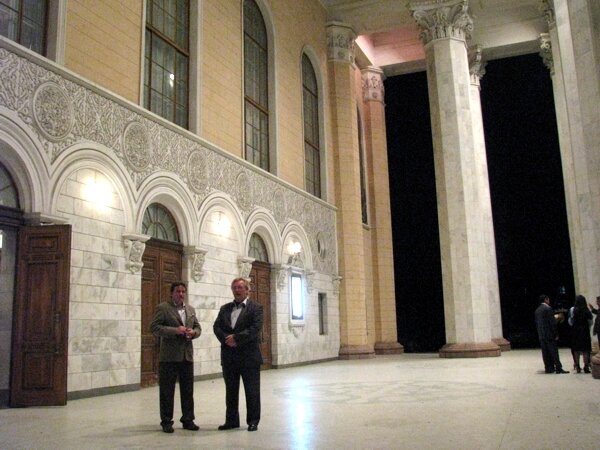



 Bishkek