Confusing times
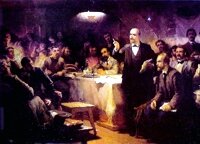
Lenin speaking at the second Congress of the RSDLP
Last weekend, having sent out my regular weekly postcard giving a personal review of the previous week’s news from here in Kyrgyzstan, I was sitting in a café having a chat with a friend over a cup of tea and he started quizzing me about Alfred the Great. It seems that during the week he had been at a loss what to do and had picked up a school History text book belonging to a nephew or niece, (I can’t remember which), and started reading. Apart from Alfred the Great he read about Charlemagne and a host of other people … I was quite impressed and reflected on what lessons English schoolchildren might learn based on historical characters from Central Asia.
As we chatted away, I discovered that we both share a fascination for the minutiae of historical trivia – like, for example, that it was on 17th November 1903 that a seemingly insignificant event took place which was to have an extremely significant impact on the world during the rest of the twentieth century.
The Russian Social Democratic Labour Party, (RSDLP), had been established five years earlier in Minsk, (now the capital of Belarus), to unite a variety of revolutionary groups into a single party. A Marxist organization, it was illegal for most of the period of its existence and the nine delegates to its first congress in March 1898 were duly arrested by the authorities. Shorlty afterwards, a certain Vladimir Ilyich Ulanov, (who is better known by his pseudonym Lenin), joined the party and joined the other delegates who gathered in Brussels for the party’s second congress. Unfortunately the Belgian authorities were not too happy to be playing host to them and they quickly relocated to London. It was on November 17th that the party split into two irreconcilable factions which came to be known as the Bolsheviks and the Mensheviks.
The two factions got their respective names from a vote for the editorial board of the party newspaper, the winning side, (that got the biggest number of votes) was called the Bolsheviks – taken from the Russian word for Majority – whilst those who lost the vote were given the name Mensheviks – taken from the Russian word for Minority. The irony of the situation is that the Bolshviks were by no means in the majority … they were not the largest of the two factions … the Mensheviks were.
As time went by, the Bolshevik Party seized power in the Russian Revolution of 1917 … and eventually became the Communist Party of the Soviet Union … and the rest is, as they say, history.
Last week’s elections in America and China may turn out to have just as much important and lasting impact on future history, but only time will tell. Here in Kyrgyzstan, the scale may be smaller but I suppose that it could turn out that some similar small and seemingly unimportant events may yet turn out to have a greater legacy in future development of society … once again, only time will tell.
The Kyrgyz authorities do seem to be taking the matter seriously … drawing up all sorts of initiatives, (such as additional taxes on the revenues of mining companies, as increase of sales tax for mobile operators and an increase of excise tax rate for alcohol and tobacco products), which they hope will increase the budget revenues and, amongst other things, offset the losses incurred when the Americans stop paying for the rent and other fees paid for the Manas Transit Base. According to the American embassy, the base was worth something like 62 million dollars in the first seven months of the year. In the meantime, the US ambassador has gone on record saying that Washington won’t be drawn into speculation about the future of the base beyond the projected end of the lease in July 2014 … saying that consultations would take place between the two governments.
Figures concerning the airbase is not the only set of financial data we’ve been treated to this week … the Economic Ministry released figures suggesting that they predicted growth of 7% in 2013 rising to just short of 8% on 2015 along with the hope that provided there aren’t any significant external “shock factors”, the monetary and tax policies followed by the government should help to keep inflation down to about 8%. Then there was the news that since Kyrgyzstan joined the World Trade Organization, (WTO), in 1998, foreign trade has grown by almost five times – although it’s not clear to me that the one necessarily resulted in the other.
Anyway, all that seems pretty impressive … but there have been a large number of articles that refer to the current budget deficit and the fact that the authorities seem to be experiencing difficulties in meeting targets for tax revenues. Indeed, the Finance Minister has warned that November will be a critical month for the country. It’s not just America that may be facing a Fiscal Cliff – but Kyrgyzstan’s is of a different make.
To make matters worse, one MP has claimed that 35% of the money received as loans is used to service debts … drawing parallels with the situation in a number of other countries and making worrying references to “default”, “changes of government, massacres and looting”.
There were a number of other reports about surveys reported during the week that highlighted interesting results. One, for example, reported that although the majority of the population in Kazakhstan and Kyrgyzstan think that their country should be secular, 33% in Kyrgyzstan believe that Islam should be part of the state policy, in one form or or another. Another reported that whereas 60% of people in Kazakhstan considered their country to be “politically stable”, only 16% of the respondents in Kyrgyzstan did so.
Apparently 70% of the population “trust” President Atambaev, (a figure that would presumably please President Obama), and 40% rate his job performance as Good … 8% as Very Good.
Ninety percent of the respondents in Kyrgyzstan consider that Russia plays an very positive role in the Region, and 95% see it as the top priority for international cooperation. Wheras in Kazakhstan, China was seen as posing the greatest threat in the region, the same question when asked in Kyrgyzstan produced answers of Afghanistan … and the USA(!)
The Prosecutor’s Office is continuing its investigations into corruption with a probe launched into the Bishkek Mayor’s office … and there have been suggestions that they may soon be in a position to start criminal probes into a number of MPs. There has been yet another survey into corruption and there was a report that the Tax Authorities are the most “corrupt” with the largest number of bribes, not to mention the largest bribes, (an average of 100,000 some, apparently – that’s just over 2000 dollars, 1600 Euro or 1400 Pounds). Apparently the average bribe paid in the Social Fund is just 20,000 and to the Customs Service just 5000.
The MPs seem to getting a lot of attention at the moment … with the security services setting up checkpoints around the parliament building, complete with sniffer dogs to check vehicles for explosives. Before the new Chinese leadership were declared, it was announced that China was going to provide the Ministry of the interior with riot control supplies.
Actually the security services seem to have had a success in that they discovered an underground printing press – but it wasn’t producing newspapers or pamphlets, it was apparently forging documents for terrorist and extremist organizations.
Last Saturday saw 35 young couples from all over the country gather together for a mass wedding. It didn’t quite match the mass weddings organized in Korea … but was quite impressive. I don’t know if the organizers were aware that the next day, (Sunday – November 11th, or 11/11), was Singles Day when a lot of Chinese arrange to get married.
A slightly more worrying story was the news that according to a report by the United Nations Population Fund, there are almost 110 abortions for every 1000 births, implying that abortion is the “most frequent form of birth control” used in the Republic.
One of the surprising things in the news this week was an article reporting a World Bank survey that concluded Kyrgyzstan outstripped both the US and the UK when it comes to the Right To Information, (RTI), – where, for example, officials – such as parliamentarians, ministers, prosecutors – are obliged to disclose information about their business interests, financial assets and incomes. Out of 89 countries rated in the survey the top three were Serbia, India and Slovenia … whilst Kyrgyzstan was ranked 21st, Britain came in 25th place and the US in 39th … and amongst the bottom five placed countries were Germany, Tajikistan, Greece, Lichtenstein and Austria. If that seems a little our of kinter with what we might have expected, then the proviso that the RTI Rating is designed as a system “for assessing the strength of the legal framework for guaranteeing the right to information in a given country” and, as such, it is limited to assessing the legal framework and not measuring the quality of implementation of that legislation.
Monday night saw the arrival of snow here in Bishkek … not much, just a light covering, but it came as a bit of a shock. The temperature had fallen during the afternoon and became quite chilly before nightfall. By the morning there was a couple of centimetres lying on the ground. It made the branches look pretty and I was glad that the central heating had been turned on a week ago, (starting on 1st November), but I couldn’t help thinking about our political pundit who last year declared Zima ne budet - there’ll be no winter – and this had announced Snega ne budet - there’ll be no snow. Surely, I thought to myself, he must get tired of being wrong.
The sharp cold spell led to a sharp increase in power consumption – basically doubling the demand – and that in turn led to power cuts as the electricity companies in Bishkek had to resort to rationing supply to consumers … imposing power cuts of one and a half power around the different districts of the capital and other parts of Northern Kyrgyzstan.
For the record: Today is the Day of Kyrgyz Cinema … as well as the 130th birthday of Karamoldo, the Komuzist who played all day.
Open Central Asia
For anyone who happens to be in Bishkek this week, (and especially next weekend), there is the Open Central Asia Forum and Literature Festival … with a number of events ranging from book readings, films, interactive drama, book exhibitions and book launches, talks by a variety of authors. For more details of the programme, events, time and venues, see here.
.
.
.
.
_______________________________________
Postcard from Bishkek: the weekly postcard that I send out as an email also gets posted on the website ianbek.kg each week – and there are other postcards which don’t get sent out. This week, for example, there has been the following postcards:
- Single’s Day - a “holiday” which originated in Chinese universities during the 1990′s as a celebration for people who are “still living the single life”;
- Baha’i - to mark one of the nine holy days of the Bahai religion, (the Birth of Baha’u'llah, the founder of the religion, in Tehran in 1817), I took a look at the Bahai faith;
- Trust you … review of customer rants and raves - Some thoughts on a survey of what hotel guests like … and loathe;
- Diabetes - Wednesday was World Diabetes Day …;
- White Cane Safety Day - I take the opportunity of White Cane Day, (an American day to commemorate the Blind), to look at the position of the Blind in Kyrgyzstan;
- Karamoldo, the Komuzist who played all day - this year saw the 130th anniversary of the noted Komuzist, Karamoldo … actually his birthday is today, but I posted this particular postcard yesterday;
It is now possible to follow me on Facebook, (where I have specific pages for Celestial Mountains and ianbek … and also links.kg and Kyrgyz Diary), and on twitter, (@Bishkekpostcard and @celestialMTC ).


 Bishkek