Single’s Day
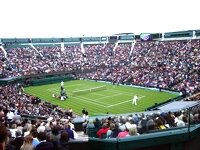
Tennis - one of those situations when it pays to be single
When planning future postcards, I noticed that today is Singles Day in China.
The “holiday” originated in Chinese universities during the 1990′s as a celebration for people who are “still living the single life” – as, apparently, an increasing number of Chinese are doing … although it now forms an unofficial holiday, or ”special day”, for fashionable young people and in popular culture. It seems that deep fried breadsticks, Blind Dates and Singles Parties are de rigueur for the day. It got the name Singles Day because the date, (November 11th, or 11/11), consists of four ones.
Although this seemed interesting, initially I passed over it and moved onto look for an alternative theme for the day’s postcard … only returning to it when I came across an article on the BBC website: “Why are couples so mean to single people?”
That got me thinking.
In the article, James Friel points out that the world celebrates “romance” and idealizes the search for Mr. or Ms. Right and there seems to be a presumption that “no-one is supposed to be single”. He mentions how people seem free to ask him questions like: “Why don’t you have a partner?” but it is considered a distinct faux pas to ask a couple what might well be a far more pertinent question: “Why are you two still together?” …
I think James might well have a difficult time out here in Kyrgyzstan … where being single might not be such a rarity – but it is normally the result of having the status “separated”, ”divorced” or “widowed” rather than that of “single” – as in “unmarried … and never have been”.
As one of those “single” people – that is “unmarried … and never have been”, I am used to the pointed and invasive questions like “Why not?” … and the inevitable follow up: “Children?”. (Hey … I said I wasn’t married … just what are you trying to say?).
The archetypal replies of “I haven’t met the right person yet”, or “It just never worked out” don’t seem to be as readily accepted as they once were. Nowadays, there seems to be an unspoken assumption that the single person has something lacking … some disability, or disfiguration.
The look of pity and the feigned sympathy when the other follow up question is posed, “Who’s going to look after you in your old age?”, is all too common. Maybe it is just me and reflects the society into which I was born and in which I grew up as opposed to the traditional nomadic culture … and, although I understand the thinking behind the question, it seems to me a rather selfish and not a particularly noble reason for bringing a child into the world.
Here, in Kyrgyzstan, it is more or less assumed that people will get married – more so than in the West where the Confirmed Bachelor or Spinster are recognised characters … and not always with sexual overtones hinting at Gay and Lesbian tendencies … perhaps someone who is “wedded to their career” or “a cause” … or someone who has genuinely chosen the solitary life.
Indeed, there is tremendous social pressure on people here to get married. I have known several people that have been faced with a dilemma, in one form or another, as a result.
When I first came here I was introduced to a large number of single women, in their late twenties … who were, as we might have unkindly put it, “left on the shelf”. Often, but not always, the implications were clear … they were seeking “a partner” and any romance would be a welcome bonus … but the status was the goal.
One acquaintance, an older brother, who delayed the moment caused considerable heartache and searching amongst the other other members of the family. Amongst the Kyrgyz there is a definite hierarchy … the boys are supposed to marry by age … the oldest first, followed by the second and so on down to the youngest. A younger brother has to obtain permission to “jump the queue” … hence my friend was basically told that it was time he stopped messing around and he should get on with the task of finding a wife.
Another acquaintance, in this case the youngest brother in the family, also came under considerable pressure. It is traditional that, whereas the older children move out of the family home when they get married, the youngest remains living in the parental home, bringing his wife to share it and raise their own children their, looking after his parents in their dotage and eventually inheriting it. My friend was looking … but had yet to find The One to whom he felt he could commit himself … but the family began to get impatient. Hints were dropped whilst he was studying at university, but it was accepted as a good thing that he wanted to concentrate on his studies. Once graduation was over, however, the family home was redecorated … including the room for him and his bride to move into. He was basically told … you want to choose your own bride; no problem … but get on with it, or else we will do it for you!
To be honest … I got the impression that the pressure was good humoured … and taken in good spirit. In each case, if the person resolutely refused to give in to pressure then there would be a sense of disappointment amongst the rest of the family; bemused incomprehension amongst friends and acquaintances … but nothing like ostracism or the “honour killings” that we have seen in other communities around the world.
As an aside: Alistair Cooke was one of my heroes, and one of the inspirations behind these postcards. His Letters from America accompanied me for many years as I went through my regular Sunday morning routine.
Alistair was a great afficiando of two sports – golf and tennis – but he made it a point not to feature either in more than one letter a year … even so, he was often taken to task for the coverage he gave them. I am not really keen on either of them, although I am aware of the basic principles and some of the history and characters of each … and I am quite happy to watch them, I cannot say that they enthral me.
Tennis always strikes me as quite interesting in that it is one of those sports that comes in various guises – Singles and Doubles with competition and ranking between Men, Women and even Mixed couples … there are even occasional Singles matches between players of different genders. Although the length of the matches can be different, (containing 5 sets for Men, 3 for Women’s matches – although for most tournaments everyone plays “the best of three sets”), and the tactics and strengths employed by the players different … it is one of the sports where Men and Women can and do meet on relatively equal terms.
I see that the controversy over “prize money” is back in the headlines once more. When Wimbledon started allowing professional players to compete back in 1968, the women’s champion, Billie Jean King, took home a little more than a third of what was earned by men’s champion, Rod Laver. These days the Grand Slam tournaments offer “equal pay”.
Oddly enough, the prize money, per pair, for the winners of the Doubles competitions tends to be about a third of that paid in the Singles competition. That could well be a reflection of the fact that the audiences gather for the singles matches rather than the doubles, (and therefore finance the competition), but it seems a little odd that double the input reaps one third of the reward.s such, Tennis is one of the situation when it seems to pay to be “a single“.




 Bishkek