Sweet tooth
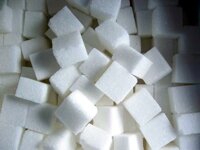
Sugar cubes
Many years ago, back in the UK, like most young people I used to have a sweet tooth. As well as being a regular consumer of chocolate and other confectioneries, I took sugar in tea and coffee, hot chocolate … and, of course, I drank “pop” – carbonated drinks like Lemonade, Orangeade, Dandelion and Burdock … the forerunners of Coca Cola, Pepsi Cola, 7-Up, Dr. Pepper and so on.
I remember that when I went off to college, and therefore had assumed some responsibility for feeding myself, there was a “sugar shortage”. I can’t remember all the details now, but I do remember that the price of a two pound bag of sugar, (roughly equivalent to one kilogram), shot up … virtually doubling.
Being a poor, hard done by student struggling to get by on a grant, I made a conscious decision to forego the sweetner. That was more or less how things stood until I came here.
Now, people here also seem to have have a sweet tooth. Coffee and tea, when it is proffered used to be served up already sweetened. At first I tried to explain and ask for drinks “biez sakara“, (without sugar), but was all too often greeted by bemused confusion.
These days, however, things are quite different … although you can get packets of “3-in-1″ instant coffee, these days the sugar is usually presented separately.
As it happens, sugar used to be an important Kyrgyz agricultural product. Indeed, one of the towns in Northern Kyrgyzstan owes its name to the substance, (Kant is the Kyrgyz for sugar), and was given that name because it was a major centre of sugar production in the republic.
Sugar is in fact a general term for a variety of sweet flavoured foods, such as glucose, fructose and galactose. The common form of granulated white sugar which we use to sweeten our tea and coffee is a form of sucrose. Sugar can be found in most plants, but most plants don’t really have sufficient concentrations for extraction … except in Sugar cane and Sugar beet.
Sugar cane, is a giant grass which seems to have originated from India and has been cultivated since ancient times, especially in tropical climates, (it is mentioned in Chinese manuscripts which date back to the eighth century BC). Alexander the Great’s soldiers brought back tales of honey bearing reeds – for many centuries, well into the Christian period, honey was the only form of sweetner available in Europe.
Originally a sugar syrup which was crystallized into what the Indians called khanda, which is where we get our modern word “candy“. This “sweet salt” was one of the products traded along the Great Silk Road, but in Europe it remained a fairly rare commodity and traders in tended to be wealthy. Demand for sugar increased and it came to be seen as ”very necessary for the use and health of mankind”.
For the record: That is somewhat different from the modern opinion which sees sugar as “the most demonic addictive known to man”.
Demonic? – apart from sugar being “bad for your teeth”, it can be linked to obesity which is the cause of cardiovascular, diabetes and other diseases, possibly cancer.
Addictive? – “Typically, our bodies convert carbohydrates, (such as those found in a bowl of rice or a slice of bread), into blood glucose and then release insulin to bring down the level. With sugar, the insulin rush is such that our blood sugar level is then depressed to a level where we crave more sugar, leading to more insulin release. And so the vicious cycle continues.”
Sugar Beet, on the other hand is a root crop which had become the main source of sugar in Europe by about 1800. It is well suited to cultivation in cooler climates – like Kyrgyzstan. The favourable climatic conditions for the growth of beets led to the establishment of a plants for processing it and as a result Kyrgyzstan held a leading position in sugar production following the collapse of the Soviet Union. Apparently, there were four main companies that were based in Northern Kyrgyzstan … but only two of them are still operating – and they appear to be in financial difficulty.
Following the collapse of the USSR, there have been several attempts to try and rescue the individual plants, including privatization, management buyouts, handing control of plants to an Association of sugar producers and obtaining credit facilities, which have been used to buy seeds and specialist equipment.
An insufficient supply of raw materials and other production problems, (for example, sugar beet requires more processing than sugar cane), means that the price of the finished refined product is quite high compared to that of competitors. Also weather conditions have hampered the development of the industry; it seems that last year, for example, only about half of the planned crop was harvested. The plants work at capacity only for a couple of months a year.
Indeed, despite the fact that we seem to have under employed production capacity, it appears that we buy sugar from Belarus, Kazakhstan, Azerbaijan and even Austria … amongst others.




 Bishkek