Civil Aviation
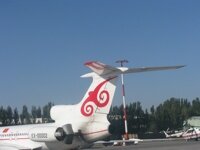
Tail fin of a Kyrgyz airplane
Today is another of those “professional holidays” that are a feature of the calendar in Kyrgyzstan inherited from the Soviet Union, today being the Day of Civil Aviation.
A couple of weeks ago we saw the publication of a new 400-page book, “When Planes Fly Up“, containing a variety of materials, stories, drawn from official documentation, articles from newspapers and magazines, and interviews covering the 75 years about the history of Civil Aviation within the country.
Technically, there are about 50 airfields in the country – which is not surprising when you remember that the republic was once used to train Soviet pilots – and even former Presidents Mubarack of Egypt and Assad of Syria trained here in the 1960s.
There are two airports which have been upgraded to meet international standards – Manas Airport in Bishkek and in Osh – and both Tamchi and Karakol on Lake Issyk Kul have been upgraded to receive international flights from Russia and Kazakhstan in order to serve the resort zone during the summer season … and which have led to considerable development in the immediate neighbourhoods.
The main civil airport, is Manas Airport in Bishkek, (although there are some international flights from Osh and Tamchi – mainly to other CIS cities). Since December 2001, it has also served as a military base (originally named Ganci and later as the Manas Transit Centre), for American and other nations – operating humanitarian flights to Afghanistan. Manas is capable of handling even the largest planes and has been used as a refuelling base for long haul flights between Europe and the far east, (e.g. Japan) – in 2003 there was a story in the local press about how the cast of ‘Matrix Reloaded’, “breathed the pure Kyrgyz mountain air whilst their plane was being refuelled”. Several freight firms use the airport as a transit hub and there are plans for this role to be expanded after the drawdown of forces in Afghanistan in 2014 and the resulting withdrawal of the airbase from Kyrgyzstan.
In addition there are seven Civil airports which have served domestic flights, although not all operate as they have proved uneconomic given the levels of traffic:
- Karakol
- Cholpon Ata
- Kazarman
- Batken
- Djalal Abad
- Isfana
- Issyk Kul (Tamchi)
- Akshiirak
- Ananevo
- Baetovo
- Caravan (Kerben)
- Daraut Kurgan
- Djani Bazar
- Isfana
- Kyzyk Djar
- Kyzyl Kia
- Naryn
- Sari-Djaz
- Shilek
- Talas
- Tamga
- Toktogul
Existence of an airfield does not imply the existence of flights. Because the mountain relief of the country can make travelling overland difficult, (limiting the number and route taken by roads, and increasing travelling times), the use of internal air routes might seem an appropriate transport option … however, the number of internal flights is limited and the main route is between Bishkek and Osh.
During one season, for example, there were only the following internal schedules:
- Bishkek-Osh – several flights a day – every day
- Bishkek-Djalal Abad – one flight every day
- Bishkek-Batken – three flights a week
- Bishkek-Karakol – two flights a week
- Bishkek-Kerben – once a week
- China – 1
- Kazakhstan – 5
- Tadjikistan – 1
- Uzbekistan – 2
The national airline (which used to be known as Kyrgyz Aba Jolduru) operates both domestic and international flights. Other international carriers include Turkish Airlines, Aeroflot, Uzbek Airlines and China Xingjian Airlines. There are a number of small, (often newly formed local companies), that operate on a number of routes, (for example: Botir Avia, Altyn Air, Cargo Avia, Itek Air,, KAS, Manas Air and Phoenix Aviation), There are also a number of special charter flights – mainly for local people going on holiday, or on “shopping tours”.
One of the biggest problems facing tourists seeking information about flights has been the fact that, until recently, local airlines are not listed on any internationally recognized booking systems – everything had to be booked through local GSAs, (General Sales Agents).
During the Soviet period, there were a large number of helicopters operating out of the republic – and some of these are still here. Helicopter flights can be arranged – for example, for heliskiing or to Khan Tengri – but tend to be expensive.
Safety of air travel has been a concern, with travel warnings from several countries advising travellers against using local airlines; Kyrgyz airlines being banned from European airspace; some accidents and near misses. For example, the British Foreign and Commonwealth Office advise that “it is not known whether maintenance procedures used on internal flights are always properly observed …”. As there are no flights from Kyrgyzstan to America the FAA have not undertaken a rating exercise for safety and security of Kyrgyz airspace and operations. As a result, there may be a question about whether travel insurance covers internal flights.
Kyrgyz flag carriers, (airlines registered in Kyrgyzstan) have been banned from entering European air space as a result of concerns over maintenance of aircraft. The government say that the issues raised by the European authorities have been addresses and they are seeking for the ban to be removed – but, at the moment, it is still in place.
One of the other controversial issues in civil aviation is the proposal that the country declare a policy of Open Skies: the liberalization of the rules and regulations of the international aviation industry in order to create a free-market environment with the aim of:
- minimizing government intervention as it applies to passenger, cargo, and combined air transportation as well as scheduled and charter services; and
- adjusting the regime under which military and other state-based flights may be permitted.
It is hoped that the adoption of such a policy which held Kyrgyzstan becoming a hub for transport throughout Central Asia. Some of the local airlines, however, are concerned about aspects of the proposal in particular the possible impact on competition – for example, that foreign airlines will be more than happy to operate profitable routes but leave the more expensive to operate domestic routes to local operators which will inevitably lead to rising prices.



 Bishkek