Arslan Bob
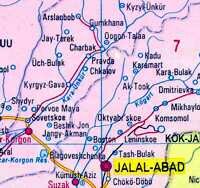
Arslan Bob
Arslan Bob, (or Arslanbap), lies in the Djalal-Abad region of Southern Kyrgyzstanand is famous, in particular, for its walnut groves.
The village is said to be named after an 11th century hero who met his death nearby – betrayed by his wife to his enemies. His footprints, handprints and bloodstains are said to be still visible at the spot.
There is another account, which tells of a modest and earnest, hardworking man charged by the prophet Muhammad with finding a beautiful and comfortable place – a paradise on earth. He travelled through many lands until he found a picturesque valley with a foaming mountain river –but which lacks trees. Inspired by his reports, the prophet sent him a bag of seeds of many different types of fruit tree – including, of course, the walnut tree. The hero climbed to the top of a mountain and spread the seeds over the valley transforming it into a “garden” which he tended for many years.
In Russian, walnuts are known as “Gretski” – or “Greek” – nuts, because Alexander the Great – sent plants back to Greece from his campaign in Central Asia. It is not clear how the trees arrived here – they originated in Malaysia. Nuts from the area were exported along the Silk Road in its heyday. Here the trees, which can live to 1000 years, with their dome shaped crowns atop two meter thick trunks, can reach a height of 30 meters and are found growing wild on mountain slopes and along river banks at an altitude of between 1000 and 1800 meters above sea level.
Arslan Bob itself lies at 1700m a.s.l.As well as the nuts, which are rich in nutrients, walnut wood is a valuable commodity and is used in the manufacture of furniture.
Recent deforestation (for the timber, despite the fact that the forests are protected by law) has been very controversial.
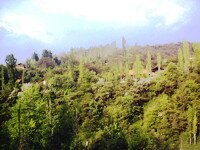
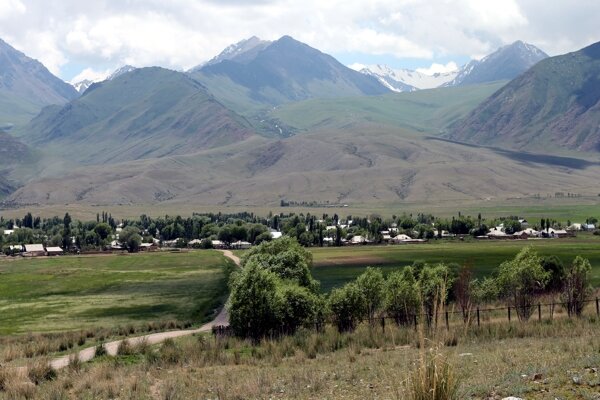
A view across the valley
The village has a population of about 15,000 and comprises a traditional, mainly Uzbek, community. It lies high up in a valley, about 55km off the main Bishkek-Osh highway at Bazaar Korgon. The village stretches a long way up the valley, nestling on the hillsides – giving many of the houses spectacular views.
The whole region is like an orchard and boasts much different variety of fruits.
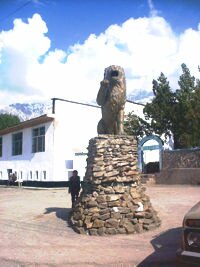
A different spelling - Arslan not Aslan
In the small village square is a statue of a lion, (in Kyrgyz, Arslan means lion). There is also the Arstanbap-Aty mausoleum (dating from the 15th century). Nearby is a new mosque.
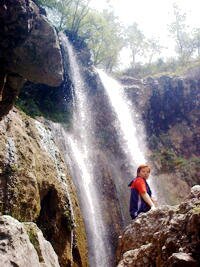
The "small" waterfall
Within easy walking distance of the village centre is a small waterfall (about 23 meters tall) and in the cliff opposite is a small cave, or grotto – known as the “Cave of Forty Angels” – where a holy woman used to live – people would come to her and make petitions. A little further off is a much larger waterfall, (actually it is split into two sections of 60 meters and 80 meters), and “Holy Lake”. A day trip can be organized (walking or horse riding) taking in the main sites.
There is a “tour basa” here dating from Soviet times when the village was a popular center for various activities. There is also an active CBT group here, (Community Based Tourism).
There are ample in the neighbourhood for trekking and horse riding in the neighbourhood – for example in the Babash Ata Mountain range. Skiing is also available during the winter months. Also within walking distance of the village is the Dashman Forest Reserve.




 Bishkek