Cranes
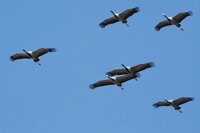
Demoiselle Cranes in flight
Kyrgyzstan lies on the flight path for a number of migratory species of birds, perhaps the most notable of which are cranes.
These long legged, long necked, migratory birds with powerful wings, live either in marshlands on the steppes where they feed on plants, insects and even small animals.
In fact, species of cranes are found throughout the world except, (for some reason), in South America and they are given a special place in many cultures. Whereas in Viking mythology warriors killed in battle would be taken by the Valkyrie to Valhalla, in Russian tradition soldiers that die in battle turn into cranes. In the Northern climes their arrival heralds the coming of Spring and their departure that of autumn.

Cranes
In Spring, (typically in April), the birds fly from the region to the West of New Delhi in India to their summer nesting grounds in Siberia. Some fly up over the Western part of the republic and then turn East along the valley of the river Chui and the shores of Lake Issyk Kul, where they are joined by others who have flown through the Central Tien Shan.
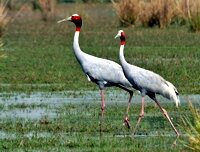
Cranes wading
There are three distinct species which migrate through Central Asia. The Siberian White Crane, Demoiselle Crane and Eurasian Crane.
The first of these is very rare. Their traditional migratory route took them from India over Pakistan and Afghanistan, which has become extremely dangerous, along Turkmenistan and it is thought that there is a small breeding colony in Northern Iran, near the Caspian Sea.
The Demoiselle Crane is a bird at home on the dry steppes, and it breeds in a number of places throughout the region – including in a few places in Kyrgzstan. These birds fly in their thousands through Kyrgyzstan in April and they don’t seem to be in a hurry in that they seem to have a number of spots which are favoured for lingering – for example near Kordai (Kazakhstan) and Eastern Issyk Kul.
The Eurasian Crane breeds in the marshes of Siberia, and although they are found in Kyrgyzstan and it is thought that they might also breed here, (for example, in the marshy areas around Lake Issyk Kul – especially in the North East), but it seems as if the birds do not linger long here and there is no documented evidence to support this suggestion. It used to be thought that Eurasian Cranes were the first ones to migrate, flying North during March, although micro-transmitters attached to birds have given us more information and it now seems that some of them might fly much later and their routes during the Spring migration tend to skirt Kyrgyzstan.
In June, the non-breeding or moulting birds start to gather for the return journey and can be seen at the Tash Otkool reservoir to the North of Bishkek, where they can normally be found until mid-September, when the shooting season starts and those that are still here fly off en masse.
This area is particularly good for encountering a wide variety of migratory species. Although water levels are generall rather high in the Spring, during the summer and early autumn they are lower providing good marshy conditions for wading and feeding.
(Actually, as this is in Kazakhstan, there are visa problems for foreigners who want to go and see them.)
In Autumn, by about September, the birds repeat the route in reverse, although apparently they are not as disciplined in following the route as in the spring, (that is, birds can be seen massing in virtually all the lowland areas before “climbing” to cross the mountains). This could be one reason why numbers seem to be fewer in the Autumn than in the Spring, (in that the birds are spread amongst a wider range of routes rather than concentrated on the more narrowly defined Spring routes), but there is also the fact that the migratory period is longer than that in the Spring.







 Bishkek