Oodles of Noodles
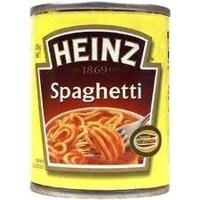
A blast from my past - Heinz Spaghetti
When I was a kid growing up on the 1950′s and 60′s, my exposure to pasta was limited to what came out of a can … Heinz Spaghetti in Tomato Sauce, (or spaghetti hoops), Ravioli in Tomato Sauce and Macaroni Cheese, (two of my mother’s favourite “stand-bys”). It wasn’t until I was a student, living away from home and catering for myself that I came across the vast variety of pasta dishes, types of pasta and different sauces.
Pasta is a of noodle, made from an unleavened dough made using durum wheat flour and water … although it can be made from other kinds of flour from cereals or grains and with eggs. (Generally, eggs are used in place of water if the pasta is for immediate use and consumption, (fresh pasta), but not if the pasta is to be stored for any length of time.
 Like most people I associated pasta with La Bella Italia, and I suppose there was good reason for this. Not only were most of the pasta dishes which we encountered from Italy, specialities of city centre Italian Restaurants, and the typical butt of television sit-com humour. As it happens, although the first specific reference to pasta seems to be from about the twelfth century, it seems that there are references to something that sounds likes pasta back in Italy as early as in the second century BC.
There is, however, a “story” which seems to be quite well known, that Pasta was brought back to Italy by Marco Polo after his travels to the mysterious Orient. Certainly noodles were well known in the East, and archaeologists have found some preserved in an earthenware jar that date back some four thousand years. The earliest written reference to noodles is about two thousand years old and comes in a Chinese document.
Noodles are a common feature of oriental cuisine and are found in a wide variety of dishes throughout Central Asia.
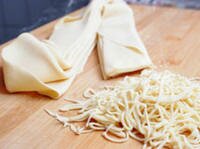
Oodles of noodles
The traditional way of making noodles is by hand: flour and water are mixed (perhaps with with melted butter, eggs and a little milk plus a pinch of salt … according to taste or the specific dish). The dough is then mixed and kneaded … rolled into a “loaf”, and then left, covered with a damp cloth for an hour … after which it is moistened with a little warm salted water, kneaded once more until the moisture is absorbed.
The loaf is then split into walnut sized potions which are then “spun” into the noodles: Taking a portion in two hands – the hands are drawn apart stretching the dough into a long thin strip – which is swung like a skipping rope, encouraging the dough to stretch into long, thin stands … until they are about a meter long. The noodles are then boiled in a pan of water until they are soft … when they are thrown into a pan of cold water (to prevent them sticking together).
Some of these stretched noodles may take the form of wide strips, thick or thin strands, (such as is used in Laghman, Beshbarmak or as spaghetti), whilst the dough may simply be rolled into sheets to be used as in Lasgane or Manti.
It is said that pasta and noodles were originally “finger food”, that is they used to be eaten with the hands rather than with utensils … utensils like knives and forks being a relatively recent innovation; forks, for example, were not commonly used in Western Europe until the 16th century. At about the same time, a mechanical method for producing noodles was introduced in Northern Italy, (somewhere around San Remo). It was not only easier to produce pasta with the aid of this new technology, the final product was more consistent in terms of shape and texture than that produced by the traditional manual techniques.
On the other hand, there is something about homemade cuisine … and there is something about noodles made in the traditional way. for example when eating Bashbarmak or Laghman in a homestay in a Kyrgyz village or a yurt in jailoo.




 Bishkek