Cheque this out
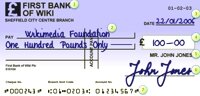
Specimen cheque, drawn on a non-existent fictional bank and based on British practice:
I went to one of the banks where we have an account in order to withdraw some money so that I could pay some bills. There was nothing unusual in that … it happens on a fairly regular basis as we have to keep some petty cash for paying small everyday bills, we can’t pay everything by bank transfers and I don’t like keeping large amounts of cash in the office, (for obvious reasons).
Usually, it’s a routine activity and doesn’t take very long – unless there happens to be a long queue of clients waiting to see the tellers. As it happens, on this occasion there weren’t many customers, but it still took quite a while because the branch was undergoing some renovations. When I eventually got to the cashier, however, I was asked to add a note on the back of the cheque stating the reason for wanting the money: “for example, ‘salaries’”, said the teller.
I was taken aback by this … although some banks do ask for this, (at least, their cheque forms ask to indicate how much of the required sum is to be used for salaries), but this particular bank has never done so before. So, I asked “Why?”
I was told it was a requirement of the National Bank.
Now, that didn’t exactly surprise me … in that there are a huge number of regulations and it was quite possible that one was issued which had slipped past me of which I wasn’t aware. Having said that, I was still taken aback but the sheer effrontery of the measure. It is none of their business … it is our money and we have to account for it in our accounts, before the investors – and, for that matter, the tax authorities. On the other hand, we should not have to disclose to third parties how we want to dispose of our own funds: itf we intend to spend it on fixed assets; on goods, services – professional services or utilities, for example, for the payment of salaries, or taxes, or for making refunds, etc.
I accept that it is probably a function of my being British and growing up in a different system but, to me, a cheque is document which orders the payment of funds from a bank account. It is an instruction from the owner of the funds in question, to the bank where they are deposited, about how to dispose or disperse them. On it are written various details, such as:
- the Bank where the cheque can be presented for payment;
- the payee, identifying who can receive the money;
- the date of issue;
- the amount in both words and figures;
- the person or entity making the cheque;
- signature of the person authorising the transaction – and here, if it is a company account, the company stamp is also needed;
- Machine readable routing information, but that not a feature of the Kyrgyz banking system.
Indeed, the Kyrgyz law On Banks and Banking Activity says quite clearly that clients can dispose of their finances as they wish, and are free to withdraw funds from their accounts provided that they provide proof of identity and act in accordance with their agreement with the bank.
To be honest, I haven’t had a chance to check the details of our contract, but as this particular bank has never asked me to indicate why I want to withdraw funds from the account in the past, I presume it has not been a condition governing the operation of the account.
For the record: in fairness, perhaps I should also point out that cheque books in the West sometimes do have space to record the reason a cheque was issued … as a sort of administrative aide-mémoire, but that is normally on the stub and not on the cheque itself.
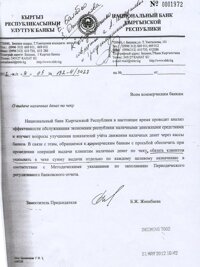
The letter from the National Bank
So, I asked for some more details of the requirement. Now most people here will understand that I was asking for four things which will enable us to identify the document:
- the type and name of the document,
- who issued it, (presumably in this case the National Bank),
- the number and
- the date.
They kept talking about a postanovleniye (which is variously translated as: resolution, decree, decision, ruling, judgement, regulation, ordinance, rule, provision, enactment, act, determination, bylaw – or byelaw, authorization, decretal, disposition, establishment, term, prescript or assize). One of the people with whom I talked, spoke in an authoritative manner about it … but later admitted that he had “never laid eyes on it”. It didn’t help that no-one seemed to be able to find a copy, (but to be fair – that is probably a result of the renovations they were undergoing).
Anyway, when they did find it, it turned out to be a letter addressed “to all commercial banks”. It wasn’t a polozheniye, a regulation, or anything of the sort – simply a letter with a request (se prosboi) that they should “obyazen“, (oblige), clients to indicate on the cheque, the sum required for each purpose according to the accounting methodology, so that they could provide the National Bank with statistics in order as part of the monitoring of the effective use of cash in the economy.
It seemed to me that this wasn’t an instruction as such; it was clearly a request addressed to the bank which actually had no bearing on me … at least not until the bank had imposed a change in their own rules about the conduct of accounts – and hence the terms of the contact between us – of which they had to inform me … which they haven’t done. So, I could quite justifiably refuse … but didn’t … I had some bills to pay and needed the cash in order to do so and I wasn’t too keen on risking being in a position where they might refuse to give me my money. So, I took the cheque, turned it over and on the back wrote tekushiye ras-hodi, “- running expenses”.
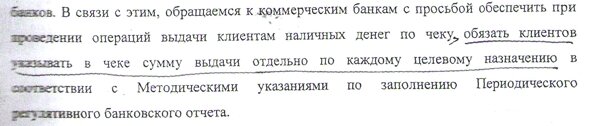
The crucial sentence
Apparently, it is all to do with completing regular periodic reports submitted by the banks to the National Bank about their activities. It seems that banks are expected to inform the National Bank about such things … although, on a point of principle, I am still not convinced that it is any of their business how someone intends to use their money.
Actually, I doubt whether it will even do the job that it is supposed to do … the data collection, if it is to be done properly and conscientiously, will take time and require a certain amount of additional work … but I doubt that it will be accurate except in the few cases where a sum of money is being withdrawn from the account for one specific purpose. If all that is required is to write “tekushiye ras-hodi” or some other equivalent “catch all” phrase then it will only take seconds, but the final statistic will be meaningless.
Then again, what if someone makes a “mistake” in their calculations or the funds are vired from one declared purpose to another?, will businessmen be held accountable for it?
There is also another issue presented by the growing use of bank cards to obtain cash advances or with the use of cash dispensers … in which case, no statistics will be collected at all.
Please don’t misunderstand me. I appreciate that there is a need for some form of control in order to protect society from corruption, money laundering, the financing of terrorism and so forth and I even appreciate the need to have accurate and reliable statistics – but this does not seem an adequate or appropriate tool in this struggle.
It seems to me that, instead, the measure is an illogical and ineffective requirement which will achieve little other than use a little more ink, a little more time, creating a little more frustration and a lot of meaningless statistics of little, or no, value.





 Bishkek