Salary Stats

Cash ...
Over the weekend, I undertook one of the tasks which make up my regular routine: checking newsletter of the legal database to which I subscribe for any amendments to the legislation which may affect out operations here in Kyrgyzstan.
As well as keeping me up to date in the various zakon, postanavleniye, ukaz and prikazes, ee tak dalee, (laws, decisions, decrees and orders … etc.), the database also includes a number of interesting articles reprinted from various newspapers and magazines as well as other such vital statistics as the official exchange rates, interest rates and so on.
Last week, it included the official list of average salaries in the republic for 2011, according to the Social Fund. This table is needed by accountants for several calculations to do with payments to the social fun. It stuck me, however, as fascinating in it’s own right.
It divided the country into 65 different administrative regions and gave the average salary for each of them.
Across the country the average salary was 9311 som, or just under USD200 a month … about EUR160 or just over GBP125. Those figures made me stop and think.
The trouble with averages, of course, is that they are meant to provide an idea of a “middle” or typical value of a set of data … and statisticians sometimes refer to them is as “measures of location) – and sometimes as a “measure of central tendency” … in other words, there will be values both above and below this figure. As this is an average salary, there will be some people who earn more than two hundred dollars a month – but, then again, there will be others who will earn less.
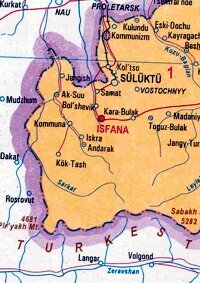
Sulukta in Batken oblast
The lowest average salary was in the town of Sulukta, (or Suluktu), in the Batken oblast – about as far South West as you can get and still be in Kyrgyzstan … (To be fair, that’s a bit of an exaggeration as the district center Isfana as a little further South and a little further West – but it will give you an idea of where it is.)
It is not a particularly well known town, even here in Kyrgyzstan. With a population of just over 20,000; representing some thirty different nationalities, although about three quarters of them are Kyrgyz).
It occupies just over 1700 hectares , at an altitude of 1380 meters asl in a narrow meandering gorge on a spur of the Northern Turkestan range. Coal mining is the main industry although there are other mineral resources nearby: quartz, sand, limestone, clay and gypsum. As well as these mineral resources, agriculture is the main employer in the area.
The climate isn’t bad: the summers are dry and hot, the winters warm and short. However, both spring and autumn can bring heavy rains.
Sulukta actually has one advantage over many other towns in the country – in that it has a railway connection, with the Proletarsk Station, 46 kilometers away across the border in Tajikistan. It also has all the usual facilities that you might expect from a Soviet township: a library; social club; parks; a stadium which can seat 5000; schools – including a music school and nearby children’s health camp, (although I am not sure if it is still operating); health services …
Despite all that, the salary in the town is just under 5000 som, that is about USD106, a month – about half of the national average.
Now, that’s food for thought!.
Of the 65 administrative districts, only eleven had an average salary greater than that for the whole country … and four of those were in the capital, Bishkek. (In other words – 54 had average salaries less than the national average.) To make matters more stark, two of those eleven were located in the Issyk Kul oblast and provided much of the workforce for Kumtor goldmine which distorted the figures somewhat. Indeed, if the Kumtor effect was removed from the statitics, then these two regions fell below the national average as well.
Hmmm … if you think about how that is possible, it says a lot about some of the distortions at the other end of the scale.
Indeed, at the other end of the scale … there were two districts where they gave two statistics – one including Kumtor, and the other without – the first was the overall average for the whole of the Issyk Kul oblast, (where the Kumtor mine is located), and the other was for the Djety Oguz district which contains the Kumtor mine and where many of the workforce are drawn from:
The overall statistic for the Issyk Kul oblast (including Kumtor) was: 13729 som – or just over USD290, EUR240 or GBP185 … but if Kumtor was excluded then it was just over half of that at 6992 som, – that is USD148, just under EUR123 or GBP95 … a month.
Much more dramatic were the statistics for the Djety Oguz district, which was a massive 44678 som, (USD945, EUR783 or GBP595), when Kumtor was included but just 5609 som, (USD119, EUR98 or GBP75), when it was excluded – that is about an eighth of the inclusive figure.
Remember, as I said, these are average figures, which means that some people will be earning less, but some will be receiving more.
Now, if that’s not food for thought, then I don’t know what is …
What I do know is that, as a former teacher of statistics, I would have loved a copy of that table when I was teaching measures of location … it raises so many fascinating questions. At least, in my mind it did …
If anyone is interested … here is the table: Average salaries. It’s in Russian, but I think it is still possible for an elementary analysis to be quite revelaing!


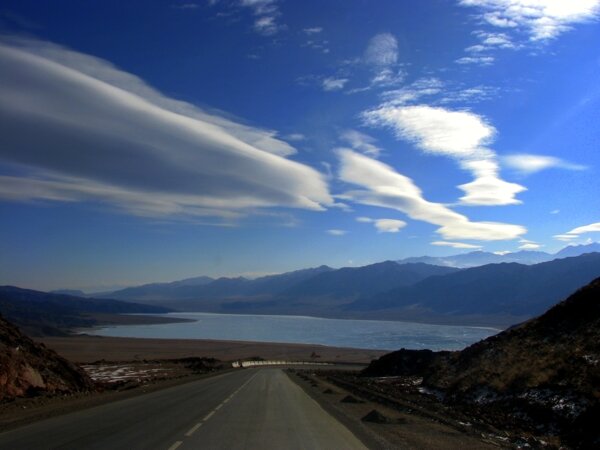
 Bishkek