The Forgotten General
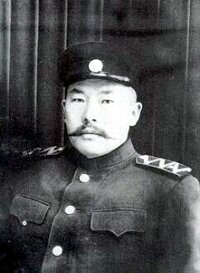
General Monuev
At the beginning of the year, the parliament considered a list of anniversaries which it would sanction for official recognition in 2012. One of the deputies created a certain amount of fuss because they suggested adding one to the list – the 110th anniversary of the birth of a famous Kyrgyz General Ysakbek Moniev.
Part of the furore it created was down to the fact that people started asking, are we going to celebrate the birthday of every General … although, perhaps, there might be some justification for commemorating the birthday of the Kyrgyzstan’s Vice Admiral.
Another point of contention was that, although he was supposed to be famous, most people claimed that they had never heard of him. Indeed, a newspaper article referred to him as the “forgotten General”
As it happens, Ysakbek Moniev, was the military leader of the unrecognized Republic of East Turkestan (which is now the Xinjiang Uighur Autonomous Region of China – which is now the Xinjiang Uighur Autonomous Region of China ). To make life more difficult for those trying to track down come information about him, it seems that there are at least three versions of his first name, (Isakbek, Ysakbek and Isabek), and four of his surname, (Monuev, Moniev, Monirov, and Munirov).
By whatever name, it seems that he was born on 31st August, 1902, in the Nura Alai region of Osh oblast in Southern Kyrgyzstan. There is not much information about his early life which is the subject of some dispute. For example, according to one source he was born into an aristocratic Kyrgyz family, but the common view is that his father was a peasant who became a trader and actually flourished, doing quite well for himself. His father apparently had some education, possibly a religious education, and knew Arabic. It is said that he had completed the Hajj, been on a pilgrimage to Mecca. When he was only eight years old, young Ysabek lived with other yound pupils in the house of a teacher.
It seems that, although the family had settled across the border in Xinjiang, his merchant father traveled across the region and often took his teenage son, Ysabek, with him. This included visits to the parts of Turkestan under Soviet control and it was during these travels that Ysabek, now a youth, first met and was greatly influenced by Bolshevik activists – noting that “they were afraid of neither God, Bai nor Manap“. When the conflict finally came to his village, his mind was already made up and he left his family to join in the defense of the Soviet system that he come to admire.
It is thought that he began to cooperate with the security services of the Soviet Union who were attempting to extend Moscow’s influence in the region and fight off the threat of the Basmachi. At that particular time, the majority of the population of Xinjiang were Uighurs, (about three and a half million). There were just under half a million Kazakhs, a quarter of a million Han Chinese, and sizable communities of Dungans, Mongols and Russians. There were also some sixty six thousand Kyrgyz in the province.
At the age 25 Ysakbek assembled a squad of Kyrgyz from the Kyzyl-Suu region, which eventually became the 35th Kyrgyz regiment and numbered some 25000. They fought with the Basmachi robber bands that traveled along the Soviet-Chinese border. By 1934 these outlaws had been effectively eliminated in the region, although they had killed two of his brothers, Kadyberdi and Shaakmata.
In recognition of his services the KMT government , (the Kuomintang, the Chinese National People’s Party), awarded him the rank of Major General. Later, however, friction with the Kuomintang government led to him taking refuge in Alma-Ata, and he was flown to Moscow where he apparently met with Josef Stalin. On his return he formed another military unit, with which he returned to Xinjiang and defeated the troops of the Kuomintang.
In 1944 he was instrumental in establishing the unrecognized Republic of East Turkestan led by Akhmetzhan Qasimi and Moniev was given control of the newly formed National Army in June, 1946.
In 1949 the government of East Turkestan flew to talks in the Soviet Union, but the plane crashed on September 3rd, not far from Alma-Ata and Lake Baikal, although the plane was never found and their is some uncertainty as t o whether it was near Irkutsk or Chita. According to some sources the accident was organized by the Soviet secret service, – either the plane landing at some obscure airdrome and the passengers all being shot, or even that they were taken to the Ljubljana prison in Moscow where they were executed. It seems that Stalin had agreed with Mao Tse Tung to restore the territorial integrity of China, and therefore an independent East Turkistan was not in the interests of either.





 Bishkek