Langston Hughes
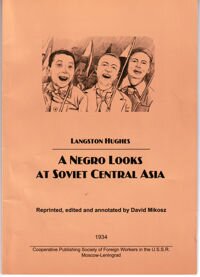
Langston Hughes' account of his trip through Central Asia
It is probable that the American Black writer and social activist, James Mercer Langston Hughes, (more commonly known as simply Langston Hughes : February 1, 1902 – May 22, 1967), never actually visited Kyrgyzstan on his journey through Central Asia … but the names of towns in the Ferghana valley echo throughout the short but vivid account of his travels through Turkmenistan and Uzbekistan. Even if the link with Kyrgyzstan is tenuous, his account of life, education, and the arts in the young USSR is interesting and informative – albeit somewhat “rose tinted”.
In her account of her jour
ney through Central Asia, the Swiss traveller Ella Maillart recounts how she had a chance encounter with a an American Negro in an office in Tashkent. This was one of a group of “experts” who had travelled to help the fledgling Soviet authorities develop the cotton industry in Uzbekistan.
Langston Hughes was travelling with them, at least for a time, at the invitation of of a Soviet Newspaper. He wrote an account of his travels which was published in Moscow in 1934 by the Cooperative Publishing Society of Foreign Workers in the U.S.S.R. as “A Negro Looks at Soviet Central Asia”. It seems that either the Society’s editors had transformed his original text somewhat, or else Hughes had second thoughts when he saw the published version – because one of the few original copies to survive (in his private papers) contains over 300 amendments and annotations. In some cases they seem to be simply minor typographical or grammatical corrections - but others are more extensive and tone down or remove phrases of even whole passages of what appears to Socialist rhetoric or propaganda. These notes have been included in a recent (2006) reprint and help to make what is already a fascinating account even more interesting and enlightening.
Langston Hughes was born in February, 1902, in the town of Joplin, Missouri. His childhood was not exactly happy. (Apparently, he contemplated suicide on at least one occasion – when he was seventeen.) His father deserted the family and left for Cuba (and later) Mexico in order to escape the racial discrimination which was endemic in the US at that time. His mother, a teacher, was left as the family breadwinner and so young Langston was brought up chiefly by his maternal grandmother – and after her death with family friends, before eventually rejoining his mother as an adolescent in Cleveland Ohio.
During his youth, he was to develop a number of traits which would follow him through life. One was a strong sense of Racial Pride. Another was indignation against the social injustice and prejudice which he saw around him. Also, there was his love of of books and an interest in poetry and writing. His own account seems to imply that he became a poet by accident – an accident of “colour” … one of his teachers kept stressing the importance of rhythm in poetry – and he was elected the class poet because as “everyone knows … all negroes have rhythm”.
Before become known as a writer and a poet he studied Engineering for a while and had a number of jobs - including as a hotel “busboy”. He travelled widely. As well as visiting Central Asia he also spent time in Paris, Spain, China, Japan, Mexico and the West Indies – where he lived in later life.
His writing included prose, (novels, short stories, children’s stories, essays and newspaper articles) poetry, plays and operas. He drew inspiration from a wide range of influences – from Harlem to Houseman. He was also a renowned teacher and public speaker.
A major theme in his work was celebrating “Black Culture”, and trying to encourage a self awareness and pride amongst black people. He wasn’t just interested in Black Affairs – but all minority and oppressed groups, and this comes out in his account of his experiences in Central Asia. He has also been claimed as “gay” icon, as well as a leading figure in raising Black Consciousness.
Like many Black writers he tended to drawn towards socialism and the promise of liberation that communism seemed to offer – although he never actually became a communist, claiming that it was rigid and disciplined a system. It still caused him some difficulties and an appearance before Joseph McCarthy’s Senate sub-committee on Investigations in the 1950′s.
He died in 1967 from complications following an operation for cancer.




 Bishkek