The Prezhevalsky Horse
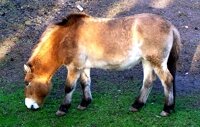
Prezhervalski Horse
The Russian explorer Nikolai Prezhervalsk was born in Smolensk on 12th April 1839 and died at the age of 49, in what is now Karakol, on 1st November, 1888.
One of the things for which he is famous is the discover of the breed of horse which now bears his name.
The Prezhevalsky horse is the world’s last remaining wild species of horse; all the other breeds of horse are either domesticated or descended from horses which were once domesticated. In fact, until the mid-1990′s the breed was extinct in the wild, having been exterminated by hunters. However, through efforts of the Prezhevalsky Foundation – based in Rotterdam, in the Netherlands and breeding preserves in Askania Nova, in the Ukraine – which has the largest herd of the horses in the world, two breeding groups of horses were reintroduced to Mongolia in the early 1990′s with the ultimate plan to reintroduce the animals to the open steppe.
The horse has been adopted as the national symbol of Mongolia.
The breed was named after the Russian explorer Nikolai Prezhevalsk who, it was thought, discovered the horse during his expedition to Mongolia, China and Tibet in 1879/80. Information has recently been unearthed which suggests that two Europeans saw these animals much earlier. One was a Scottish doctor who had been sent by Peter the Great on a mission to China. His account of his experiences (Journey from St. Petersburg to Pekin, 1719 – 1723) includes an accurate description of this Asiatic Wild Horse. Even earlier, a Bavarian nobleman, Hans Schiltberger, was taken prisoner by the Turks and “sold” to Tamerlane, who in turn “gave” him to a Mongol prince named Egedi. Schiltberger spent several years in the Tien Shan mountains and he wrote of the wild horses which he observed in his memoirs (“Journey into Heathen Parts”). The unpublished manuscript was written in 1427 and is housed in the municipal library in Munich.
Prezhervalsk brought back the skull and hide of a wild horse that had been given to him by a frontier guard. During his third journey he himself saw two herds of these animals in the Tachin Schara Nuru Mountains near the edge of the Gobi desert. In 1881, he published an official statement describing their appearance, their remote and deserted habitat and their characteristics. According to him, they lived in herds from five to fifteen animals led by a stallion. He noted that they were alert and very shy, with acute hearing, very good eyesight and a highly developed sense of smell. They seemed to prefer saline soils and could survive for a long time without water.
By the end of the century, news of the discovery has spread throughout Europe and America. There were at that time a number of large landowners who had developed an interest in rare animals. One of them, Frederic von Falz-Fein, kept many rare species on his vast estates at Askania Nova in Southern Russia (now in the Ukraine). Hearing of the discovery of wild horses in Mongolia he ordered an expedition to capture some of these animals. The adult horses, however, were too shy and too fast and so evaded capture. A first attempt to capture foals, in 1897, was unsuccessful. In 1898, two foals were caught but both died soon after capture – despite attempts to feed them on sheep’s milk. Finally, in 1899, seven foals were captured and reared by imported mares, and of these four eventually arrived at Askania Nova. The expeditions had cost over 10 roubles – a considerable sum in those days. A number of other specimens were captured over the next few years – but most died soon after capture, in transit – or shortly after arrival at heir new homes in the zoos and parks of Europe and America. In fact – all the Prezhervalsky horses currently alive can trace their ancestry back to 13 foals caught during this period (1897-1901).
Up until and through the Second World War, the population of herds was thought to be fairly constant, The last sighting of a herd, however, was in 1967 and the last sighting of a horse in the wild was in 1969. By 1977, about 300 individuals were alive, in captivity. A breeding programme was established with an aim to reintroduce the horse to the wild. Unfortunately the natural habitat of the horses has undergone irrevocable change, although some relatively pristine areas of steppe were identified in Hustain Huruu which has been turned into a National Park and a number of horses released into the wild in the early 1990′s.
Currently, about 1500 individuals are currently spread in about 130 private collections around the world and about 100 horses live on the steppes of Hustain Huruu.
Some authorities suggest that the Prezhevalsky horse is the ancestor of all modern breeds, although others point out that it is a different species from the domesticated horse. Although similar to the domestic horse though it has a smaller (about 12-14 hands high), more robust build, and a dark coloured, upright, mane which stops between the ears – there is no forelock, and a dark coloured, low-set, tail. The most common colouring is sandy tan, dun, or reddish bay. They have a dorsal stripe, a shoulder stripe, stripes on their legs (similar to a Zebra), and a lighter colouring on their muzzles and bellies. Apparently only a few Prezhevalsky horses prove to tameable, (similar to the Zebra).
In a sandstorm a horse would turn his head, with the eyes and nose, away from the fierce wind and the driven sand grains and protect the vulnerable parts of his rear with the tail.
The Prezhevalsky horse is a social animal, living in groups like steppe Zebra’s and domestic horses. There are two kinds of social groups, “family” and “bachelor”. A family group generally consists of a stallion plus three or four mares, with their foals and some yearlings. As the name implies, a bachelor group consists of stallions only, mostly led by a somewhat older stallion. Each group covers a specific territory – although this may overlap with that of other groups.




 Bishkek