Lechebniye Tourism

Holiday in a Hospital?
A few years ago I was accompanying someone from The Swiss Hotels Association who was here in Kyrgyzstan on a project to try and help develop the provision of hospitality services in the republic. As part of the mission we went to visit several educational institutions which offered courses in Tourism and Hotel Management and also a wide range of hotels, “pensionats”, resorts, and other establishments which offered accommodation. We got into trouble at one establishment because in the introductions he referred to “hotels” and the Director sitting on the opposite side of the table pointed out: “We are not a hotel. We are a Sanatoria.”
To those of us from the West, the word “Sanatoria” usually refers to some sort of medical institution or facility which cares for patients suffering from long-term illnesses, (such as Tuberculosis in the days before antibiotic treatments were available for the disease.) Here it tends to refer to a hotel with health resort facilities offering various types of treatments or health services, (similar to a Spa – although a spa is usually associated with “water treatment”).
Kyrgyzstan has a large number of Sanatoria established in the days of the Soviet Union. Many of them are located around Lake Issyk Kul and they are equally happy to take in holiday makers and people seeking treatment for a variety of ailments. In addition, many of them are open all year round, and not just during the high season in the summer.
They provide an example of Lechebniye Tourism, or Medical Tourism, travelling away from one’s own area of residence for health care. Although the term is usually used to refer to travelling abroad, technically, it can also refer to travelling within one country. It used to be associated with “elective procedures” such as cosmetic surgery but has recently come to be applied to other procedures such as knee or hip replacements.
In the case of cosmetic surgery, patients would travel to Latin America, (such as to Brazil, Costa Rica and Mexico – to mention just a few), or North African destinations, (such as Tunisia). For many years, patients would travel to places like the United States in search of “cutting edge” technologies, but in recent years destinations such as Thailand and Singapore have become popular, as a result of lower prices and a lack of waiting lists.
A couple of weeks ago, we were approached by someone who had come to Kyrgyzstan from Australia in order to receive dental treatment. Basically she had a few days off in her course of treatment and was looking for something to do in the meantime, places to go, things to see … and she thought a tour company might be able to put a package together for her. She told us that she was making a sufficient saving on the treatment, even when talking other costs into account, (transport and accommodation, etc.).
In fact, a few years ago, we were approached by another company from the other side of the world that was exploring the possibility of putting together just such a product for the European market and were looking for a local partner who would be responsible for making the arrangements here in Kyrgyzstan. They were convinced that the cost savings and the fact that treatment could be started and completed without having to be placed on a waiting list would be a very attractive proposition for a rapidly growing market.
Personally, I have my doubts … there are many potential problems: legal, insurance and ethical issues risks for the patient associated with obtaining medical care in a strange environment, questions of qualifications, standards or levels of care in different communities … not to mention the problems of communication.
However, I do have to admit that you can’t argue against success, and there is a growing interest in the market with on-line forums featuring: Cancer treatments, Cardio and Cardiovascular treatment; Cosmetic Surgery; Dental treatment; Diabetes; Fertility treatments; Optics; Orthopedics; Stem Cell therapy; Transplants; Urology; Weight loss surgery (Beriatric surgery); as well as alternative, oriental and Wellness treatments.
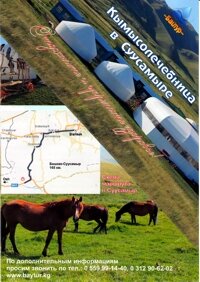
Kumyz Clinic
As it happens, on Sunday I went to visit a new complex constructed at Suusamyr where they specialize in treatment using Kumyz - fermented Mare’s Milk.
For the record: Kumyz has long been considered to have medicinal qualities. The first written evidence of its efficacy is found in the writings of Herodotus. Even as far back as the 16th century it was extolled for its curative properties. In the 1840’s, Russian doctors discovered that kumys was especially effective in treating tuberculosis, anaemia, chronic lung diseases and gynaecological and skin diseases – even indigestion. Some 16 special sanatoria were established which treated patients with lots of fresh air, exercise and kumyz. They served a number of famous people including members of the imperial family, Lev Tolstoy, Anton Chekov, Maxim Gorky, and even a minor British Member of Parliament (who made the journey to Central Asia especially to undergo the treatment). It is also used as an antiseptic.
The Suusamyr plain is some 2200 meters above sea level, some 160 kilometers from Bishkek, (about three hours travelling time). You have to keep you wits about you because it would be easy to miss the turn off – which is really just a track across the undulating grassland. The sign at the turn off to the complex – it’s rather low key, not very large or brash … rather in keeping with the setting, I thought, however, some people did miss it and having overshot the turning had to turn around and double back. Although the sign says it is only one kilometer from the main road, it certainly seemed further than that to me. You can’s see it from the road because the complex is hidden behind some of the hills of that undulating grassland.
The Suusamyr plain is famous for its lush meadows with a wide variety of herbs and this is thought to add to the value of the Mares milk and Kumyz from horses that graze here.
The Baytur group of companies which constructed and operated the complex is based in Bishkek. They have a wide spectrum of activities including: a construction company, a hotel, saunas and fitness centers … and, of course, the Kumyz treatment center in Suusamyr.
They began the center last year with a limited number of facilities and little marketing, but still managed to attract a wide range of clients, and not just from the local population but also apparently some international guests from Europe who seem to have learned of the enterprise over the internet. It seems to have provided the company with food for thought, because they say that they have been adding facilities in accordance with feedback from those guests.
Accommodation is basically in converted shipping containers … now, if that sounds unattractive, it should be remembered that shipping containers have been put to a wide variety of uses … including market stalls, (as at Dordoi Market, just outside Bishkek); storage facilities; offices – such as site offices on building sites and we even saw what looked like a couple of these on the journey up to Suusamyr; and apartments.
The rooms in these “cottages” appear a little small – being just the width of a single container but, having said that, they are not as small as the brick built “cells” that I saw in another sanatoria which was based on a salt mine – Honest! – and concentrated on asthma treatments. Even if the rooms seem small, (and I have come across hotel and guest house rooms even smaller!), they have been reasonable well fitted out and seem to be quite comfortable. Then again, for those undertaking a course of treatment – comfort isn’t necessarily the most important factor to be taken into account.
The 38 standard rooms are made from small containers and have three beds, toilet and washbasin (with hot and cold water – which is no mean feat bearing in mind they are in a high mountain meadow) with a TV. (It is possible to book the entire “room” or a single bed in a shared room.) Slightly more expensive is a “Pol-luxe” with two beds; toilet, washbasin and shower; TV and refridgerator. Top of the range is a “Luxe” room, which has two rooms, a separate bedroom with a large double bed and a sitting room.
Prices include three meals a day and mare’s milk five times a day.
There are other facilities including: a cafe offering European and national cuisines, separate dining rooms, a sauna, different types of massage, a large meeting room which houses a disco several nights a week, horses and local guides, a children’s playground, billiards and facilities for other games/sports and even papaplaning is possible.
It was all very comfortable and I admit to being impressed. I am not sure, however, how many “international” tourists are likely to make to the journey – some certainly may be interested in the special form of treatment, but I think that the main interest will be from locals – from Kyrgyzstan and our neighbouring countries.
Some people will come for the treatment, but a full course of treatment takes a minimum of ten days, (apparently you have to take some time getting acclimated - remember it is 2200 meters asl – and used to the milk) and I think there will also be a relatively large number of people from Bishkek who might be interested in taking a short break, (anything from a weekend to a week) … getting away from the hussle and bustle of city life and relaxing in a place where it is possible to forget the cares of the outside world, (well, that is, apart from the TV and there is one mobile phone company whose signal stretches up here).
To be honest, I am not sure that we at Celestial Mountains will be pursuing medical tourism as a developing niche market, but given the country’s heritage of spas and sanatoria, it may be that Kyrgyzstan will soon appear on those internet forums.





 Bishkek