Florence Nightingale’s Mathematical Bent

The lady with the lamp - illustration from the Ten pound banknote
My home town of Malvern, in Worcestershire, was famous in Victorian times as a spa town. In the middle of the nineteenth century the ”water cure” attracted a wide variety of celebrities to the town including the likes of Charles Darwin, Lord Tennyson, Samuel Wilberforce and Florence Nightingale. Despite that, not everyone was convinced in the efficacy of the treatment.
I am not sure exactly when Florence Nightingale visited Malvern, before or after she made her name in the Crimea, tending to wounded soldiers. Her pioneering work in organizing the hospitals and earning herself a reputation as a reformer, the adoration of the public and a place in history as an icon of Victorian womanhood. She became known as “the lady with lamp” which is the image that most people have of her – as featured in the illustration on the reverse of the ten pound banknote.
It was, however, her later work which was to be far more more important, saving far more lives as it helped to bring about a radical change in the entire medical system, and not just the care of patients in the wards. In order to achieve this she pioneered a brand new technique for bringing about social change – the use of applied statistics.
Yes, the lady with the lamp was also an accomplished mathematician.
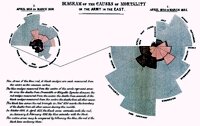
A Nightingale "infographic"
She pioneered the use of what is now known as the “infographic” – what is now the ubiquitous use of visual graphical representations of data, designed to communicate complex information quickly and clearly, giving an overall impression without getting bogged down in the detail of the data.
That, at least, is the theory … but I am afraid that quite often the artistic appeal in designing the infographic seems to get in the way of the data.
For example, one infographic that might appeal to a loyt of people might be one showing Tax Freedom Day in different countries. The idea behind this dubious concept is that if we had to pay out tax up front, then we would start the year by earning the tax that we have to pay the government – and on Tax Freedom Day we have reached the point that we have earned enough to pay our tax bill for the year and from then on we are earning cash for ourselves. There are all sorts of reasons why it is “dubious”, for example, there is no agreed way of deciding what constitutes the “tax bill”, (is it just “income tax”, or does it include sales tax paid by the individual, and what about Capital Gains Tax?); it varies not just between countries but also from year to year and indeed between individual tax payers … in some cases it is designed as the tax paid by an “average taxpayer” but in other cases by a “worker”. In fact, no matter how attractive and interesting it is, strictly speaking it is not possible to use it in order to compare different countries. Despite that, it appears that in the United States Tax Freedom Day falls on April 9th, in Kyrgyzstan it falls on May 10th. (For the record, in Britain it falls twenty days later on May 30th – although it is moving later and later each year at the moment). It’s nice to know that Kyrgyzstan can beat Britain in some things! What a pity it is victory in a dubious statistic.
Infographics have certainly seem to have become extremely popular with different news outlets here in Kyrgyzstan vying with other to publish them – some with support, (financial and logistical), from donors! Topics have included the size and structure of the national debt; The presidents and Prime Ministers of Kyrgyzstan since Independence; Infant Mortality rates; Road Traffic Accidents in Bishkek; Crime in Kyrgyzstan; Wage Dynamics; Emergency situations, (Earthquakes, fire, flood, avalanches and landslips); Food Prices … and so on. I have to admit that they are fascinating …
It strikes me that an obvious contender for an infographic is the topic of the Customs Union in that it is a complex and bemusing subject with lots of statistics which could, perhaps, be better understood if a clear means of portraying them could be found. The two sides, (those favouring Kyrgzstan’s accession to the Union and those opposing it), are equally vocal and quote both arguments and statistics to support their own case, bewildering the public: Differences in tariff rates with the volumes and composition of imports and exports – and re-exports; details about the structure of the economies of the various countries, members and applicants of the Union – and what about our neighbours those who are neither; what is likely to happen to prices on a range of goods once Kyrgyzstan enters the Union; how membership of the Union might impact on labour migrants, (Kyrgyz leaving for jobs in Kazakhstan and Russia), and the valuable remissions they make sending money they have earned abroad back to their families still in Kyrgyzstan.
Indeed, it seems from comments made by President Nazarbaev during Atambaev’s official visit to Kazakhstan suggest that the accession procedures will be accelerated.
One subject I would like to see presented in an infographic would be an analysis of the statement by Askar Salymbekov, the head of the Dordoi Association, and former governor of the Naryn oblast, that it is both profitable and convenient to work as a Joint Enterprise, (for example, Kyrgyz-Russian, Kyrgyz-Japanese or Kyrgyz-English). As it happens, he was talking to a forum in China that was exploring the possibilities of cooperation between Central Asian countries and China, so he put forward many of the advantages, (reductions in taxes, the number of licences, the cost of labour and energy … and so on). It would be interesting to see these compared to those of our neighbours.
The Nature and extent of military connections would also be an interesting subject for an infographic. It would help to put some of the statistics into context – the number and nature of foreign bases in the country, (US – 1, Russia – 1 plus … plus … plus … – although they are all supposed to be merged). Especially as it was announced that the Americans are about to build six new facilities in Southern Kyrgyzstan, including barracks, border posts and the regional office for the border troops. These are not for American troops, none will be deployed at any of these facilities; they are for the local border authorities and are being funded as part of the programme to combat drug trafficking.
It will come as no surprise to anyone that Russia has now announced that it supports Kyrgyzstan’s plans for the future of the Transit Center once the lease agreement with the Americans expires in 2014 – i.e. NOT to extend the lease, but transform the facility into a civilian international hub without any military components … and to resolve outstanding issues through the various regional security bodies.
Although there existing infographics about Kyrgyzstan’s external debt, it would be interesting to see one about the level and distribution of foreign investment – the countries making the investment, into what sectors of the economy, where in Kyrgyzstan, as well as – of course – how much. It would help us to see how important different “strategic partners” (such as America, China, Europe, Kazakhstan, Russia, Turkey and so on … ) are to the country.
One interesting surprise might be that a small Chinese company has apparently struck Oil in Batken – the poor oblast in the extreme south west of the country, virtually cut from the rest of the country by enclaves and closed borders. At the moment the Chinese have only produced a “test barrel” and further exploration and more drilling is required before “industrial production” can begin.
Interestingly, there is also a new Kyrgyz-Kazakh proposal to construct an oil pipeline
Talking of the Chinese, plans have been announced for a Presidential visit by Atambaev to China which would “prove” the high level of bilateral relations. Apparently, important results are expected from this visit, “which would further expand and deepen the Kyrgyz-Chinese relations in a broad range”.
Another interesting subject for an infographic would be the contributions of the Donor community. It seems that since July 2010, the World Bank alone is funding eight new projects to the extent of USD200 million, about half of which is in the form of grants. It would be interesting to see how the other donors are lining up.
It would be interesting to see an infographic on language in the republic.
There has been some promising news on the progress of implementing a Kyrgyz option in Google Translate. Apparently there aren’t enough pages in Kyrgyz yet for the project to be implemented, but there are plans to increase the number, for example, by adding to the number of entries on Wikipedia, (from 6000 to 50000). It would be really helpful and I am really looking forward to September when the Kyrgyz version of Google Translate is due to make an appearance.
It would certainly help me because my knowledge of Kyrgyz is still very basic – I can’t even describe it as the equivalent of “schoolboy Kyrgyz” as I sometimes describe my fluency in French as “schoolboy French”. I’m don’t think that I can even claim “Dictionary Kyrgyz”, (that is, that I can make sense of a passage so long as I have a dictionary to hand). I do know some words and phrases and after almost seventeen years here, I should really know more, but there hasn’t really been either the need or the opportunity to learn it. I often joke that, here in Bishkek, everyone speaks Russian or “they want to practice their English”. Still I can understand why some of the Kyrgyz feel so strongly about trying to support the use of the language and measures to enforce its use.
I am not sure, however, that all the protests are helpful. Last week saw some protests about the school exams being administered in Uzbek. The Ministry of Education rejected calls to stop Uzbek pupils being able to take their exams in their own language, and the Ombudsman came to their defence. It seems a little like a storm in a teacup when you consider that very few people actually take advantage of being able to sit the exam in Uzbek … apparently only about 1000 out of a total of 40,000 students – or about 2.5%, which is a little odd when you consider that the Uzbeks make up about 15% of the population.
A group of students at a National Assembly apparently made a call that Kyrgyz should be the only state language, (which, incidentally, it is – the status of Russian is that it is an “official language”). This caused a certain amount of outcry and the organizers had to call a press conference to say that it was a mistake and they had been misinterpreted … probably as a result of a “poor translation”.
Talking of students … I keep hearing that there are a lot of foreign students studying here in Kyrgyzstan. This week, a report stated that there were 1500 from Pakistan alone. The report went on to suggest that this was worth something in the region of ten to twelve million dollars to the country in terms of tuition fees, accommodation, transportation, food and so forth. Seeing this, I thought how it would be to see an infographic giving a breakdown of these foreign students, their origins and their contribution to the country’s economy.
Bearing in mind that the internet has done a lot to build on the popularity of the infographic, a suitable topic for such a graphic might be the usage of the internet. It has just been announced that the number of active internet users in the country has reached 2.4 million – out of a total population of about five and a half million, which amounts to penetration of almost 40%. Most of that, of course, is centered around Bishkek, with over 70% of the users, but it interesting to see how many people in the other regions of the country have access to the internet, especially using their mobile phones.
Of course, not all the topics represented ion infographics are positive. Some topics from this week’s news which could easily and usefully be presented in a graphic way are the number of children that have gone missing, (27 already this year – two of whom have been found dead); the number of “stolen brides” which is estimated as 8000 a year, although as one tweeter pointed out , there really isn’t any way of getting reliable statistics on the latter subject; the number of wrongful convictions in Kyrgyzstan (321 acknowledged cases where later court decisions overturned that of a lower court, in 2011); the threats to crops and livestock whether it be cold weather, mudslides or the Moroccan Locust.
Perhaps a little disappointing will be the fact that it looks as if there are only going to be 12 Kyrgyz athletes competing at the Olympic Games, mainly in sports like Greco-Roman Wresting, and weightlifting. There will also be representatives in shooting and swimming. However, it is not yet clear if all those who have won licenses to compete will be able to do so as a number of organizational issues have, apparently, yet to be resolved – including “funding for athletes”.
Oh … and by the way … today is Florence Nightingale’s birthday. I tried to find a suitable infographic to commemorate the occasion but drew a blank … perhaps will send me one.
________________________________________
Postcard from Bishkek: the weekly postcard that I send out as an email also gets posted on the website ianbek.kg each week – and there are other postcards which don’t get sent out. This week, for example, there were postcards about:
- Welcome to the new Department of Tourism - a quick look at the executive order establishing the new Department of Tourism in the Ministry of Culture and Tourism, and why I think there is a problem with it;
- The Kyrgyz National Conservatory - about an institute of Higher Education and a concert venue;
- The Real Thing - On the 126th anniversary of the appearance of the ubiquitous soft drink, I take a brief look at the Coca Cola Bottlers franchise here in Bishkek;
- Peak Pobeda – Victory Peak - On Dehn Podeda, (Victory Day) I took a look at what must be the ultimate in war memorials – a mountain;
- Just what we didn’t need - “Weird” travel stories from around the world … including one from Kyrgyzstan;
- Encounters with Dali - the surrealist artist Salvador Dali turns up in the strangest places … even in Bishkek.
It is now possible to follow me on Facebook, (where I have specific pages for Celestial Mountains and ianbek … and also links.kg and Kyrgyz Diary), and on twitter, (@Bishkekpostcard and @celestialMTC ).
If you decide that you don’t want to receive these weekly postcards in your email anymore, please drop me a line to and I will take you off the distribution list. Alternatively, if you know someone who might be interested in being added to the mailing list, then get them to drop me a line and I’ll be happy to do so.




 Bishkek