Just what we didn’t need
Earlier this week I came across a link to news item which looked as if it might be interesting:
Top 10 Weird Travel Stories
By Paloma Migone: Everyone has a crazy story about their adventures overseas. Cows on a plane? A kidnapping before your eyes? A naked receptionist? Yes, apparently, these did happen.
I clicked on the link and soon wished that I hadn’t.
I didn’t find most of the entries all that surprising, although the naked receptionist would have caused me to do a double take. Being witness to a kidnapping would have been more than a little worrying, but tucked in amongst the stories there was also this entry:
“4. THE PERFECT CRIME
When planning a trip, you always hear warnings about muggings and the new tricks of the trade. What you may not be prepared for is police committing the crime. A reader got mugged in Kyrgyzstan by police – three times within 30 minutes.”
Unfortunately, (or perhaps that should be “Fortunately”), there are no extra details. We don’t know, for example, the circumstances that lie behind those 45 words;
- Where and when did it happen?, Most of the complaints from tourists center around the Bus Station, and the central Ala Too Square – was it in one of these two spots or somewhere else?) .What time of day, or night, did it occur? They thoughtfully noted that it happened the space of half an hour but didn’t tell us if it was in broad daylight or in a dark and deserted spot?
- What constitutes a “mugging” in this context?, (“mugging” is usually taken to be an assault with the intention of robbing someone, so was there violence, or a threat of violence), … three times in quick succession?, … or what?;
- What did the “reader” victim do about it … apart from broadcast the “news”. I would like to think, for example, that the witness to the kidnapping did actually do something to help raise the alarm instead of simply keeping quiet and waiting until they got back home to “spill the beans”. In this case, especially if it happened three times in half an hour, that they would have tried to report it to someone.Obviously I cannot promise a happy ending, but on one occasion a tourist walked into the office to ask a question about crossing Torugart and in the course of discussion told us how a policeman had stopped him in the main square, asked for his passport and then gone through his pockets and his backpack and relieved him of some of his US dollars.Of course, we sympathized with him and, (although it was probably a case of “shutting the stable door after the horse had bolted”), went through the standard advice about not needing to empty your pockets etc. Then we learned that it had all happened a short while beforehand … which meant that the policeman concerned could still be traced. So, we called the local police station and arranged to meet with an English speaking officer who took the tourist to the square where he was able to identify the culprits who were still “on duty”. The money was returned, and the “rotten apples” disciplined.
Now, there have been times when I have been stopped by the police; usually asking for my “documents” – passport of other means of identity – foreigners are required to carry some form of identification with them at all times.
For the record: Here is some advice that we give to clients about the need to carry passports and how to handle encounters with the police:
“According to the Ministry of Foreign Affairs, it is necessary that foreigners carry with them at all times when they outside their place of residence (e.g. their hotel), to carry passports, or other documents verifying their identity.
Some embassies have, in the past, advised travellers that they do not carry the actual passport but a photocopy – and to show this to police if stopped. However the local authorities, as noted above, say that you should carry identification documents.
At times the police conduct special probes of foreigners because there is a problem with some illegal immigration/transit and, even if you do not look like a drug dealer they may use this issue as an excuse to ask you for a fine if you do not have your actual passport. According to some press reports, foreigners have actually been “arrested” in one of these checks for only having a photocopy of their passport.
Do not be alarmed if you are stopped by police – it is not uncommon. The best advice if stopped by police is to show what documents you have, and do not try to speak Russian.
|
In 2005 a reader of the newspaper “Megacity” posed a question about when an policeman or other official could ask for passports. Here is the answer the paper posted:
“According to the law of the Kirghiz Republic ” About law-enforcement bodies ” a policeman has the right to check the identification card of a citizen in any case at own discretion. But it should be noted that, irrespective of whether the official is in uniform or civilian clothing, he is obliged to identify himself first and to show his identification documents. Citizens in a state of intoxication or persons behaving suspiciously, first of all draw attention of guards of the order (i.e. policemen). Employees of law enforcement bodies can examine the identity documents in cases where a serious crime has been committed in the city or there is a search for a dangerous criminal. Only a woman police officer has the right to demand from a woman her identification papers and to make a search, in the presence of witnesses, in appropriate premises.” |
If someone is stopped by a police patrol in order to ascertain their identity – then they only have to show their documents. It is not necessary to show the contents of bags and pockets. They have no right to search you: do not allow this.
(Actually, to be honest, the situation can be a bit more complicated – if there has been a serious crime or there is a suspicion of drugs of firearms … then the police may be able to ask to see the contents of bags, etc. … and a citizen is obliged to cooperate. However, the the officers have to have a reason … they cannot simply demand to see what you have … so ask. If necessary – you can ask to consult your consul for advice.)
Refuse to pay any money if asked (refuse even to show your wallet as sometimes you may get it back lacking some of what was previously in it!) and simply show your passport and your hotel card. Police who have no business to do so may occasionally stop people in the street. If this happens you should write down the number of the policeman – they should be wearing a badge. You can ask to see their documents – hold out your hand and say “documents”. We also know of cases where people have been stopped by persons dressed as policemen (or in some cases in track suits) who were not in fact policemen (and in one case, who had what appeared to be genuine documents). Happily, these are not common occurrences.
Also, there have been occasions when I have sometimes been stopped several times in quick succession. I remember how, on one occasion, I was stopped four times in the main department store, TsUM - once on each floor and then once again as I was leaving the store … On the final occasion I exclaimed “skolko raz … “, (“how many times …”), and explained that I had already shown my documents to police officers three times … and was greeted by “Sorry … sorry … no problem … off you go … “.
However, such incidents are very rare and, of course, I have an advantage over the average foreigner … in that I have lived here for some time and, (despite the advice given above), I know the language and the system well enough to argue the point …
For example, on one occasion I was with a client when we were stopped and asked for documents. It was evening and quite dark and I felt that something wasn’t quite right so I asked to see his identification – which surprised him somewhat. ”I’m in uniform,” he said, to which I replied that the uniform didn’t mean anything, several had been reported missing or stolen and anyway, anyone could buy the uniform at the shop Voentorg … reluctantly he reached into his pocket and pulled out his identification. (Also, there are a wide variety of different uniforms and it is not always clear what the uniform actually signifies).
The client, who didn’t speak Russian, said that he had no idea what he would have done if he had been alone.
I told him that he needed to remember one simple word – “Consul”. Oh yes, the police can cause is problems … but then again, we can be the cause of problems for them. However, the word “Consul” is not like a magical spell – saying it won’t solve the problem and make it disappear, but it will put the situation on a formal footing.
For the record: Foreign nationals must, if arrested, be allowed to contact their embassy, (not to do so is an infringement of the Vienna Convention), so it would be a good idea for travelers to have a list of the appropriate contact numbers.
Also, every policeman has to identify themselves – they should wear an identity badge and you should make a note of the name and number, (OK, the name will be in Cyrillic – but numbers are numbers … ), and the time and place.
Now, to be honest, there seems to be a general impression here that many of the police are indeed corrupt and use their position to extort money from people. There are stories of confessions being beaten out of suspects, of “rewards” being offered (or demanded) for “solving” a case and bribes being required in order to drop a charge. In particular there have recently been a number of fairly high profile stories of people claiming of being “set up” or “framed”.
If that sounds bad … then can I suggest that we stop and think about it, for a moment and put it into some sort of context. I have no doubt that there is some element of truth behind these general impressions, but to what extent is it a fair representation of the force as a whole? Is it just a stereotype based upon some instances and the low salaries and morale of the law enforcement bodies?
Before those of us from the West start taking the moral high ground, let us consider how many Hollywood blockbuster movies are based on a plot about “bent cops”, “policemen on the take”, or ” purging rotten apples from the force”. I have no doubt that there is also some element of truth behind these stories, but that doesn’t mean that all those working in law enforcement are all “wolves dressed up in sheep’s clothing”, “devils in disguise”. It would be wrong to stereotype all police officers based on these incidents.
On the other hand, I am not saying that the police are all paragons of virtue. As I said, I have no doubt that there is some element of truth behind the impression that there is corruption in the police force. However, many of the officers with whom I have had contact have been nothing but the model of propriety and I have been impressed at their efforts in the fulfillment of their duties.


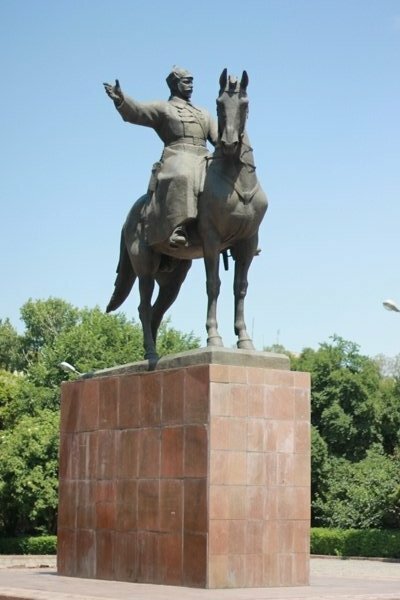


 Bishkek