Polygon – Bishkek’s Rubbish Dump
Recently, there have been a series of news stories about the Polygon; Bishkek’s rubbish dump.
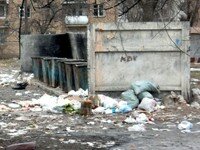
Rubbish bins behind an apartment block
Around the city there are bins for the collection of garbage. The ones nearest my home are placed behind in the yard behind a neighbouring apartment building. We collect our rubbish in plastic bags and take them and throw them in the bins. “Throw”, because approaching the bins can be unpleasant … especially if the ground is wet and muddy. The bins have no lids so any loose rubbish can be picked up and blown in the wind, or stray dogs and cats may rifle through the plastic bags looking for tit-bits, and as a result there is often rubbish floating around on the ground surrounding the bins.
The municipality arranges for the bins to be emptied regularly, every day, and the garbage is taken by truck to Polygon.
The dump, itself, is located on the northern outskirts of the city, some ten kilometers from the city center, in an old abandoned Quarry called Krasniy stroiltel, (Red Builder). The site opened in 1972 and according to one report was supposed to close back in 1996, having reached its planned capacity, but after the fall of the Soviet Union, this was one of the projects which got overlooked.
Apparently the amount of garbage is massive; the mound of garbage on the 47 hectare site is now some six to ten meters high and contains over six million tons of waste. It is also growing at a pretty impressive rate – by 1000 cubic meters a day.
As with the city center bins, the wind and animals and birds, (whether strays or wild), pick up and spread debris to the surrounding areas. There is an unpleasant smell from the putrefaction and decomposition of the waste. The local water table is quite high and there is filtration of chemicals into the local water supply, and thus. Most of the rubbish gets burnt and causes environmental damage and there is a fear that smoke from the incineration of the rubbish contains toxic chemicals,
The residents of the nearby communities, (apparently there are some 11 residential blocks nearby), have asked the authorities to move the site, as they see it as a health risk. Apparently there are some people who have set up home in a sort of shanty town or camp on the dump and search through the rubbish in order to find items which have been thrown away that they can salvage and sell. An enterprising blogger published a number of photographs taken on the dump and a number of videos posted on one of the local video sharing websites.
The European Bank, (the European Bank for Reconstructions and Redevelopment, the EBRD), has provided over half a million Euro to study the nature of the waste and prepare a feasibility study for introducing a comprehensive waste management system for the city.
It’s not just Bishkek that has a problem and neither is it just the EBRD that have been working on the problem. There are apparently just over 30 official landfill sites throughout the country, (one report says that more than half of them do not meet sanitary norms), and there have been reports about problems with garbage collection systems in Karakol, Talas and Naryn. OSCE, (the organization for Security and Cooperation in Europe) have even provided specialist vehicles for garbage collection to some of the oblast centers, (Naryn and Talas). The main dump in Naryn is by the side of the main road approaching the city and it used to be pretty unsightly, although work has been done to help clean up the site.
A European approach to waste management is likely to lead to a system of recycling. Many districts in Europe require the separation of waste into different categories, (glass, paper, etc.), so that they can be disposed of separately and more efficiently. There has been an attempt by the donors to try and introduce a recycling scheme. I have often wanted to adopt such an approach, but everyone assures me it would be a waste of time as Kyrgyzstan doesn’t have the facilities to cope with such a system, (although I am told that there used to be such a system – but that it is not working now).
The result is a disorganized approach to the problem with, not only a rapidly growing city dump, but different types of waste being mixed, (domestic garbage together with industrial waste), and a number of unofficial, unregulated informal landfill sites.






 Bishkek