KGNU
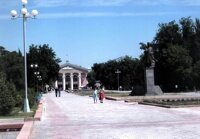
Statue of Djusup Balasagyn standing before the main building of KGNU
One of the things you get accustomed to in Kyrgyzstan is the number of portmanteau words and abbreviations in use. One such set of initials is KNGU – The Kyrgyz National Gosudarstveniy (State) University.
Kyrgyzstan has an impressive number of Institutes of Higher Education given the size of the population (just over 5 million) The provision of Higher education has increased dramatically since independence with 24 institutions according to one list and 114 to another. One of the most complete directories in the country lists 89.
Some people have argued that there are too many universities and others have said that the graduates they produce are not balanced to the needs of the economy. Some of these institutions have been links with other countries, such as America, (the American University of Central Asia), Turkey, (The Kyrgyz-Turkish Manas University and Russia, (such as The Slavonic University). One of the “monsters” of the educational world, (and I am a little anxious about using that word, but I am assured that in Russians it doesn’t have same sort of connotations that it does in English, referring to the size – like “gigantic”), is the KGNU, the Kyrgyz National State University named after Djusup Balasagyn. (Jusup Balasagin is an interesting character and worth a postcard to himself.) It is certainly a monster if you consider the statistics:
There are almost 30,000 students registered, with just over 1000 on postgraduate courses, taught by almost 4000 teachers including 9 Academicians and 135 Doctors. (I am not sure if that figure includes the thirty odd Honorary Professors and eight honorary doctorates that they have awarded.) The fourteen faculties, six institutes, two centers, five colleges, two lyceums and a graduate school offer undergraduate courses in 37 different disciplines, preparing students in over 80 specialisms; postgraduate courses in 31 disciplines and doctors in 6.
The university dates its creation to a decision of the Regional administration of the Kyrgyz Autonomous Region of 25th October, 1925, when it was decided to establish a Kyrgyz Institute of Education in order to train teachers. Up until that point, teachers were trained in institutes in Tashkent and Almaty. One of the aims in establishing the new institution was to develop the necessary knowledge and skills amongst the local indigenous population. The official opening was held less than a month later, on 10th November.
The first students studied for a total of seven years; the first three years on a preparatory course, before starting the main four course of training, specializing in Language, Mathematics and History. It was reorganized in 1928 into a Central Pedagogical College for the republic and new premises were commissioned for it. New specialisms were added to the curriculum, (Biology, Physics, and the Social Sciences). A further reorganization came in 1951 when it was transformed into the Kyrgyz State University, and Geology and Geoditic sciences joined the subjects on offer, and then again in 1993 when it became the KGNU.
The name of Djusup Balasagyn was added only in 2003. As in all Universities around the world, there is also a requirement for staff to conduct research. Projects are apparently under way in a number of fields: Physical science, chemistry, Information technology, bio- and nanotechnology, mathematics, environmental and energy sciences, economics, social sciences, jurisprudence, history and philology. A number of the staff collaborate on various international projects. A lack of finances means that “basic” research requiring expensive equipment and access to advanced technologies is somewhat limited.
In 2010, however, news broke of a particularly astounding research breakthrough, if it is confirmed. A Professor of Mathmatical Analysis at the university, Taalaibek Dardayilovich Omurov announced that he had solved the Navier Stokes Equation, one of the seven Millennium Prize Problems posed by the Clay Mathematical Instuitute, for which they were offering prizes of one million dollars each. The problems were chosen to represent some of the most difficult questions with which mathematicians were grappling at the turn of the second millennium. This particular problem concerns the use of special equations to describe, explain and predict the behavior of such things as waves following a boat as it meanders across a lake or turbulent air currents following the flight of a modern using the Navier-Stokes equations which, although they were first were written down in the 19th Century, our understanding of them remains minimal and the Clay Mathematical Institute sought to improve our knowledge and understanding by offering this as one of the seven prizes. I don’t know whether the solution, which has been published, (it is available on the internet for anyone who thinks they might understand it – I certainly don’t … although I understand the problem put in the general, layman’s, terms, I wouldn’t pretend to understand the details of the problem).
The University also publishes … producing textbooks, monographs, research papers and teaching materials as well as publishing an annual university newspaper and, since 2008, operate their own radio station.


 Bishkek