A slice of Pi, anyone?
Pi
If you are an American, or happen to be in America, then you might come across references to today being Pi Day.
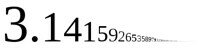
Pi, of course, is the ratio between the circumference of a circle and it’s radius, and most schoolchildren, (I won’t tempt fate and say any school child), will probably be able to tell you is approximately equal to 3.1415926 … I say approximately because it is what mathematicians call an “irrational number” which has nothing to do with the insanity that it seems to send people into, but that it cannot be expressed precisely in a rational format – that is, as a fraction: a/b. The stream of digits behind the decimal point in the number goes on, … and on, … and on … without ever repeating itself or forming a predictable pattern – or so the mathematicians inform us.
To most people, pi is equal to 3.14. That’s not exact … but for most purposes it works perfectly adequately as an approximation.
And that’s why today, March 14th, is known as Pi day – especially in America. Back in Britain we write the date in the order Day, Month, Year, (DD/MM/YY – so today’s date is 14th March, 2012 – or 14/03/12), but in America, for some unaccountable reason, they write the date in the order Month, Day Year, (that is, today’s date is 14th March, 2012 – or, in figures, 03/14/12 … or more simply 3.14).
Of course, March 14th, 2015, will be a very special day, (03/14/15 or 3.1415), but in the meantime, modern Mathematicians are happy to commemorate the occasion annually whilst planning special events for the centenary celebrations, (there’s already a special Facebook page to commemorate the occasion).
The history of Pi is quite interesting – but you would probably expect me to say that, having been a Maths teacher, and one who is interested in the History of Maths; in my opinion it was one of the best courses I ever took.
However, there is one incident in the history of Pi which is well worth recounting and I would like to share with you … the attempt by Dr. Edwin J. Goodwin to get the Indiana State Legislature to pass a law decreeing that the value of Pi in the state would not be the incredibly difficult to use value of 3.1415962… but, instead, to use the much simpler value of 3.2, (or maybe 3.2325 or 4 or even 9.2376 – Dr. Goodwin is not very clear in his various on the subject and the Bill doesn’t actually mention Pi … it’s actually about Squaring the Circle – something that Mathematicians have suspected for centuries to be an impossibility – which was finally proved in 1882 ).
As an aside: popular folklore says that he actually tried to change the value of Pi to 3, and the state is variously recorded as Kansas or Alabama …
Goodwin even managed to get his theories published in an early edition of what was to become the prestigious journal, the American Mathematical Monthly, (although they published a disclaimer … that it was “published by request of the author”).
Apparently there was some confusion amongst the elected members of the legislature when it came to debate the bill, (No 246 of 1897), possibly because the members didn’t understand the gobbledygook that was written in the substantiation of the measure, (at least one openly admitted as such), and were “blinded by science”. Anyway, it mustered some support and looked like it might actually pass into law until one of the senators pointed out that no matter how august a body, it didn’t have the authority to “define mathematical truth”.
I often wonder what would have happened if Indiana had indeed passed the Bill.
This is one of the two stories I often tell people when discussing law making … politicians have a knack of thinking that they know the best course of action, but they are simply making decisions and guided by various principles and advice. Sometimes they allow their fervor to get the better of them and make bad decisions, (albeit with the best of all possible motives), … but decisions that the rest of us then have to live with and which are often far more far reaching than was originally intended.
Oh, and the other story? … it was told to me by a lawyer and is about a politician who wanted to pass a law raising the age of puberty.


 Bishkek