Yaks
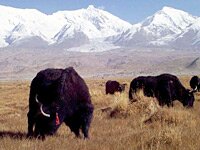
Yaks grazing
One of the first groups of tourists that I had here in Kyrgyzstan was a family of four: Mum, Dad and two children, six and eight years old and they had two particular requests.
The first was easy to satisfy: the kids loved swimming and wanted to swim. There are several swimming pools here in Bishkek and we spent the most of their first day here at the large open air pool behind the Sports Palace, Mum and Dad sitting at the side of the pool under the watchful gaze of a bust of Vladimir Ilych Lenin. Then, there was plenty of opportunities to swim in Lake Issyk Kul.
The second was a bit more problematical: they wanted to see Yaks. Now, although we do have yaks in Kyrgyzstan, (their numbers reached a peak of about 67000 in the late 1970’s, but their fell to just 16500 at the turn of the century – and they tend to be domesticated rather than the wild variety), they are found in the more remote parts of the country. . Virtually all the yaks I have seen in the country were in the Naryn region: by Lake Son Kul, at Tash Rabat and in the foothills on either side of the Dolon Pass.
Yaks are large animals, which can reach two metres in height, a relative of cattle and bison – indeed some people think the American bison is descended from them.
The name comes from Tibetan, gyag - which technically refers only to males of the species. the females being called dri or nak. In English, as in most other languages, we have simply adopted the word and use it to refer to both sexes.
It is thought that they were first tamed and domesticated by man as long as 3000 years ago.
The wild yak weighs can grow up to 1000 kg but domesticated ones are usually only half that weight. They can grow to 1.8 meters tall, and grow horns which can reach half a meter in length.
Despite their rather intimidating appearance, yaks tend to be quite shy. The accounts of some early European travelers like the Swedish explorer Sven Hedin, seem to over dramatize the dangers they experienced but, to be fair, they might have been describing encounters with wild animals. Domestic yaks, in particular, tend to be smaller and quieter than wild ones. Indeed, the first ones I ever saw proved impossible to approach … they stood staring at us as we stopped and got out of the vehicles, then as soon as they saw us moving in their direction, they turned and trotted off.
They don’t need special care and they are able to survive on scanty mountain vegetation. As well as being husbanded for their hair, (they have long, shaggy coats of coarse, black hair and a hairy tail – which was used by the Ancient Chinese, among others, as a symbol of authority), milk, (which is especially rich in butter fat), and meat, (yak meat is highly sought after as a delicacy, although, to be honest, I have never tried it, I have seen it occasionally on sale in the market in Naryn), they are also used as pack animals. I am told that some Kyrgyz herdsman in the Pamir even use them as a mount, riding them through the mountains.
Their natural habitat is in treeless uplands, including plains, hills, and mountains, from as low as 3200m up to the limit of vegetation at about 5400m. During his attempt to climb Mt. Mustagh Ata in Xinjiang, to the South of Kashgar, Sven Hedin complained that the yaks he was using as pack animals to transport his gear, were unable to cope at altitudes above about 6100m – which is actually considerably higher than their usual habitat. They stay in high areas with permanent snow during the warmer months of August and September, and spend the rest of the year at lower elevations.
The wild yak grazes on grasses, herbs and lichens. They can graze on the alpine grasslands in the summer and during winter on the shrubs in deep snow quenching their thirst with snow and ice. They loose weight during the winter but recover and gain weight rapidly with the coming of spring grass.
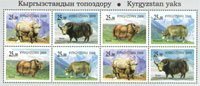
Kyrgyz stamps showing Yaks
Ordinarily, in the wild, yaks gather in groups of 10-30 or more, but they may occasionally be observed in large groups of 100-200. Herds in the wild are not stable units: they readily split, or two or more herds may join together.
Yaks are sturdy and well adapted to coping with the extreme climatic conditions. Their thick hair forms the characteristic “skirts”, under which a mother will hide her calves from cold weather. During the winter season they even bathe in ponds which haven’t frozen over.
In domestic yaks, females first calve at about 3-4 years old. Full size is reached at about 6-8 years old. Most births occur sometime between April and June. Domestic yaks give birth to single calves in alternate years, but in areas of poor grazing, a few may give birth only once every three years. The young become independent after about 1 year. They can live to about 25 years of age.


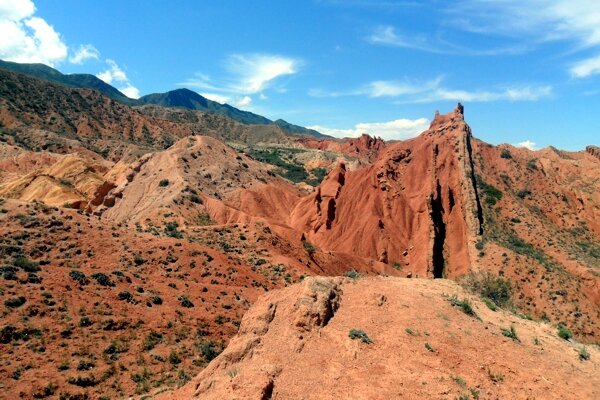


 Bishkek