FEZ
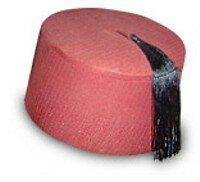
A traditional Fez
To most people a Fez is a hat worn by the Turks of the Ottoman empire. It comprised of red felt wrapped around a cylindrical or truncated cone, topped with a black tassel. It is thought that the hat is named after the Moroccan town which had a monopoly on its manufacture, although it is probably of Greek origin, and the colourful uniform of the guards outside official buildings in Athens include it as the headgear.
Although it became popular in the Ottoman empire, it was officially banned in Turkey as decadent by Kemal Ataturk’s government in 1925.
To me, however, it has a totally different meaning even if every time I use the term it conjures up images of the comedian Tommy Cooper who wore one as his trade mark.
FEZ is an abbreviation in economic circles for Free Economic Zone, a specially designated are where a special tax regime operates in order to encourage development.
Here in Kyrgyzstan we have a number of such areas, each administered by a General Directorate and which offer companies registered within them a favourable tax regime … in return for a fee paid to the General Directorate, (based on turnover), they are exempt from paying most taxes.
One of these zones is in Naryn and when we opened our guesthouse in the city we were advised that we could apply to be a subject of the FEZ and thus benefit from the advantages that it offered. We applied and were accepted and duly registered with them.
As well as the tax advantages, which are obvious, the administration of the Zone have been very helpful over the years in terms of advice and assistance with other official bodies when problems have arisen. They can’t solve all our problems but the fact that they are there, listen to us, offer advice and sometimes are able to intervene with other bodies to help us find a solution, is a definite advantage; especially for me as a foreigner, (even now after 16 years), trying to come to terms with the bureaucratic maze.
Ther have been a number of problems over the Kyrgyz Free Economic Zones over the years, and a debate constantly rages about their future.
The Naryn FEZ is, to be honest, a bit of an anomaly. When it was established, instead of designating a particular site for the Zone, where factories and other facilities could be built in a fenced in territory, the whole of the oblast was designated as the zone. That has created a number of difficulties as has the increased amendments to the law restricting what sort of companies and business activities are allowed to be registered in the FEZ. The constant uncertainty about the nature and future of the zone is cannot be particularly attractive to potential investors … and thus work against the aim of encouraging development of the region.
Naryn is definitely in need of development. It is one of the poorest regions in the country and has, according to some measures of geometrics, the remotest places in the country.
The staff of the FEZ are all very enthusiastic about their work, and are constantly coming up with ideas of how to preserve and improve the economic prospects of the region and to publicize their work. They recently asked me for a brief article about the future prospects for tourism in the country and why we chose to work in Naryn and become registered in the Free Economic Zone.
Here’s what I wrote:
The Celestial Mountains Guesthouse in Naryn was established in December 1997 by a group of British investors who were excited about the possibilities for the development of tourism in both Kyrgyzstan and the region as a whole. Little about known at that time about the country in the West and we thought that many people would be interested in travelling here, for example to follow in the footsteps of travellers along the ancient Great Silk Road, or who wanted to trek or ride horses in the magnificent mountain landscape and explore the traditional lifestyle of the nomadic Kyrgyz. We felt that there were many people who would be interested in visiting somewhere new, somewhere different that was “off the beaten track”.
The situation hasn’t changed that much even though some fourteen years have passed. Although people will have heard of Kyrgyzstan as a result of two revolutions, there are still very few people who really know much about Kyrgyzstan. The mountains are still here and people still walk and ride horses in them, staying in yurts with shepherd families. That doesn’t mean, however, that nothing has changed at all. Now, for example, there are more facilities for visitors than before and people can be accommodated far more comfortably, with hot water and even internet access.
There hasn’t been as many tourists in the last two years as in previous years, for obvious reasons, but there is no reason why people shouldn’t come to Kyrgyzstan if they know about it. We have to tell them about Kyrgyzstan and what we have to offer. It may take a few years to build up the industry, but I am as hopeful about the future prospects as I was back then in 1997.
As well as marketing ourselves, we have to prepare ourselves to receive visitors. We have to make sure that there are facilities ready for them and people trained and ready to welcome them and serve them to the standards that they are used to from travelling to other parts of the world. That means investing not just in things like hotels but in the general infrastructure such as roads, telecommunications, heating and hot water, all of which will help improve life for the local population as well.
In order to attract investment, from local people or foreigners, large or small, (and not all investments have to be in the millions), then they have to be convinced that it is worthwhile; that they will be able to make a profit and benefit from it. They need a good investment climate: available credit at reasonable rates; favourable tax conditions; clear and fair regulations; willing and well trained employees; reliable sources of supplies and services; a legal system that they can trust and above all safety and security for their investment.
We chose to invest in a guesthouse in Naryn for several reasons. We could identify a need, Naryn is on the Great Silk Road to China and although there was accommodation already available it was limited and we could see a potential demand for our services. Although about half of our guests are travellers along the Silk Road, the other half are people from Kyrgyzstan visiting Naryn for business. The existence of the Free Economic Zone was a definite advantage giving us not only a lower rate of “taxes”, (paid in the form of fees to the General Directorate of the Zone), but it was also a far simpler system than operates outside the Zone. It also provided us with a sort of “one-stop shop” which provided us with advice and help when problems arose.
The guesthouse has worked well over the years. Of course there have been problems. Apart from the smaller number of tourists in the last dew years, we have had to cope with difficulties such as problems relating to water, electricity and heating supply, the hot weather in summer and extreme cold in winter and avalanches which have blocked the roads to Bishkek and Torugart, not to mention the constant questions about the operation and future of the Free Economic Zone.
We have slowly improved the facilities in the guesthouse over the years: improving the rooms and the dining room; installing a satellite dish, water tanks and our own heating system; building an additional block containing storage, laundry facilities accommodation for staff and a meeting room. We hope to add to these in the future, for example, with a summer kitchen and sauna.
The hotel is just quite small, with twelve guest rooms that can accommodate up to 29 people. In the summer season we also place eight yurts which can accommodate another twenty people. There is a dining room and a room for watching television. The small, friendly staff can also provide other services to help guests such as assisting with finding transport or laundry.




 Bishkek