Cycling tours
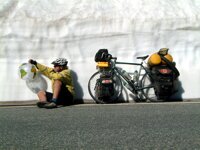
I think I need a better map. Photo Rob Cassibo
G.K. Chesterson’s book “Three Men in Boat” is well known, but he also wrote a sequel called “Three Men on Wheels”, (which is also known as Three Men on the Bummel), with the same characters undertaking another tour, this time through the Black Forest and on cycles. To be honest, I had never heard of it until a couple of months ago when a friend recommended that I read it.
I have managed to track down a copy for my Kindle, but I am not sure that I will like it … although I have read several books from that period, I can’t say that I am all that fond of them … and then cycling always seems to me to be such hard work. Mind you, there are lots of people that enjoy it … it helps to keep them fit and active … and gives them a chance to get out and about and enjoy the landscape in a way that is not possible in the back of a 4WD.
Actually, there aren’t that many cyclists in Kyrgyzstan and as a result, they may attract a fair amount of attention … especially if they are on a tandem. Here in Bishkek, you might come across young people like Maxim on their beloved BMX bikes, and mountain biking is a fairly popular, (albeit minority), sport with the occasional festival and competition.
Kyrgyzstan is quite a good location for mountain biking – after all, over 90% of the country is classified as mountainous.
.

The Daily Telegraph article
I was pleased to see over the weekend that the Daily Telegraph, ( a British newspaper), has picked up on an interesting story about tourism here in Kyrgyzstan. In an article entitled “Ex-Soviet Kyrgyzstan aims to become premier cycling destination“, they described a new project “Bai Issyk Kul“ which, at the moment, is still very much on the drawing board, but if the finance can be found should be a very promising initiative.
The name, “Bai Issyk Kul”, is no accident. It means “Rich Issyk Kul”, but it was chosen because it sounds like “Bicycle”.
For the record: Issyk Kul is, of course, the name of Kyrgyzstan’s largest lake and its beaches make it the centre of the country’s tourism industry with many thousands of Kazaks and Russians descending on it during the short Summer Season. In Kyrgyz, Issyk Kul literally means “Warm Lake” and it got the name not because of the temperature of water, (which cannot really compare to that of the Mediterranean on Turkey’s southern shore), but because the waters never freeze over even in the harshest of winters.
This is partly because of the depth of the water but mainly because, although there are over 80 streams flowing into the lake, there is no outlet and that means that the waters are slightly salty, thus lowering the freezing point. (There is apparently one area of shallow water at the Eastern end of the lake which has been known to freeze occasionally, but it is a fairly localized effect.)
Bai means “rich” and was an honourific title used in the days before the Soviet Union for rich nomads who owned many yurts and sheep. It is still sometimes used, but the version “Bai-ke“, (as in Ian Bai-ke), is more common and is used like “sir” as a sign of respect to an elder.
The aim of the project is to construct a special bicycle track around the lake. There is already a reasonably good road. It’s one of the best roads in the country, mainly because of the annual influx of tourists which demanded better communications than are available in some of the other, more remote areas of the country.
As I understand it, although it is not one of their projects as such, it is connected with a number of initiatives supported by USAID who are trying to help develop the tourism potential of the region. They have been one of the major initiators in the development of Karakol airport, for example, and last year they organized a special cycle “info tour” around at least a part of the lake.
It will probably take some time for the project to be implemented, but if and when it is completed it will make a good addition to the tourist attractions of the region. I am always anxious when we have a group of cyclists either on this road or the main road up from Bishkek. The traffic is quite heavy and can can be very fast. The idea of a dedicated cycle lane, yet alone a separate cycle track, would be very welcome.
.
Although many cyclists prefer to travel independently, there are advantages to travelling on an organized tour in a group in that the participants have to concentrate just on the cycling … the tour company, like us, will arrange to transfer tents, etc., from site to site.
Here are some comments about cycling in Kyrgyzstan which are based on notes that we distribute to clients who enquire about such trips:
It is possible to set up camp just about everywhere in the country – although there are a couple of restricted areas, (at the eastern end of Lake Issyk Kul, for example), and permits may be needed in some border areas, (for example in the Ak Sai valley near the Chinese border).
At some places there are control posts on the road. These could be police check-posts, customs, ecological control posts, the entrance to a park, or even an enterprising local charging a toll for use of the road.
The main roads in Kyrgyzstan are quite good – asphalt, but once you get “off the beaten track” then expect to meet some roads which could not exactly be described as “cycle-friendly”. Although some people ride “touring bikes”, the Kyrgyz Republic is ideal for “mountain biking” … and many cyclists even cycle up to the Khunjerab pass between China and Pakistan – reputedly the world’s highest international road border crossing.
The level of traffic is not very great except in the towns and on the main roads – such as between Bishkek and Lake Issyk Kul, It does however, tend to travel very fast. The speed limit is usually 60km/h in villages and towns, and 90km/h in the country … but not everyone adheres to it. In fact, it sometimes seems that although traffic rules do exist, they are honoured more in the breach, than in observance. As a result it is probably best to assume that the car always has the “right of way”.
If anyone asks, I always say that it is best to avoid cycling at night; as well as the fact that people tend to drive too fast and without observing the “rules of the road”, street lighting tends to be poor – where it exists, that is, but in most places it is non-existent. It is usually better to stop early, before sunset, and set up camp, or simply relax, rather than try to cover those extra few kilometres.
Cyclists should be prepared to encounter snow, especially if they plan to get off the beaten track. For much of the year there will be snow on the passes, although this usually starts to melt in June there will be still be patches and, remembering that Kyrgyzstan is predominantly a mountainous country, it can snow at any time of the year.
Careful planning pays dividends … although it is important to remember to be flexible and leave some room for manoeuvre. To be fair, generally cyclists tend to be well prepared and give us the most detailed enquiries. However, it is probably worth mentioning the following points:
If planning to bring a cycle to Kyrgyzstan by air, then remember to check with the airline if they have any special requirements or regulations about packing, etc.
Most independent and experienced cyclists know this already, but when planning an itinerary there are many things to consider, including:
- The possible weather conditions;
- The distances planned to try cover on each day,
- The road conditions, (asphalt, stone, gravel, dirt … etc.).
- The likely amount of traffic,
- The altitudes on the route and
- The gradients that will have to be negotiated;
- Places to stop for sightseeing, rest, etc.;
- How much weight can be carried on the bike;
Incidentally, for someone planning to cycle “around the world” or on a “In the footsteps of Marco Polo” trip, and who has to get onward visas, making arrangements en route … it is important to remember that there are difficulties getting visas for China in Kyrgyzstan, and that time will be needed for making arrangements for crossing either Torugart or Irkeshtam.
Two people who did the “round the world” trip in 2006 were Bernard Binagwao and Christel Arras from France and you can read about their adventures on here. Amongst their advice they say:
- do not cycle from Bishkek to Issykul take the train as the traffic is awesome and dangerous.
- most mountain roads are in really bad condition so when planning a circuit don’t count on more than 60 kms a day. However the view and landscapes are worth the effort.
- the trip from Barksoon to Naryn via the pass is a must do. If people find the whole trip to difficult they can at least try the 30 to 40 kms along the Eki Naryn which is really spectacular and perfect for mountain biking even beginners.
- Camping is really easy everywhere and accepted so, “don’t hesitate”




 Bishkek