Float like a Butterfly …
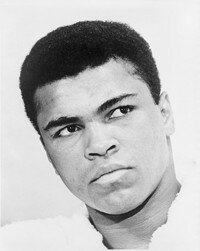
Muhammad Ali
“Float like a Butterfly, sting like a Bee” was the catchphrase coined by Muhammad Ali, (whom I will always think of as Cassius Clay), a three time World Heavyweight Champion who was born on 17th January 1942. He was in many ways is an icon of the 1960′s, a period in which I was growing up. It wasn’t all hero worship; he was both idolised and vilified.
Idolised as a good looking, fit, black sportsman … who showed that race was no barrier to success. Vilified for that name change and refusing to be called up in the draft and take part in the Vietnam War. Elvis Presley had quietly accepted the call and gone off to serve in Germany, but Clay’s refusal to be answer his country’s call would eventually lead to his being arrested, (and found guilty), on draft evasion charges; stripped of his boxing title, and his boxing license was suspended. Although he was not actually imprisoned, he did not fight for nearly four years whilst his appeal worked its way up to the Supreme Court, where it was eventually successful.
To be honest, I am not keen on boxing. I accept that it can be good as character forming, does involve an element of physical fitness and skill and it may represent one way for people in socially deprived regions to find a “way out” and succeed in life, but it always me as odd that the sport involves two people standing in a ring pounding each other in the head, perhaps the most sensitive part of the body. Maybe I am just being super sensitive to the photos showing bruises and contusions on fighters and stories of boxers, albeit relatively few, who have suffered brain damage or worse as a result of their participation in the sport.
Whatever, boxing is a very popular sport here. Kyrgyz boxers have competed in the Olympic Games and other competitions and managed to gain some success and recognition. Amongst the most notable Kyrgyz boxers are:
The Klitschko brothers, Vitaly (a former professional kickboxer and WBD world heavyweight champion in 2004/5) and Vladimir (an International Boxing Federation (IBF) and IBO world heavyweight champion). Although Ukranian, they were born in Belovodsk when their father, a colonel in the Soviet Air Force was based in Kyrgyzstan. Vitaly knocked out each of his first 27 professional opponents – only three of whom managed to survive beyond the first round.
Almazbek Raiymkulov won the provisional NABF (North American Boxing Federation) Heavyweight title in 2006. At that point he had won 23 of his 25 professional bouts – 14 by a knock-out – and losing only one … the other was a draw – but according to some accounts, (not all of them Kyrgyz), it was a controversial decision. He started boxing at the age of thirteen, becoming the Kyrgyz national champion at seventeen, (the youngest holder of the title), and representing his country at the Sydney Olympics in 2000, (where he came fourth in his class), and other competitions. Although his parents wanted him to be a doctor, he turned professional in 2001 and moved to Las Vegas to live and train. He is probably the most internationally famous professional Kyrgyz boxer and is known by the nickname “Kid Diamond” (a version of his name, Almazbek … in Kyrgyz Almaz means diamond and “bek” is a diminutive could translate as “kid”), although sometimes he is klnown as “Doctor Evil”. However, he ran into trouble in the States a short while ago, after a dispute with his trainer, and I don’t think he fights any more.
Oruzbek Nazarov, a lightweight southpaw, born in Kant in 1966, who won a bronze medal in the 1986 World Amateur Boxing Championships in Reno, and went on to become European Champion in 1987. He turned professional in 1990, emigrating to train in Japan, (one of six “elite” boxers from the Soviet uUnion recruited by a prominent Japanese Gym) and reigned as the World Boxing Association, (WBA), Lightweight Champion in from 1993 to 1998, defending his title six times. He won 26 of his 27 bouts; 19 by a knockout and eventually retired from the ring as a result of eye problems. He has occasionally officiated as a boxing judge.
Nazarov’s been in the news here recently, commenting on the state of Sports administration in the country. ”Since independence, Kyrgyzstan has changed the structure of the sports department about 15 times. This is absurd! ” Decrying the fact that the status of sport in the country has been declined, he noted that the government department with responsibility for sport demoted from a Ministry, to a Committee, and now an agency. Regional Sports Committees have been abolished and the sports school closed. There is a real problem of funding when it comes to sport.
As it happens, Bishkek hosts the first major international boxing competition of the year in the Duisenkul Shopokov Memorial Tournament.
(The tournament is named after Duisenkul Shopokov, who was one of the biggest Kyrgyz heroes of the Soviet Union, a soldier, died on November 16, 1941 defending the city of Moscow during the Great Patriotic War as one of the famous Panfilov Brigade.)
This year, the 37th annual tournament will be held in the week week from January 25th to the 30th and competitors from some seven nations will be participating: Uzbekistan, Kazakhstan, China, Iran, Russia and Tajikistan, as well as the hosts Kyrgyzstan. Last year there were 170 competitors from five nations who took part. During the 2010 competition, Kyrgyzstan collected six of the gold medals, whilst Uzbekistan took three and Kazakhstan and the People’s Republic of China each secured one. Kyrgyzstan dominated the 2011 competition as well, and it was the first time that women also competed in the competition. There are high hopes for a similar successful tournament this year, (the President of the Kyrgyz Boxing Federation, Abdibakyt Khalmurzayev, has apparently said that he expects at least four gold medals from the national team), even though at least one prominent Kyrgyz boxer won’t be there as he has other contractual commitments in Moscow.


 Bishkek