Trouble spot Tourism
In a recent postcard I referred to an analysis of the problems facing tourism in Kyrgyzstan at the moment, and concentrated on my concerns about the statistics which he used to open his article.
The official statistics from the National Statistics Committee suggested a 260% increase in the number of tourists arriving in Kyrgyzstan in 2010 compared to those of 2010.
He went on to argue that, “if you believe the National Statistics Committee”, such phenomenal growth is not unusual. He pointed out that the same set of figures shows a similar impressive growth following the 2005 revolution when, apparently, we also saw a massive increase in the number of tourists visiting the country. (For the record: that also happened to be the year they changed the basis of data collection, so year-on-year comparisons are difficult to make and likely to be unreliable.)
Why should there be such an increase in tourist arrivals?
Citing Germany in 1950, (just five years after the end of the second world war; Vietnam following the end of the Vietnam war and Israel despite the constant conflict with the Palestinians, he suggested that in the long run, the negative publicity afforded by the upheavals actually helped to boost the industry.
In both the cases of Germany and Vietnam, it seems to me there is an argument that helps to explain this interest in these destinations … people were interested in seeing the places they had heard of (and maybe where they lost someone – a close friend or relative), or may even be a serviceman revisiting the scenes of his combat service.
Germany is an interesting case, but was a long time ago when travelling and social conditions were quite different from what we experience today.
The author doesn’t give dates, (at least not in this article), for the growth in tourism in Vietnam, but he does draw attention to both the distance of the destination from it markets and the fact that many of those tourists are, in fact, Americans – which would, I think, support the argument I give above.
Let’s not worry too much about Israel, which has special conditions as a Holy Land for three of the worlds major and most populous religions.
It is probably true that the fact that Kyrgyzstan hit the news headlines around the globe at least helped to raise the profile of the country in the public awareness, but will it really help to encourage an increase in the number of tourists?
Now, it has to be admitted that there are some tourists who take delight in travelling to trouble spots be it Iraq, Afghanistan or Kyrgyzstan. Despite the fact that there seems to be something “disturbing” about the voyeuristic nature implied in this form of “Trouble Spot Tourism”, and its relative, “Disaster Tourism”, there are also other reasons why people may be attracted to such a destination.
For most tourists, “safety and security” is one of the most important factors that they consider when deciding planning a holiday. In a recent survey of ski tourists, for example, “a staggering 92%” of the participants said they would back measures designed to improve safety on the slopes.
On the other hand, some people seem to derive some form of kudos from their bravado and chutzpah and apparent disregard for potential danger, (although I doubt that many tour companies would be willing to expose clients to actual danger), and being amongst the first visitors to such a destination.
There may, also, be other perfectly good reasons why people might choose such a destination; they may simply be interested in travelling to places which are “off the beaten track” and where they are unlikely to run into other “tourists”.
Although there is a chance that some people might be tempted to travel to Kyrgyzstan for such reasons, I don’t think there will be many of them, so the effect is likely to be limited and short lived, especially as the situation returns to “normal” and other trouble spots around the world emerge to grasp their attention.
.
On the other hand, the author went on to say that the existence of the troubles which deter potential tourists from travelling to a particular destination is simply a temporary impediment. As the situation settles then a “pent up demand” takes over. People who were put off one year and as a result “postponed” their journey will “be sure to schedule it to the next year”.
There may well be something in this argument, although I would take issue with his phrase “be sure to schedule it next year.” We’ve certainly encountered that situation before, where a tourist has had to reschedule their plans because of a a variety of reasons: a revolution, for example, or an illness.
On the other hand, a tourist who was thinking of travelling along the Silk Road but decides to put their plans “on hold” because of the political or social situation in their destination or along the route, may alternatively decide to “cancel” and not simply “postpone” their plans. They may “miss the moment” and next year be attracted to a different destination … London for the Olympics, for example?
Once again, however, this “pent up demand”, (if it does indeed exist), may well go part of the way to help explain an apparent recovery in levels of tourists arrivals, but the effect is likely to be limited and a “one off”, short term character.
.
One of the things that worries me the most about this analysis is it that, (even if it is a fair description of an observable phenomenon), it seems to suggest that the phenomenon is an inevitable feature of such political and social disorder. If it is indeed a natural trend that is to be expected, then there is an implication that we don’t have to do anything except sit back and wait for the figures to recover.
That, however, would be a big mistake!
The phenomena is not something that we can rely upon as inevitable and, as I have argued, even if it does occur then it is likely to have only a limited and short term, (“one off”), effect.
It is certainly not a recipe for the development of the industry.
One of the things that we shouldn’t be tempted to do is to bury our heads in the sand and ignore the situation, (neither what has happened nor what we need to do in order to protect and grow our business), hoping and relying on a backlash effect which may, or may not, be forthcoming. We have to be proactive and redouble our efforts to try and build on the greater name recognition that may exist as a result of our exposure in the news.
To be fair, the author acknowledges this, saying that, ”no tourist market develops in a ‘natural’ way, that is, without the direct intervention of the state …”. He goes on to make several points about the absence or ineffectiveness of state intervention … but more about that on another occasion.


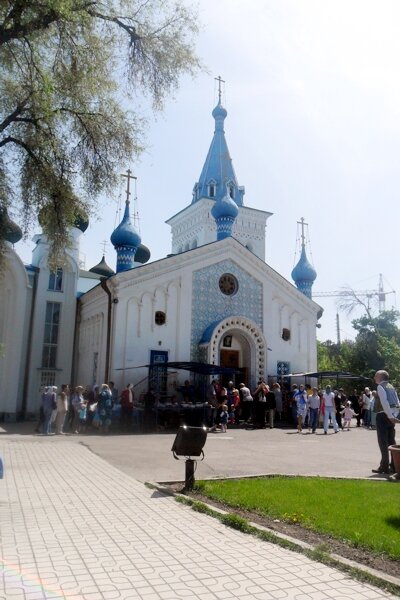

 Bishkek