Which way is North?
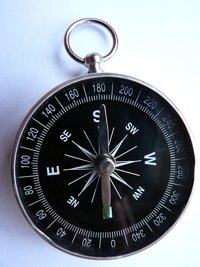
Compass
Some time ago I was invited to a little get together in a private apartment.
Like most of the guests, I had never been therefore before but our host had, very thoughtfully, provided us with a map showing the location of the apartment in relation to the nearest crossroads, which happens to be one of the well known intersections in the city center. This was rather welcome as I have had unfortunate experiences trying to find buildings in Bishkek before, given just the address,
Unfortunately, they forgot one thing: in Bishkek, maps often have the mountains at the top … and the mountains are to the South of the city. True to British tradition, they had placed North at the top of the top of the map.
That caused me a certain amount of confusion.
I arrived at the crossroads nearest the apartment where the gathering was to be held, and duly turned down the side road as indicated on the map, (or at least, as I thought was indicated on the map), and crossed to the side of the road where I expected to find the multi-storey apartment block as indicated on the map. I stopped and looked around me. Where was the block of flats? Here where I expected to find a substantial building was a two storey building, and an unfinished construction site.
Confused, I reached into my pocket for the map, and perused it carefully. That wasn’t easy because it was already quite dark. I walked on to find a street lamp, (one that was working, that is), in order to shed some light on my dilemma.
Under the glow of a street lamp I studied the map carefully. Yes, I was on the right street, and at the right crossroads. So where was this block of flats? I was standing in front of the spot indicated by the notorious “X” which is supposed to mark the spot, but there was no apartment block. I reached for my mobile phone and was about to dial the number of the invitation when I noticed that my host had thoughtfully provided a small arrow on the map, with a capital “N” above it, to indicate the orientation.
I had missed this when setting out from home and made the mistake of assuming that it was like all other maps of Bishkek with North being at the bottom of the page, and not at the top. Now, however, I understood, crossed the road and headed South, up towards the mountains, crossed the main road and there I found … a multi storey apartment block … just where the map indicated I would find it.
Feeling somewhat foolish, I made my way in through the door and to the lift which took me up to the sixth floor as indicated on the invitation. I couldn’t help wondering as I pressed the number “6” in the lift, if my host had persisted in following British custom and practice when numbering the floors, (as he had on the orientation of the map), or if he had fallen in with local practice. In Britain, we call the street level the “Ground Floor” and the one above it the first floor … here the first floor is found at street level and the one above it is called the second floor. If he was still following British custom and practice then I was going to have to climb one more flight of stairs.
Fortunately, as the lift doors opened, I could hear the murmur of the other guests through the open door of the apartment just across the corridor and I assumed that this must be the place. Indeed, it was!
I had expected to be amongst the last to arrive having spent some time trying to locate the apartment, but I need not have worried. True to local tradition, timekeeping was not a matter of paramount importance and, although the guest of honour had arrived, many others were yet to wander in.
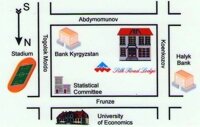
A "South-up" showing the location of the Silk Road Lodge - Notice the arrow
As I thought about this experience afterwards, apart from being embarrassed at my mistake, (a simple oversight, I maintain), I reflected on how it revealed that, (having lived here more than sixteen years), I have become accustomed to many of the little things about life here in Bishkek that at one time I found perplexing, quaint and quirky.
To be honest, it took me some time to realize that the city maps of Bishkek had South at the top of the page. It wasn’t something that I had to think about, until one day I had to head to the Western Bus Station. I found it on the map and walked “down”, (literally – downhill, away from the mountains, and also “down” towards the bottom of the map), and headed towards the street called Jibek Jolu, (which means “Silk Road” in Kyrgyz), and then instinctively turning right and expecting to be facing West.
I had walked a couple of blocks before something struck me as “not quite right”. I was heading towards Sovietskaya, but shouldn’t I have been walking in the direction of Molodaya Gvardia? Fortunately, I had a map with me; it was the early days, and I still didn’t know my way around town and I found a map a useful thing to carry with me. So, I took it out and cast a glance at it. Yes, I decided, I was definitely heading in the wrong direction, so I turned round and set off again.
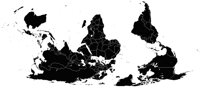
An "Upside Down" map of the world
Maps of Bishkek aren’t the first “upside down” maps, (also known as Reversed Maps” or “South Up” Maps), that I have come across. Back in London, a friend of mine from New Zealand proudly displayed in his kitchen a copy of MaCarthy’s Universal corrective Map of the World. (It’s copyright so, unfortunately, I can’t display it here, but you can see it here, click on the picture and you can see a larger version). The text, which is too small to read here, tells how certain people think they are so superior because they appear towards the top of the page in the centre of the map, and with cheeky “downunder” “Aussie” humor he decided to correct this viewpoint. It always struck me as amusing as on his map, New Zealand was also in the center of the map and was placed higher than Austarlia, but we’ll let that point pass.
For the record: The story is that Stuart McArthur, who comes from Melbourne in Australia drew his first upside down map for a school assignment when he was just 12 years old (in 1970). His geography teacher told him to re-do his assignment with the “correct” way up if he wanted to pass; a typical unimaginative schoolteacher! Three years later he was an exchange student in Japan and he was taunted by his exchange student-friends from the USA for coming from “the bottom of the world.”
In fact, there is no particular reason why we traditionally place North at the top of a map, the convention seems to have begun only a few centuries ago when navigators from Europe, (in the Northern hemisphere, of course), began using the Pole Star, (the North star), and the magnetic compass. There was a tradition before that, which put East at the top of the map, which is where the word orientation comes from.
Although MaCarthy may have been employing downunder Aussie humour, there may a serious point to this. There has been some psychological research which suggests that we may indeed have a tendency to associate the top of the map (North) with notions of good, or better. In common jargon, for example, “gone south” means “screwed up ” or “crazy”, and is used to describe a failure, loss or bad experience, (although I am told that in the Southern States of America it is a synonym for “dead”).
In the case of Bishkek, however, the use of an upside down map seems perfectly prosaic and even logical. When giving directions, we often talk about Verk and Vneez, Up and Down; up towards the mountains and down, away from them.


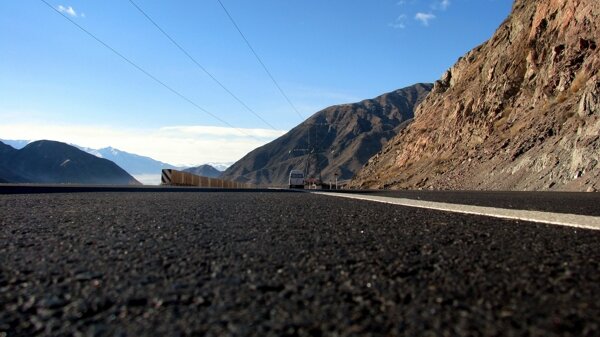




 Bishkek