Roads
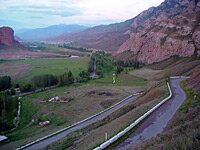
A serpentine road ascending to a mountain pass just outside Naryn
There is a short stretch of road up in Naryn which is remarkable.
Remarkable for Kyrgyzstan in that it is smooth and comfortable; free of potholes and undulations and with clear road markings and clean bright road signs. It was constructed by the University of Central Asia as it skirts the site of their planned campus. Shortly after construction people would come to marvel at it.
When I first came to Kyrgyzstan there was a lot of talk about how bad the roads were in the country, and although there are problems with the condition of many of the roads, I never really agreed wholeheartedly with this point of view. Many of the trunk routes were reasonable, albeit not as smooth as we might be used to in the West, and once you got off the main roads and into the mountains then the roads were not asphalt, but they made access to some of the more interesting remote regions possible.
The mountains divide the country up into several distinct regions – and travel between them is limited by the number of routes available.
For the record: There are about 36000 kilometers of roads in Kyrgyzstan – but not all of them are asphalt, (I have seen some statistics that suggest that some 91% of roads in the country are paved – but sometimes it may seem difficult to credit this – another source suggests that only 18000km are paved), and some of those mountain roads, in particular, may be rather difficult at times.
In former times, many high mountain passes (e.g. Kegeti or Sokoluk) may have been cleared by snow plow in late spring – but this doesn’t happen now, restricting the already limited number of available routes. Snow can fall in the mountains in every month of the year and close a road for several days. Some roads are closed throughout the winter period. For example, the Kazarman-Djalal Abad road is closed for eight months of the year, and even though some road works were undertaken to cut this to just six the road is still impassable for much of the year.
There are considered to be 22 “main” roads … but the really vital routes are: Bishkek–Osh; Bishkek–Naryn–Torugart, and around Lake Issyk Kul.
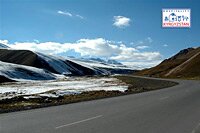
KCBTA postcard featurin the Bishkek-Osh Highway
The Bishkek-Osh road is a relatively new one, but for a long time the condition of the surface was not good and many drivers were reluctant to drive it, preferring to drive the much longer route around the mountains – through what is now Kazakhstan and Uzbekistan. The road, however, underwent reconstruction and now provides a good route between the Northern and Southern parts of the country – although it still takes virtually a whole day to travel the entire 700 kilometers between Osh and Bishkek.
Travelling from Bishkek to Issyk Kul, there is a choice of route, at least for the first seventy odd kilometers. The “old” main road one passes through a number of villages but the “new” road, built sometime in the 1960s, bypasses them. This “new” road is dual carriageway and runs parallel to the Chu River, which forms the border with Kazakhstan for much of its length. (In fact, at one point you cross the river into Kazakhstan – but only for a short distance and you don’t need a visa). This is part of the main route to Torugart which has recently been undergoing renovations, reconditioning and widening, and noticeable improvements are already visible even though the work is not yet finished.
The road around Issyk Kul was heavily used in summer months by tourists arriving to relax on the beaches around the lake and the Kumtor Gold Mine up the Barskoon Valley provided another incentive for creating good road communications.
There is a chance that we will see more work done on improving the trunk roads in the country because, recently, newly elected President Atambaeva instructed the Ministry of Transport to consider utilizing Public Private Partnerships, (PPP), to create additional “parallel roads”, possibly “toll” roads, which would be high quality, well maintained routes for the transport of goods through the country. He cited some examples of where such roads are needed, such as bypassing the enclaves of Tajikistan and Uzbekistan in the Ferghana Valley. However, road construction is not only an expensive business, it is also a long and time consuming one, so it may be some years before these become a reality.
.
Several of the minor roads in remote mountain areas are not “on the balance” of the Ministry of Transport – in other words they are the equivalent of ”unadopted roads” – they are not maintained by the authorities and so the condition of the road can be variable. For example the road to Tash Rabat is one of these roads and when the bridge was washed away in a flood several years ago – there was no-one responsible to repair it. As a result it was necessary to ford the river until funding was found to repair the bridge.
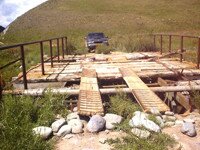
A bridge in the mountains
Bridges are actually quite important - they provide a vital link for the population of remote mountain regions, for transport and travel, communication and commerce. A Swiss Association (Pamir Bridges – www.pamirbridges.ch) has been set established by people who have visited the country every year since 1992 to help support the local populations be arranging for the renovations of a number of bridges throughout the Tien Shan mountains (in Tajikistan and Kyrgyzstan).
Even if a road appears on a map – there is no guarantee that it exists in practice. Many maps of the country still show the A364 road which looped from Karakol, through Enilchek, Ak Shyyrak, Yshtyk and KaraSai to the Barskoon valley and the Southern shore of Lake Issyk Kul – but in the early 1990s a couple of bridges collapsed and have not been repaired …
Another example is the road through the Kegeti valley between Tokmok and Kochkor through Kegeti … although it is possible to travel a long way along this road – it is not possible to complete the journey any more. In the Soviet period it was cleared of snow every year – but this no longer happens and so the highest mountain passes are traversable for a short period at the height of summer … but as you approach Kochkor, the road is washed away and blocked at a crucial point forcing you to turn back.


 Bishkek