The National Library
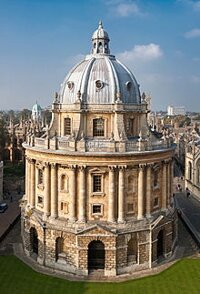
The Radcliffe Camera - Part of the Bodleian Library, Oxford
On November 8th, 1602, the Bodleian Library in Oxford opened it’s doors for the first time.
One of the oldest libraries in Europe, and the second largest in the UK, (after the British Library), its history goes back to collections which started in the fourteenth century. It takes it’s name, however, from Sir Thomas Bodley, a fellow of Merton College, who sought to revive what had been become a depleted repository and donated many of his books to the collection.
Although I didn’t use the library much when I was a student in Oxford, we had a pretty good library in college. I do remember, however, visiting the Radcliffe Camera, (one of the iconic sights of Oxford), to track down a particular volume on one occasion; how we gathered in the library before my graduation ceremony, which took place in the nearby Sheldonian Theatre, and being taken to register and receive my library card and having to swear the time honoured oath:
I hereby undertake not to remove from the Library, nor to mark, deface, or injure in any way, any volume, document or other object belonging to it or in its custody; not to bring into the Library, or kindle therein, any fire or flame, and not to smoke in the Library; and I promise to obey all rules of the Library.
(This is apparently a translation of the traditional Latin oath – the original version did not include the prohibition on smoking tobacco). I don’t have it any more, but I kept my Readers card, which had the oath printed on the back, as a “souvenir” for a long time after graduating.
Nowadays, the Bodleian is one of six “legal deposit” libraries, entitled to receive copies of any book published in the United Kingdom. Here in Kyrgyzstan we also have a “Deposit Library” – the National Library, on the corner of Sovietskaya and Frunze streets in downtown Bishkek.
In the years since it was founded in 1934 it has become one of the major repositories of culture in the country.
The first public library in what is now Kyrgyzstan was established in Karakol, but by 1934 there were several such institutions around the country. In May, 1934, the People’s Commissars decided to create a Republican State Library, by merging two such libraries, the Frunze Central Library and the State Scientific Library. Donations of books were received from libraries all over the Soviet Union, (including some 16,000 from Belarus), and there were some 700 registered readers and 13 employees when the doors of the new institution opened in August.
During the war years, when Kyrgyzstan received many factories and institutions evacuated from the West, the work of the library expanded considerably: staff organized a series of smaller libraries in hospitals and military establishments: attendance rose from a pre-war figure of about 250 people a day to between 600 and 700 and a research department was established to support this increase.
Following the war, work on extending the bibliography records started during the expansion continued and the Library began training to support the staff from regional libraries. During the mid 1960’s, when the library moved into new premises, there were over 45,000 readers.
Then, in 1984, to mark it’s 50th Anniversary, the National Library moved into its present home on Sovietskaya Street.
Following Independence, a lot of work has gone into updating the technological resources.
Its public mission of the National Library is the:
- promotion of science, culture, education and other spheres of society;
- provision of free and equal access to domestic and international information resources;
- develop a national information space;
- preservation of documentary heritage of Kyrgyzstan;
- integration into the global information space.
and this translates into the following tasks:
- acquisition, storage and providing access to the complete collection of national documents, as well as the extraterritorial publications, which have a direct or indirect relation to Kyrgyzstan;
- providing for the formation and use of the stock of domestic and foreign publications necessary for the development of the state, society, science, culture and education in the republic on the basis of exhaustive acquisition and storage;
- providing permanent storage, restoration and preservation of library collections;
- organizing the search for and purchase of Kyrgyz books and manuscripts, both within the country and abroad;
- providing scholarship and publication of library collections through a system of directories and files on various media;
- providing a national exchange-reserve and reallocation of underutilized literature;
- organizing the storage of literature of scientific, technical and cultural value;
- organizing the library and bibliographic information service for the use of readers and subscribers, ;
- organizing information and reference and bibliographic services for Kyrgyz readers living outside the country;
- as the centre of the national bibliography, collecting the most complete current and retrospective bibliographic information about domestic and foreign publications of the country, establishing and maintaining a unified catalogue of “Kyrgyzstan”;
- ensuring the creation of an automated information-library system in the country;
- serving as a leading scientific research, scholarly and methodological institution in the field of library science, bibliography and book science;
- conducting sociological and marketing research relating to all aspects of library activities;
- carrying out international co-operation of library services and serving as the national centre for international book exchange and subscription;
- promoting the development and implementation of state policy in library development within the Republic;
- organizing the training of library staff, and participation in continuing professional education.
In short, the library collects copies of all literature published in the country, as well as a variety of publications from other CIS countries and further afield. There are a total of over 6 million documents, (books, magazines, newspapers, sheet music, records, patent and other reference documents and some 97000 Doctoral dissertations, private papers of several prominent people) in 89 languages – including:
- a copy of the first book ever to be printed in Russian – “Apostol” which was printed in Moscow in 1564.
- a collection of of 74000 items written in foreign languages – mainly reference literature: encyclopaedias, dictionaries, directories and biographies
- a collection of miniature books – the smallest of which measures only 5cm by 3.5cm.
- books in Kyrgyz written in Arabic, Latin and Cyrillic scripts – reflecting the various changes that have taken place in the transformation from an oral, nomadic tradition.
There are some 120 thousand items added to the stock every year.
The fourteen reading rooms can accommodate upto 600 people. During a year there are about 200,000 visitors and the number rises annually. About one and a half million books are issued on loan to readers – including books obtained by international inter-library loan. There is a special reading room, (the German Reading Room), which is supported by the German Embassy and the Goethe Institute which houses a collection of books in German and organises a number of joint events each year.
The building also hosts a number of exhibitions and conferences every year, and offers a number of other services such as internet access – although the rise in the number of internet cafés in Bishkek means that there are plenty of places to check email for anyone who doesn’t have access at home.
The Library has a website, (www.nlkr.gov.kg), which is supposedly in Russian, Kyrgyz and English … but, at the moment, if you click the British flag you are greeted with the message “No Translation available” against all the posts.
For about 25 years it has published a directory of “Literature about Kyrgyzstan” – in Russian and Kyrgyz.
One of the major tasks facing the staff at the current time is cataloguing the vast array of material that it has in its collection.
The blue spruce trees in front of the building were apparently planted by visiting writers and artists including: Arthur Miller, James Baldwin and Peter Ustinov.
Outside the museum is a statue of Osmonov, a Kyrgyz Poet. He also appears on the 200 som note.
In the small park area behind the National Library, hidden amongst the trees is the statue of Dzerzhinsky. It bears no name or inscription. At one time this stood on a plinth in Oak Park, at the foot of the upper part of Prospect Erkindik. At that time the Avenue was also named Dzerzhinsky. His statue replaced that of Lenin when that was moved into the main square – and was in turn replaced by the monument to Erkindik. Rather than lose the statue, it was relocated here. As a young boy he shot his sister – but in some accounts it was his brother that was responsible for the girl’s death. He was a religious youth and even entertained the idea of joining the Jesuits. However, he then took an interest in social justice and so became involved in revolutionary politics and became one of the leaders of the Socialist parties of Poland and Lithuania. Active in the 1905 revolution, he organized strikes and worked amongst the military. Later he was arrested and imprisoned several times – and contracted tuberculosis. He was active once more in the 1917 revolutions and later in the Polish Communist Party. However, Dzerzhinsky is probably best remembered as the founder of the NKVD – the forerunner of the KGB.





 Bishkek
Interesting, but I don’t believe still gets 200k visitors