Jumping into the void
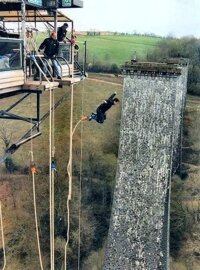
A bungee jump
Today happens to be the anniversary of the first parachute jump using a “modern” parachute; that is one using folded silk rather than linen stretched across a wooden frame as in Leonardo Da Vinci’s famous sketch. That was as far back 1797 when André-Jacques Garnerin made the jump from 1000 meters above Paris. The concept had already been proved as viable with drops carrying dummies and a dog and the first ever successful manned jump was by Louis-Sébastien Lenormand on Boxing Day some fourteen years, earlier, (in 1783), when his hot air balloon ruptured and he had to jump to escape using a Da Vinci type device.
(Incidentally, although Leonardo is usually credited with “inventing” the parachute, his sketch, (which is dated as being drawn in 1485) was not the earliest one; the British Museum has an anonymous sketch which is apparently dated from the 1470’s.)
Garnerin held his parachute in his hands, which he threw out as he jumped. In 1894 some Germans, Hermann Lattemann and his wife, tried putting their parachutes into bags and although one of them was successfully deployed, the other failed to open and Hermann fell to his death. The “knapsack” parachute that we are familiar with today was a Russian invention, patented in 1911.
Although I have never done a parachute jump,I do know some other people who have, like Jean Coulter who last year did a sponsored jump to raise money for the Karakol orphanage, and my cousin Tim, who apparently loves sky diving. On the other hand, if I thought of emulating their exploits, then the experience of Valerie, (one of my acquaintances here in Bishkek, who broke his leg and spent several months in plaster and on crutches as result), is probably enough to dissuade me from giving it a go.
I also know some people who have done some bungee jumping. Now, I have been tempted to have a go at that.
When I visited Moscow in 1994, I had an afternoon to myself and went for a walk in the famous Gorky Park. Despite the fact that it was the middle of August, it was really chilly and overcast. I felt really pleased with myself because I was beginning to recognize a few words in Russian, and able to say a few phrases like “One, please” when buying the entry ticket.
I also remember being amazed at just how huge Gorky Park is, quite unlike its namesake here in Bishkek, which is basically just a square with a statue of Alexei Maximovich Peshkov, (who is better known as Maxim Gorky). As I walked through the park I saw a tall crane in the distance and wondered what construction project they had going on, but as I drew closer I saw that it was, in fact, set up as a Bungee Jump. I thought to myself how I would love to do that … and here I was, alone in the middle of a foreign city with nothing to hold me back. No friends telling me not to be “so stupid”, or to laugh as I screamed “No, No, I can’t do it!” with fright and climbed down. I summoned up all my courage and made up my mind; I was going to “have a go”.
However, my luck was out, (or as my friends would probably have said, my luck held), because the place was closed. So, I turned away and walked dispiritedly back to the hotel. I doubt if I will ever have the chance again and as a result I will never know if I really could have gone through with it.
Yes, I am beginning to feel my age!
So, here we are with just over a week to go before the Presidential election and, yes, sometimes it does feels a bit like standing on the edge, waiting to jump into the void, feeling a little unsure and placing all our faith and hope in the parachute or the bungee rope.
The Prime Minister, Atambaev, is still considered the front runner. One survey apparently puts his support at something approaching 60% and in the event that he is able to achieve that on polling day, then a second round of voting will not prove necessary. Unfortunately for him, other polls put him with less support and suggest that we will have a second round. According to the published figures, he has used most of his election fund and is easily the biggest spender, spending almost double his closest rivals Adakhan Madumarov, (who scores 15% support in the survey), and Kubatbek Tashiev, (who gets 10% in the survey – everyone else, all of whom have spent much less, scoring somewhere round the 2% mark).
There are two other problems for the leading candidates – there seems to be more attention given to alternative solutions: firstly, as one report it, “To vote, or not to vote? That is the question.” It might not be such an important obstacle to overcome, however, because those same surveys suggest that almost 80% of the electorate do intend to cast their vote. Apart from the author of that particular article, however, at least one other commentator seems to think that electoral apathy seems to have set in.
Then there seems to be some discussion of the “Against All” option being chosen. It might seem an attractive option to tick that box on the ballot paper for those who feel cynical about the nature of politicians – especially after some of the antics that we have seen in the parliament. It is said that the majority of people don’t like the present system as it seems to be chaotic, and that a return to strong leadership provided by a Presidential rule rather than current factional parliament would be better. If this “Against all” option proves to be the most popular one, then the election is deemed invalid and we have to hold another in which all the current candidates are ineligible to stand. Although that seems logical, it would present an interesting but difficult question as to which political heavyweight would remain to stand in the next election? One suggestion that I have seen mooted is that Roza Otunbaeva would then be free to stand and might just get enough support to unify the country. Still, that’s all hypothetical and, I think, unlikely to happen. Most people just seem to want a result and to settle down to a “normal” life.
Whatever, the campaign has just over a week to run. Apart from the posters and TV campaign slots, there have been a series of Presidential election debates broadcast live on TV. I admit that I haven’t seen any of them, but I have seen the running commentary on Twitter and the analytical pieces in the press – none of which seems to be very positive. Some people are saying that they are not debates, but more like a “show”, and even then as not being very effective with comments like: “As a viewer I have not received enough information about the programs and actions of future candidates.” The overall feeling seems to be that they have reflected the campaign as a whole as being a bit of a damp squib. Some people are saying that this is because Kyrgyzstan has no democratic tradition to fall back on, but I think the number of candidates and the lack of distinguishing policies between them may have been a more important factor.
All this uncertainty is probably a good an indication that politics is not the key issue at the moment. People are more concerned with the economy. Even more so than with security.
The question of security is still, however, a concern. There are suggestions that dissatisfied voters could cause problems, especially if they think that the results are being falsified in any way or “administrative resources” are used to the benefit of one or another. There are also concerns that militants might seize the opportunity to create havoc, but if last week I referred to the question of journalistic standards amongst the Kyrgyz media, this week saw an interesting broadside addressed at the Washington Times about an article it ran concerning possibility of extremist and terrorist outrages in Kyrgyzstan during the election period. What’s more there is lot of international support being poured into the country, from international observers to military equipment from Kazakhstan.
One thing that might upset the applecart is that a number of cases against members of the former regime, for things like “the abuse of power”, have resulted in not-guilty verdicts. The really high profile cases are continuing, although some have been postponed, indefinitely, or extradition from foreign countries has been refused.
Another, that might cause a headache for Atambaev’s campaign in particular, is that it seems many teachers have not received their salaries for September, yet alone the much vaunted salary increases that they had been promised.
Despite all the uncertainty of what will happen next, life goes on. The parliament has been busy debating the state financing of political parties, and a law regulating the activities of the president, (which now goes out for public discussion), and they have amended the rules once more concerning the granting of licenses for the mining industry giving a greater role for various bodies to be involved in the process and adding new costs that have to be paid.
There was also a problem with a law which would privatize one of the TV channels that is considered part of Maxim Bakiev’s financial empire. Roza Otunbaeva wouldn’t sign it into law because she said it didn’t provide for the financing, but the parliament passed it in the same format at yet another reading, overriding her veto and the Speaker duly signed it as provided for in the constitution and so it is now law.
There has been a whole host of important visitors to the country this week. The British Minister for Overseas Development was here at the end of a “grueling” two week tour, but I am afraid that he was outranked by the Foreign Minister of Pakistan, the Speaker of the Iranian Parliament and the Prime Minister of Kazakhstan. Each, of course, had their own issues to discuss with the Kyrgyz government. Amongst other things, the British were discussing their aid portfolio; the Iranians the question of a Bank registration currently being withheld by the National Bank, (and incidentally, if one news report is to be believed that case may lead to the National Bank suing the Speaker of parliament over comments he has made about the case); for the Pakistani’s there was the question of the seat on the UN Security Council and the Kazakhs investment policies and Kyrgyzstan’s possible entry in the Customs Union.
This last point is hanging over us at the moment like a sword of Damocles. Kyrgyzstan submitted an application to join some time ago and it looks as the Union is willing to accept us as a member, but there is a lot of debate concerning the pros and cons of membership. In something of a surprise move, even strong supporters of membership, if not the prime movers of the application, Atambaev and his deputy, Acting Prime Minister Babanov, have admitted that there are problems that need to be sorted out before joining. Kyrgyzstan has to consider its position says and Babanov went so far as to say that Kyrgyzstan is not ready to join yet. That doesn’t mean they have changed their minds, just that they recognize that there is still a lot of preparatory work to do. Indeed, Babanov has since gone so far as to say that Kyrgyzstan has “no other way out” than to enter the Union which represents something like 44% of Kyrgyzstan’s international trade. Perhaps they are preparing the population for the fact that there will be some problems and negative effects to Kyrgyzstan’s accession. Perhaps that is to address the opposition to the move which seems to be becoming more vocal, but I think it is more likely that the “penny is dropping” that the short term prospects of membership could mean difficult times ahead. However, staying out of the Union would also be difficult. It seems to be a case of “Heads you win, Tails we lose”. During his visit here this week, the Kazakh Prime Minister has been saying how they see it as an important and “sensitive” issue as well. If we do go ahead, however, then Tajikistan’s accession will be next on the agenda and Vladimir Putin’s new EEC, (The Eurasian Economic Community – not the European Economic Community that we used to debate back in Britain in the 1970’s and 80’s), will come one step closer to being realized.
In the meantime we’ve signed the agreement to enter the “CIS free trade zone” which consists of most of the countries of the former USSR and should give Kyrgyzstan access to a market of 250 million consumers on favourable terms once the agreement has been ratified by parliament.
With the surprising news of the week – the death of Colonel Gaddafi – came a question from one blogger: why is it that on ALA TV, (the local Cable TV service), there is no news channel. That’s because they are all foreign services and have been blocked for the period of the election to avoid Russian TV coverage having a distorting effect on the result. Although the event was covered, in the local news, we missed the wall-to-wall coverage that was available elsewhere in the world.
In the West, of course, there is currently an assumption of the public’s right to know – hence the Freedom of Information laws that many countries have adopted. There are always questions, of course, about what information relating to security should be released into the public domain. The GKNB, (the successor of the KGB and the Kyrgyz security services), and the Ministry of Finance have apparently entered into a fight about whether the security service budget should be made public or not.
We seem to have a problem with forged banknotes becoming more frequent and the National bank has urged everyone to check the various security features.
Two relatively major stories remain that turned out to be disappointments:
The first is the fact that Kyrgyzstan dropped three places in the World Bank’s Doing Business survey, having achieved an impressive improvement in the rankings in previous years. Now we are sandwiched between Belarus and Turkey.
The second relates to Kyrgyzstan’s pursuit of a seat on the security council of the United Nations. In addition to the five permanent members, some ten countries are elected for a two year term, five being elected each year. The seats are allocated regionally and this year Kyrgyzstan pit itself against Pakistan, (which has already served a number of terms), for the “Asia seat”. This has been one of the country’s foreign policy aims since 1997, although it’s the first time it has actually put itself forward as an actual candidate. It was always recognized that it would be difficult to obtain the necessary 127 votes to achieve a seat on the council but the feeling was that, maybe this year Kyrgyzstan might be able to do so; some commentators suggesting that the presence of the Manas Air Base might have been a bargaining ploy, others pointing to the presence of a female Head of State and her democratic credentials whilst yet others to the support apparently pledged by France by others. Well, it wasn’t to be. The election took place yesterday and we’ll never know who voted for Kyrgyzstan because it was a secret ballot, but Kyrgyzstan but could only muster 55 votes against Pakistan’s 129, so Pakistan won the coveted seat.
Finally, my interest in statistics was rewarded with a number of specific examples during the week. Apart from those already mentioned:
Apparently, over nine million people and more than one million vehicles crossed Kyrgyzstan’s borders in the first nine months of the year. Apparently, however 28 people were denied permission to cross the border and turned back, 361 people were deported from the country, almost 2000 people had improper travel documents and 215 people were arrested for various violations,. The border troops found eight weapons and 52 pieces of ammunition, over 55 kilograms of drugs and smuggled goods to the value of over 30 million som.
Then there was the news that international trade managed to increase by about 35% over last year’s figures, (although it’s not clear to me what affect the problems we have been experiencing with the borders may have had on this figure). The bad news is that whilst exports rose by a creditable 32%, imports rose by 36%, resulting in a growth in the overall Balance of Payments deficit of almost 41%.
Despite the problems facing the mining industry, which has led to mounting criticism of the responsible Minister, Kyrgyzstan actually produced over 14 tons of gold last in the first nine months of the year; an increase of 9% over last year, (and another one and a half tons are expected to be produced during October). There seemed to be something wrong with the news report, however, which said that one company, (Kumtor), produced most of it and the gold was valued at 31.4 billion soms, whilst another company produced just under 400 kilograms which was worth 35.7 billion som.
- – - – - – - – - -
Postcard from Bishkek: the weekly postcard that I send out as an email also gets posted on the website, www.iank.kg each week – and there are other postcards which don’t get sent out. This week for example there were posts about: Ala Kachuu – the tradition of kidnapping a bride; Kojo Moe – a apparently new trend in Tourism, visiting industrial sites; The Snow Leopard, Kyrgyzstan’s only remaining Big Cat, known locally as Bars; some thoughts about film trailers and Destination Marketing; The Kyrgyz mini epic of Er Toshtuk, a Kyrgyz Orpheus who descends to the underworld; and a look at the phrase first rate and it’s connection with Trafalgar Day. I’ve also updated the page on Alymbek Datka having come across a series of articles which included some more details on his life.
If you decide that you don’t want to receive these postcards in your email anymore, please drop me a line to and I will take you off the distribution list. Alternatively, if you know someone who might be interested in being added to the mailing list, then get them to drop me a line and I’ll be happy to do so.




 Bishkek