City Street Traffic
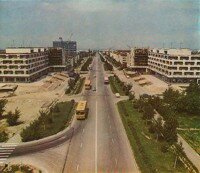
"One of the city's main streets" - 1978
The other day I met an old friend, from Kyrgyzstan, he is someone who has been living out of the country for something like eight years. He has been back twice in that time and was on his third visit home when he called me and asked if I would like to meet for a drink. I was happy to agree and we fixed a time with no difficulty, but when it came to choosing where to meet, he asked if we could meet on the crossroads outside my office. I smiled to myself when he explained, “I have been away and don’t know my way around the city any more.”
I had to admit that I had a similar problem last time I was in London, in 2005. It was five years since my previous visit but there seemed to have been a lot of changes in the intervening period and although, at times, everything seemed so familiar, there were other times when everything seemed strange and foreign to me. In a way, I didn’t feel at home. Bishkek is now my home.
What’s more, I even find myself often surprised here in Bishkek. New buildings seem to be cropping up all over the place and I often find myself doing a double take as we drive down a road that I thought I knew well, as I see some newly constructed edifice. In one particular case, I was taking a friend to see one of the few remaining wooden Russian houses left in Downtown Bishkek, just a couple of blocks away from my office, and I stood dumfounded looking at a massive new apartment and Office block standing on the site where the colonial house once stood. It had gone now, of course. Demolished, in order to make way for “progress”. I can’t help admitting that I felt a pang of sorrow.
It’s not just the new high rise buildings that have brought about a change in the feel and appearance of Bishkek.
When people hear that I have been here in Kyrgyzstan for over sixteen years they often ask me what changes I have seen in that time. Of course, as is often the case in life, many of the changes we experience occur gradually and creep up on us almost unawares. It is only when we stop and cast our minds back to the way things were, that we realize the scale of the changes and innovations that have taken place.
.
My usual answer involves: vehicles, cafés and restaurants and, of course, the buildings.
In all three cases there has been a vast increase. In the case of restaurants and cafés, it’s not just the number that has increase but also the variety. As I wrote in another recent postcard, in addition to the traditional Russian, Central Asian and all embracing “European” cuisine, it’s now possible to find Pizza parlours, fast food joints offering Hamburgers not to mention Sushi. There are restaurants that specialize in Armenian, Brazilian, Chinese, Dungan, Georgian, German, Indian, Japanese, Korean, Lebanese, Mexican, Moldovan, Turkish, and Ukrainian cuisine. I think that this is a positive sign. Not only does it offer a wide variety of choice, but it is an indicator that, at least here in Bishkek, there are people with a disposal income that they are prepared to spend on dining out.
The main difference, however, has be the traffic on the roads. When I first came to Bishkek, for a holiday in 1994, there was very little traffic on the roads. A friend of mine used to joke that you could safely cross without looking because you could hear approaching vehicles. One of my favourite pictures of Bishkek comes from a “photoalbum” published in 1978. The caption reads: One of the city’s main streets.” The road is virtually clear of traffic – just four buses and two cars. There are also parked cars visible. A photograph of the same street today would present a vastly different picture.
There has a huge increase in the number of vehicles on the city streets.
Once again, there is a positive aspect in this trend. Although many of the vehicles on the road are commercial, (belonging to a firm), or official, (either government or one of the donor agencies), there are a large number of private vehicles. The quantity of vehicles, variety of make and model, are all indicators that there is money in Kyrgyzstan – families with disposable income that they choose to spend on buying vehicles.
On the other hand, there are distinct drawbacks or disadvantages in the current situation. First of all, there is the question of road safety. In the ten years between 1997 and 2007 there was a 57% increase in the number of road accidents and, apparently Kyrgyzstan suffers approximately 3 deaths per 1000 kilometers of road a year, (compared with just 0.1 in the UK). In the same period the number of casualties rose by 68% and fatalities by 83%. (Fatalities accounted for a fifth of all recorded road traffic casualties).
Although, in many ways, the infrastructure of the road network has been neglected to some extent since Soviet times, there have been some major projects to improve the network. The classic is, of course, the main North South trunk route, the Bishkek-Osh highway. Now the main other main North-South route, Bishkek-Torugart, is also undergoing reconstruction. The road is being widened through the narrow Boom Gorge and plans are underway to resurface the whole carriageway in the next few years with large doses of financial help from a variety of donors. This is an important route for international trade as it carries much of the trade between the Republic and one of its major trading partners, China, Indeed it is this trade, utilizing large Chinese trucks which are much larger than the road was designed to cater for, that is blamed for damaging the road surface. This road also represents the corridor to Kyrgyzstan’s nearest sea port: Karachi in Pakistan.
For the Record: There are about 36000 kilometers of roads in Kyrgyzstan – but not all of them are asphalt, (according to World Bank statistics some 91% of roads in the country are paved – but sometimes it may seem difficult to credit this – another source suggest that only 18000km are paved), and some of the mountain roads, in particular, may be rather difficult at times.
Snow can fall in the mountains in every month of the year and close a road for several days. Some roads are closed throughout the winter period. For example, the Kazarman-Djalal Abad road is closed for eight months of the year, but recent road works have been undertaken to cut this to just six.
The mountains divide the country up into several distinct regions – and travel between them is limited by the number of routes available. In former times, many high mountain passes (e.g. Kegeti or Sokoluk) may have been cleared by snow plow in late spring – but this doesn’t happen now, restricting the already limited number of available routes.
There are considered to be 22 “main” roads … but the really vital routes are: Bishkek–Osh; Bishkek–Naryn–Torugart, and around Lake Issyk Kul.
Several of the roads in remote mountain areas are not “on the balance” of the Ministry of Transport – in other words they are the equivalent of ”unadopted roads” – they are not maintained by the authorities and so the condition of the road can be variable. For example the road to Tash Rabat is one of these roads and when the bridge was washed away in a flood several years ago – there was no-one responsible to repair it. As a result it is necessary to ford the river.
Bridges are actually quite important - they provide a vital link for the population of remote mountain regions, for transport and travel, communication and commerce. A Swiss Association (Pamir Bridges – www.pamirbridges.ch) has been set established by people who have visited the country every year since 1992 to help support the local populations be arranging for the renovations of a number of bridges throughout the Tien Shan mountains (in Tajikistan and Kyrgyzstan).
Even if a road appears on a map – there is no guarantee that it exists in practice. Many maps of the country still show the A364 road which looped from Karakol, through Enilchek, Ak Shyyrak, Yshtyk and KaraSai to the Barskoon valley and the Southern shore of Lake Issyk Kul – but in the early 1990s a couple of bridges collapsed and have not been repaired …
Another example is the road through the Kegeti valley between Tokmok and Kochkor through Kegeti … although it is possible to travel a long way along this road – it is not possible to complete the journey any more. In the Soviet period it was cleared of snow every year – but this no longer happens and so the highest mountain passes are traversable for a short period at the height of summer … but as you approach Kochkor, the road is washed away and blocked at a crucial point forcing you to turn back.
In Bishkek, itself, there have been a number of projects to renovate roads, including a new outer Southern Ring road, linking the suburbs that nestle under the foothills of the Kyrgyz Ala Too. Even with these improvements, however, the huge increase in traffic has also led to traffic jams and parking problems, especially in the city centre.
Then there is the economic aspect, most of the vehicles are imports; primarily from Germany, the Baltic countries and Japan, representing a balance of payments problem. Still, I suppose that is inevitable as Kyrgyzstan does not have a car manufacturer.
Sometimes there are discussions about how to address these problems. Some have quoted, for example, London’s Congestion Charge, (a fee paid by vehicles to enter the city center, whilst others have referred to Athens and its ban on vehicles with even numbered registrations on some days of the week and odd numbered ones on other days.
Whatever method of controlling traffic that is chosen, today, September 22nd, offers a chance to focus on the problem as it is World Car Free Day.
Car Free days are held in several cities and countries to promote the improvement of mass transit, cycling and walking, and also the development of communities where jobs are closer to home and where shopping is within walking distance.
The movement behind these days emerged after the Oil Crisis of the 1970’s and in the 1990’s became more formalized. In the end, World Car Free Day was established in 2000 as a grassroots movement by the World Carfree Network, (WCN), to coincide with the European Mobility Week. It has since grown to involve official and unofficial participants in over 1,000 cities in more than 40 countries.
You can find out more about World Car Free Day on the WCN website: http://www.worldcarfree.net/wcfd/




 Bishkek