Aryk and canals
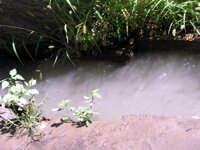
An Aryk full of water
One of the features of Bishkek is its system of irrigation channels – or Aryks.
The word “Aryk” comes from the Turkic word aryg which means “stream” or “ditch with clear water.
One normally thinks 0f “irrigation ditches” in terms of agriculture – and there are plenty examples of this here in Kyrgyzstan, but they are also an important feature of city life.
In fact this irrigation systems have been an important feature of civilization from ancient times – the Aquaducts of ancient Greece, the Roman Empire and, of course, in the cities of Central Asia.
The aryks in Bishkek are fed during the summer months with melt water from mountain glaciers in the Kyrgyz range to the south of the city. The flow is regulated by opening sluice gates, so at times the water channels are dry, but at others they are full of water – sometimes overflowing onto the pavements. The water not only is important for irrigating the streets of downtown Bishkek, watering the many trees and shrubs which helped to make Bishkek the “Greenest city in the world”, but also has a cooling effect in itself.
In fact they are found throughout the region known as Semirechiye, (Seven Rivers in Russian, in Kyrgyz it is Jetisu orZhetisu), not just in Bishkek. In Almaty, for example, one of the the main streets, (Abai Avenue), marked the start of the city’s irrigation system when Verney, (as it was called then), was established in 1854. The street was called Main Arykand only changed its name in the 1960′s.
Water is vital for sustainability in Central Asia and in ancient times the distribution of water between settlements was strictly regulated under tribal laws. Citizens had the responsibility of helping to dig the irrigation channels and the civil servants of the city states charged “taxes” for releasing water to the fields, deciding which sluice gates and when.
Even in today’s modern world this is an important issue. There is much speculation about the possibility that access to water could lead to international conflicts.
We have seen, for example, how Kyrgyzstan’s Toktogul Reservoir on the Naryn River affects water supply to the cotton fields of Uzbekistan and even further into Kazakhstan. The Uzbeks complain that Kyrgyzstan witholds water during the crucial period and releases it at other times for the generation of electricity. As a result they were even more upset when Kyrgyzstan proposed the construction of the Karambata II power station further upstream, and when Tajikistan proposed constructing a similar project.
And it is not just an issue here in Central Asia, but is found in other parts of the world; for example, along the course of the River Nile.
The word aryk is normally used to refer to small, artificially constructed water channels and it can also be applied where a stream has been artificially redirected in order to provide an irrigation channel. In the Naryn oblast, near to Kochkor, there is a river called Joon Aryk which is formed by the confluence of the Kara-Kujur and Telek rivers – but, to be honest, I don’t know why it called an aryk, as it is not a man-made waterway like a canal.
.
In Europe canals performed an important role in the Industrial Revolution as a means of transportation. Barges loaded with goods, transported them from centres of production to ports and other markets. In Kyrgyzstan, canals are important, but not as a means of transport – for irrigation.
With so much land classified as mountainous – it is perhaps not surprising that only 7% of the land area is arable. More than half of this is irrigated with water transported from mountain streams and rivers to agricultural land in the valleys.
Archaeological evidence suggests that some of the irrigation channels still in use in the Ferghana valley today date from about 2000 BC. It was, however, only after 300AD that large scale irrigation was introduced, thus increasing both crop yields and the variety of crops that could be grown. Then in the Soviet period, the programmes of irrigation were extended and now sprinkler systems can be seen watering the fields in many places.
The largest canals are found in the North of the country – the “Big Daddy” of them all is the B-Ch-K – the Bolshoy Chuisky Canal (= Large Chui Canal – sometimes referred to as the Grand Chui Canal). It flows through the Northern parts of Bishkek. The river itself flows some 20 kilometers to the North of the city.
In 2003 a large project for cleaning and repairing many of the canals was undertaken (affecting some 950 kilometers of waterway). For example, as part of this project work was undertaken both to clean and extend the 13 km. “Kyzyl-Kiya Komur” canal. This was the largest irrigation project in Kyrgyzstan at the time and when complete will result in over 700 hectares of dry land being developed and will also improve the water supply for another 660 hectares.
Here is a list of the largest canals to be found in the Republic:
|
Canal |
Source |
Length (km) |
Irrigation (1000’s Hectares) |
| Western Bolshoy Chuisky Canal | River Chui and Krasnaya (Red) River | 147 | 86 |
| Eastern Bolshoy Chuisky Canal | River Chui | 97 | 42 |
| At Bashinsky | River Chui | 44 | 21 |
| Krasnorechensky | River Chui and Krasnaya (Red) River | 39 | 17 |
| Nayman | River Chili Sai | 22 | 14 |
.





 Bishkek