Kyrgyzstan – where the Walnuts come from!
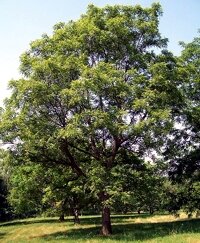
A walnut tree
Charley’s Aunt is a three Act play, first performed in 1892 which proved to be very popular, breaking all sorts of records, constantly being revived on stage, screen and Television. It was so commonly performed, even when I was growing up, that, in some ways, it seems to be have been a part of my youth – to be recalled with affection, even if, at the time, I found it to be grossly annoying. In it, a young Oxford undergraduate is inveigled by his friend to impersonate, Donna Lucia d’Alvadorez, a rich widow from Brazil and the Aunt of one of the other undergraduates.
One of the constantly repeated phrases throughout the dialogue was the phrase, “Brazil, where the nuts come from.”
Well, the Brazil Nut tree is indeed a native of Brazil, although it is also indigenous to several other neighbouring South American countries.
Here in Kyrgyzstan, we do not have an equivalent Kyrgyz Nut … but we do have walnuts!
In the South of Kyrgyzstan, on the slopes of the Chatkal and Ferghana valleys, at altitudes of between 800 and 2000 meters above sea level, there are stands of ancient forests of nut and fruit trees. They cover almost a quarter of a million hectares, scattered throughout the region, but these forests were once much more extensive and denser than they are at present. They include the world’s largest remaining areas of walnut forests.
Perhaps the most famous spot where walnut trees are found is in Arslan Bob – an ancient settlement – where the houses are spread along the valley slopes, many with spectacular views - but they can be found throughout the region.
These trees can live up to a thousand years and reach two meters in diameter and thirty in height. The branches of the trees form a huge canopy which can block out sunlight from reaching the forest floor. In ideal conditions, the tree grows tall and straight – capped with a small canopy, but in less ideal conditions, (such as on dry or stony ground), then the trees form an uneven shrubbery.
The walnut trees are interspersed with fruit trees (such as apple, plum and numerous berry bearing species) and other types of nut-tree (such as almond and pistachio). They also provide a habitat for a wide variety of birds and animals as well as highly a nutritious harvest, (the nuts, themselves), and timber.
They are classified as Deciduous Trees, have a large spreading crown are large leaves, (measuring anything between 20cm to 45cm, with between 5 and 9 leaflets ), and can grow to anything between 10 and 40 meters tall. They require a lot of light, benefit when their is protection from the wind and are also very hardy against drought.
The nuts can fall at harvest time creating a carpet of nuts. They have a very high calorific value and are consumed by a variety of animals, not just humans, such as mice and squirrels.. The nuts are encased in an outer layer of thick green pith. They cab be eaten fresh or used in cookery. In some countries immature nuts in their husks are preserved in vinegar – (in England these are called “pickled walnuts”) and they can be preserved in sugar syrup and eaten whole – (in Djalal Abad, these are sold as Walnut Jam).
Walnuts are considered to be an herb in Traditional Chinese Medicine. useful for treating the kidneys, strengthening the back and knees, moisten the intestines and as a relief for constipation. It is believed to treat asthma.
The nuts are rich in oil, but as the oil is expensive it is used sparingly, most often in salad dressings and as a binding medium in oil paints – known for its clear, glossy consistency and non-toxicity. Walnuts are also an excellent source of certain types of of fatty acids which can be helpful in lowering cholesterol levels. They can be difficult to store and need either to be kept dry or refrigerated as in warm conditions they become rancid in a few weeks, particularly after shelling.
Apart from it’s edible nuts, almost all the parts of the walnut are useful. The shells are mostly used to clean soft metals, fibreglass, plastics, wood and stone, in cleaning automobile and jet engines, electronic circuit boards, in paint and graffiti removal products, as a paint thickener and also as a filter in dynamite. The husks can be used to produce a rich brown dye.
In a good year the harvest yields some 800 tons of nuts and 1000 tons of fruits – so they contribute considerably to the local economy.
The timber from the tree is also a valuable commodity – selling on the world market at the same sort of price as silver. The wood sought after for its attractive appearance and durable quality. It is hard, dense, tight-grained and polishes to a very smooth finish. The colour can range from a creamy white in the sapwood to a dark chocolate colour in the heartwood. T he burl is sought after by cabinet makers all over the world. This has led to a large amount of controversy as areas of woodland have been denuded to take advantage of this valuable crop. In theory, the trees are protected from felling by law … but the value of the hardwood is an attractive cash-crop and has been the subject of much exploitation and controversy.
.
Although these “Royal Woods”, or Royal Forests”, of Southern Kyrgyzstan represent the world’s largest relicts of walnut forests, the walnut tree is probably not a native to this region – it probably came here from further South-East, possibly as far away as Malaysia.
Alexander the Great and his army discovered it in Central Asia, however, and sent specimens back to Greece, where it thrived. To this day the walnut is known in Russian as “Greek Nuts” – an irony not lost on the local populace.
The 21 species in the genus range across the north temperate Old World from southeast Europe east to Japan, and more widely in the New World from southeast Canada west to California and south to Argentina. The Latin name, Juglans, derives from Jovis glans, “Jupiter’s acorn”: figuratively, a nut fit for a god. The species which is most common in Kyrgyzstan is the Juglans regia which is renowned for it’s delicious nuts. Ironically, it is also known as the “English Walnut” because English merchants once controlled the trade in them.
.
Now, as it happens, we received a Press Release earlier this week about a four day Conference that is being held “on the sustainability in Kyrgyzstan’s walnut-fruit” which is being held this week in Arslan Bob (Arslanbop). I wasn’t sure why we received a copy of the Press Release, we must be on someone’s distribution list. When I first read it, I thought that it was an announcement being sent all interested parties in case someone wanted to take attend it, but then I reread it and realized that it was, indeed, a Press Release and I understood why it was being sent out on the day before the conference was due to start. I was intrigued the next day, however, to see how at least one news agency had reproduced the text word for word, (including spelling and other mistakes  … but then, we are all human, and who am I to talk … how many spelling and other mistakes are there in my postcards?).
According to the Swiss Cooperation Office who are organizing the conference, (with financial support from the Karl Popper Foundation, the Vontobel Foundation and the Swiss National Science Foundation), the idea is to bring together scientists and “specialists”, (Oh, how I love that word! – sorry, please excuse the sarcasm,), “to exchange results and ideas on various topics related to walnuts”.
It is part of a project, (ORECH-LES … orech is from the Russian for nuts, and les means wood or forest in Russian), which was started in 1999 and aims “to improve the multifunctional management of the walnut-fruit forests” in close collaboration with State Forest Service, especially the “leshozes“, (forestry organizations), in the South; the Forest and Walnut Research Institute P.A. Gan in Bishkek; universities in Bishkek and Jalal-Abad and the “Groupe de foresterie pour le développement” (GFD) at the Swiss Federal Institute of Technology in Zurich, Switzerland.
As part of the project, research was carried out within a field network of 34 trial plots in lezhoses located in Arslanbop, Kaba, Ortok and Uzgen. As part of the conference, the participants will visit a selection of these trail plots during a guided one day excursion, so as to see also the practical results of the research. They will also receive copies of various publications associated with the project.
The conference is a truly international event. As well as “specialists” from Kyrgyzstan, about 70 “walnut specialists” are expected from Russia, Moldova, Kazakhstan, Tajikistan, Azerbaijan, China, Germany, Switzerland, Austria and, (I am pleased to say), from Great Britain. There will be over 20 presentations covering such topics as the variety of “experiences in silviculture (the practice of controlling the establishment, growth, composition, health, and quality of forests to meet diverse needs and values), agroforestry (an integrated approach of using the interactive benefits from combining trees and shrubs with crops and/or livestock), biodiversity, selection, cultivation and socio-economic research associated with walnut forests.





 Bishkek