A woman’s place
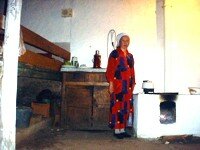
A woman's place ... in the kitchen?
In April, last year, a protest in central Bishkek became a revolution which led to the President, Kurmanbek Bakiev, fleeing the country. As his replacement was chosen Rosa Isakovna Otunbaeva, who became a member of one the world’s most exclusive “clubs”: Women Heads of State.
What a long way we have come since September 19th, 1893, when women were first given the vote in New Zealand, (the first country to grant “women’s suffrage”). In fact, two years later the women of South Australia were granted the same right, plus the right to stand for election as well as to cast a vote. That privilege was not granted to the women 0f New Zealand until 1919!
It would be wrong, however, to assume that Kyrgyzstan is a society where there is full gender equality, even though the Constitution of Kyrgyzstan prohibits all discrimination on the grounds of gender, (and also ethnic origin or religious belief); the civil, penal, labour and family codes of Kyrgyzstan all uphold equal rights and the legal framework protecting Kyrgyz women’s rights complies with international standards. However, the legislation also recognises the existence of certain discriminatory traditions or customary norms that are obstacles to gender equality in the country.
In Kyrgyz society, women have a definite role as wife, mother and helpmate.
It is easy to think of Kyrgyz society as patriarchal, but women do have a strong position, as befits a nation whose very name supposedly means “Forty Girls” – “Kyrk Kyz”. There are several versions of this legend of the forty girls … but perhaps the most picturesque has the daughters from several clans ending a war by dressing alike and asking their warring fathers, husbands, and brothers to tell them apart. When they fail to do so, the girls point out that they all one people and should not be fighting amongst themselves. Another version tells of forty girls who survived a raid by their enemies who then protected by a lone yellow dog on the banks of a deserted river. A third version has the forty girls meeting a band of thirty youths in the mountains of the Ferghana valley. Yet another version has the girls transformed into stone to avoid the incorrect, improper attention of inspectors of a local warlord – and their spirits watched over the people.
The statistics tell an interesting story – women make up 52% of the urban population and 50% in rural areas. The average life expectancy of women is 71 but for men it is only 63. Although the average age for marriage is 25 for men, for women it is 22. Just over half (51%) of the people who have received a Higher Education are women – but there are 10,000 more women registered as unemployed than men. When they are employed they earn only about three quarters of the average salary earned by their male counterparts. They make up less than a third of the workforce in administrative bodies (state and local governments), or of people high official positions of various sections of society. Only a few of the members of parliament (Jogorku Kenesh) are women.
In pre-Soviet times, Kyrgyz society and culture developed around family groups which had a basically patriarchal structure. The nomadic lifestyle involved hard physical work – much of it falling on the shoulders of the women in the family, who assumed a full share of the responsibilities of a community constantly on the move.
Women were assigned a subordinate status – they were dependent upon their fathers, and then on their husbands – who had “bought” them with a “kalym” (a dowry or bride price). Apparently some Kyrgyz even practiced polygamy.
This domestic role is evidenced in the traditional layout of a yurt. There is separate parts for both men and women. In the half are stored implements and things connected with hunting, husbandry and livestock whilst in the women’s half are stored domestic objects. However, when it comes to the work, many tasks are shared between the sexes.
(Although domestic chores in the home might be “women’s work” – it is interesting top note that in the South (for example, in Osh, and Djalal Abad) professional cooks (for example, in cafes and restaurants) are always men. Also, when it comes to making Shashlik – this preparation and cooking is always performed by the men of the household.)
There is a phrase amongst the Kyrgyz that when a daughter is born … the family is not raising a child of their own, they are raising a child for someone else. If she is later “stolen” as a bride, (Ala Kachuu – Bride Kidnapping), the groom’s family may well call her parents with the news, “You no longer have a daughter – she is our daughter now”. Her allegiances now switch from being to her natural family, to her husband and his.
Another interesting saying is “The birth of a girl is an addition to the herd, the birth of a boy is an addition to the defenders”.
It would be wrong to assume, however, that Kyrgyz women were doomed to a life of subservience. The very nature of the nomadic lifestyle meant that women took on many tasks as equal partners. They were given far greater freedom and communal responsibility than their sisters in the settled societies of Islamic “oasis cities”. Their voice was important in decisions such as the marriage of a child or purchases of jointly owned property.
The Soviet period brought about a revolution concerning the place of women in Kyrgyz society – although no government or system could completely eradicate many of the traditional mores of their earlier existence. However, universal literacy and access to Higher Education meant that many more women took on the role of “wage earner” and several advanced through the various hierarchies to hold significant positions. Of influence and authority.
In several of his works the Kyrgyz author Chinghiz Aitmatov explores the tensions between “modern” women and traditional Kyrgyz lifestyle. The classic is one of his earlier novel – Djamila – a love story where a young bride has to decide whether to stay within the traditional family system or leave and accept all the shame and dishonour that will pour down on her.
Today, there are some women who take senior positions in government. Some have been elected to the parliament (Jorgorku Knesh) and some have become ministers, (in May 2003, for example, there were 5 female members of parliament and 2 ministers – there were 6 political parties headed by women. There are also a number of women entering business. This may be a feature of the Soviet past where women had a more equal role in society than generally found in the West or other societies – and it may be partly the result of modern Western influences.
In particular, there are a number of famous and important women in Kyrgyz history – perhaps the most important is Kurmanjan Datka, who broke with traditions and rejected the husband chosen for her by her family, returning to live in her father’s yurt – and later marrying into nobility and assuming the role of the Queen of the Alai – one of the few women ever to have achieved the role of leader in the Muslim community. She is often referred to as the Mother of the Kyrgyz.
It is also claimed with pride that whilst very few nations honour women on their banknotes – the Kyrgyz Republic actually honour two – Kurmanjan Datka who is featured on the fifty som note and the ballerina Bubusara who appears on the five som note.
In recent years, growing interest has been shown in the issue of the place of women in society. In keeping with the local of declaring a theme for for each year, 1996 was declared the “Year of Women” by President Askar Akaev. Activists from the public were involved in developing the “Ajalzat” program aimed at improving the situation of Kyrgyz women.
A few additional points:
- Women in Kyrgyz society do not wear the veil as in some other Muslim countries. A married woman may wear a scarf whereas unmarried girls tend to go without.
- When women meet they usually bow slightly – even from afar. They sometimes greet each other by touching right cheeks without actually kissing – although an older woman may place a kiss on the cheek of a younger woman. It is considered polite for younger and foreign women to kiss elderly women on the cheek.
- When travelling in a car women and children usually travel in the back seat – not in the front – even if there is no-one else in the front seat. It is not necessarily a sign of subservience, however, but it is thought that a woman who would sit in the front seat is thought to be forward and brazen.
- Women do not normally enter graveyards but stand and watch from afar. There is a tradition in some parts of the country, however, that a woman on a white horse will read a prayer at the funeral.




 Bishkek
“Every year, the World Bank publishes its World Development Report (WDR) focusing on a specific development challenge. In recent years, the WDR has highlighted issues of climate change, agricultural productivity, urbanization, and the inequality of opportunity within and among nations. Yesterday, the Bank published its World Development Report 2012, which focuses on gender equality.”
http://blogs.cfr.org/coleman/2011/09/20/world-development-report-2012-gender-equality/
For the report see: http://go.worldbank.org/U6VCPKOOB0