Out with the old, in with the new
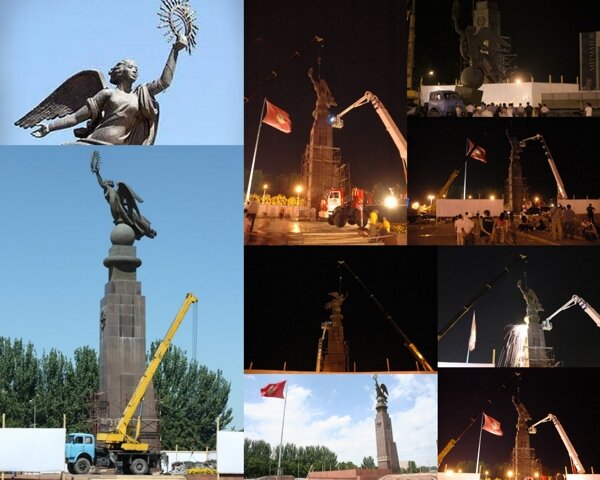
Erkindik - Freedom - Liberty ... removed from Bishkek's main square
When I am asked about the changes I have seen in my sixteen years here in Kyrgyzstan, (yes, sixteen already!), I normally reply that there are too many to count. However, the top three things I could enumerate are: the number of vehicles on the roads – especially foreign imports; the number of restaurants – and these days I would add the sheer variety of choice available; and the amount of construction that is taking place.
Indeed, the skyline in Bishkek is changing, in lots of many different ways. There is a Kyrgyz blogger who occasionally posts photographs of old buildings here in the capital, often not the whole building but just a detail that has caught his eye, such as the windows or a cornice. I wouldn’t say that the skyline was unrecognizable from that which greeted me on my first visit back in 1994, but there are definite differences.
I would probably recognize the main Ala Too square in the city center, but I would probably do a double take … something is different, but what is it? Can I put my finger on it? Even though it has had a makeover and been tidied up, it’s basically still the same marble clad frontages to a clothes factory and office block. Dom Druzhba, (Friendship House) and the cube that comprises the Historical Museum are still there. The huge arch with a squashed dome, (the building of the Ministry of Agriculture), still stands at the opposite end of the square.
The neighbouring building, on the other hand, right in the south Western corner of the square is behind tarpaulins. This was the Prosecutors office that was set ablaze in the revolution of April 7th 2010 and is still awaiting reconstruction. The floral clock and the huge flagpole flying a massive Kyrgyz flag are new. But there is something else … the center spot, where a statue of Lenin once stood staring at the Mountains to the south of the city and gesturing as if he was saying, “Look at those beautiful mountains!”, is now empty.
Back in 2002, Vladimir Illych was removed, gone but not forgotten. He was simply relocated to the other side of the Historical Museum where he now stands staring at the Parliament building and the American University of Central Asia, (AUCA). “What”, I wonder, “is he saying now”?, as he seems to point towards the university.
His commanding place in the square was taken by a more modern, symbolic statue, called Erkindik, Freedom. Bishkek’s own Statue of Liberty, erected to mark the Year of Kyrgyz Statehood marking 2200 years since the first mention of the Kyrgyz in ancient Chinese Chronicles. But now, she too has gone. Removed overnight and put into storage until a new location can be prepared for her. That surprised me a bit. If the symbolism was so bad, then, perhaps, logic suggests, she should be retired to a museum.
In her place will be new statue dedicated to the legendary hero and uniting figure of Manas sitting astride a horse. The statue is not ready yet, it should be delivered in late august and the plan is to erect it in situ in time for the celebrations of the twentieth anniversary of Kyrgyzstan’s Independence.
It was all done quickly and quietly – although there were two days of preparation work and the demontage itself was put off for one day because the workers didn’t have a long enough cable, then it was delayed for three hours and so took place in the middle of the night. It took five hours to complete the job, which was more than twice the estimated two hours.
We had learned of the government’s plan for remodeling the square late last Friday and by Thursday she was gone. There were protests, but no large demonstrations on the street, more of lobbying on the internet. A sign of the times? Apparently, there have been over 700 rallies in the first six months of this year – spread throughout the country, but most of them in Bishkek. Over half were political but the others addresses a variety of social and economic issues. When the protest about the removal of the statue took place, one of the local news sites reported that the supporters of the removal outnumbered those who wanted to keep “Freedom” – but the numbers were very small, 30:15.
Mind you, there have been other protests, especially about the cost. (Indeed, there is some controversy about the overall cost of the independence anniversary celebrations.) The new statues alone are costing about 22 million som, (somewhere around half a million dollars) … and this in a country which relies heavily on international aid. The government assures us, however, that not a som will come from the public purse, as they have sponsors who have either donated or pledged the money – although they’ve asked for anonymity.
For the record: there will also be a new statue at the other end of the square as well. Facing the new statue of Manas will be statue dedicated to the famous Kyrgyz author Chinghis Aitmatov who died last year. At the moment, there is only one statue dedicated to him in the country, in Issyk Kul. The chosen designs for both monuments are by Bazarbai Sadykov.
So it is a case of Out with the old and in with the new.
We seem to be doing a lot of that lately. Out with the old Presidential style of government and in with the new style of Parliamentary Democracy, for example.
Soon it is to be a case of out with the old president and in with a new one. The nominations for the presidential election are still flooding in. There were twenty five at the last count, and I have seen at least three more names being touted around. Just five of nominations come from political parties, (the Communists, Ata Jurt, Butun, the Greens and El Uchun), with the others coming from private individuals. Nominations don’t close until August 16th, so there could be even more candidates to choose between in the first round of voting! To be fair, however, (as I said last week), one individual has already withdrawn from the race.
It’s unlikely that there will be twenty four names on the final ballot paper, however, although there could be as many as a dozen with a major contest developing between say five or six of them. The candidates have to fulfill several requirements and at the moment their nomination is just “an expression of interest”. What’s more, it seems probably that some will form combined tickets, one person for the Presidency and another for the post of Prime Minister.
There is already a certain amount of posturing about campaigning with the Central Election Commission, (CEC), trying to establish clear rules of the “game”. The Media, for example, have been that they will not be allowed to campaign for one candidate or another … so it won’t be a case of a newspaper of a newspaper being able to endorse a particular candidate. It is not clear, however, how this will affect the internet. As you can imagine, there has been an outcry from the media, duly reported widely in the media. There is also concern about the possible influence of reporting in the Russian media, widely available and popular in Kyrgyzstan, might have on the results. Whatever, media outlets will not be allowed to raise their prices during the campaign, which should, (but might not), help some of the candidates with less financial resources. Another measure is that no-one will be able to use images of sound bites featuring politicians of other states in any of their election materials, so photo opportunities with Putin or Medeved, Obama or Cameron won’t be of much use … that’s all well and good in theory but we’ll see how it works out in practice.
One of the candidates, a former Finance Minister, is claiming that country is following in America’s footsteps and is approaching a “technical default” situation. He says that rumours about the risk hyperinflation are exaggerated, but that there are real difficulties in the current economic situation. Of course, there are reasons why he wants to stress the financial situation in the country, it’s his strength, and although it seems that there is much in what he has to say and the warnings that he issues, the head of the IMF mission in Bishkek says that the budget is under control.
It won’t, however, be a case, (or so we have been assured), of out with the old World Trade Organization and in with the new Customs Union. Prime Minister Atambaev has made a point of stressing this. The controversial debate about whether we should join the CU keeps rumbling on, however.
The Customs Union is being cited by several people as an explanation for something a little odd. I mentioned last week that the big news over the previous seven days had been the problem over petrol supplies. The Prime Minister flew off on an unscheduled visit to Moscow to discuss the issue with his counterpart there, Vladimir Vladimirovich Putin. By all accounts it was a short and amicable meeting and the question was resolved. Petrol supplies have been resumed and there is no problem here in Bishkek; prices and availability are back to normal. The question on people’s minds, however, is why?
Why did Putin agree so readily and without any form of preconditions? No comment about previous spats over tax concessions and re-exports of the fuel (and, incidentally, of cheap “Kyrgyz” fuel to our neighbours continues to be an irksome problem); no mention of the either the American or Russian bases on Kyrgyz territory; no request about the treatment of Russian investors, (in Megacom and Dastan, or the various new projects in Mining and power generation, for example); nothing about bi-lateral relationships either before or after the elections, (assuming that Atambaev will be in position to follow through on any agreement) and no reference to trade issues with Kyrgyzstan acting as a transit for cheap Chinese goods. Most of the analysis I have seen, seems to be convinced that both the origins of the problem and its resolution lie within the Customs Union. Russia, it suggests, is exercising its influence through its energy policy as it has in other cases and is aiming to engineer for Kyrgyzstan to join the CU, and possible drag in with it other former Soviet states.
Some people have mentioned that a crisis over petrol could prove damaging to any member of the present government entering the Presidential election, so perhaps it is a good job that the issue has been resolved. There is another liquid, however, that could also prove to be damaging: beer. The consumption of beer has been rising over the years since Independence and Kyrgyzstan only bres about a third of the 50 million liters consumed in the country, importing the rest mainly from Russia and Kazakhstan, although many up market outlets also stock European and other foreign beers. A new measure was recently introduced which provides for a five-fold increase in the duty on the beverage. The new tariffs don’t come into force until next week, but one local brewery has already raised its prices. At the moment there is no disquiet about the increases, but it will be interesting to see what reaction, if any there will be.
If that wasn’t enough, it’s been reported that the cost of pesticides have also risen, between one and half and two times their level last year. Much of this is supposed to be a result of the border closures last year. More importantly, however, it means that there is rise in a number of the pests affecting Kyrgyz agriculture … which could have an impact on food supplies and prices. On the other hand, as I understand it, many smaller private farmers don’t use pesticides heavily, they can’t afford them. A few years ago there was a move to promote organic farming and “ecologically pure|” food production and, oddly enough, this latest development might actually help that.
Another story I referred to last week was the interest being shown in the snow leopard. Unfortunately, this week some bad news emerged on that front. Two of the four cubs being raised in the rehabilitation center in Issyk Kul are in need of surgery on their eyes for congenital eye defects. The good news is that if they had been born in the wild then these cubs would almost certainly be dead already, but the bad news is that Kyrgyzstan doesn’t have a clinic that could perform the operations.
The Ministry of Emergency Situations has been busy during the week. As well as dealing with the fallout from the earthquake last week, they have also had their annual board meeting. It was particularly noteworthy because it was held in both Bishkek and Osh with a video conference link between the two … Kyrgyzstan has clearly entered the twenty first century. The reported that in the first six months of the year there had been 227 emergencies, in which, unfortunately, 131 lives had been lost and causing damage of almost 600 million som.
Early in the week they also issued a warning concerning the Merzbacher Lakes, which lie at an altitude of 3300 meters above sea level are currently holding something like 200,000 cubic meters of water. The lakes were first discovered by the German explorer Gottfried Merzbacher in 1903 and are an enigma in that they fill up in the summer and then suddenly disappear with the water draining away, somewhere, and we still don’t know where or how. The Ministry said that this is a seasonal phenomena which happens every year but this year lake may be “overfilled” with water and burst. Although, they assured us, there is no need to panic, they warned people in this high, remote region, (people living near to the lake, shepherds and tourists), to be especially cautious in the area. Anyway, a group of specialists have gone up to monitor the situation.
One piece of good news they were able to report was something like a 40% reduction in the number of fires in the republic during the first half of the year compared to last year … but then, last year we had all that trouble in the first half of the year, so I suppose this statistic is not so surprising. Anyway, during the week we got some news that might indicate that those figures are going top take a bettering. After a fire when dry grass ignited in the Sokuluk district, not far from Bishkek, came an announcement that several areas of Kyrgyzstan face a high level of risk of fires in the current weather conditions. Most of these areas are in the south of the country, but the list also included Naryn and Djety Oguz. I am going up to Naryn over the weekend and will be interested to see what conditions are like.
Among the more general items that caught my attention this week, there was a report on the BBC that Mexico saw an increase in foreign visitors during the first five months of the year compared to the same period last year – despite the violence related to drug wars in the border zones in the north of the country, (most of which, to be fair, is located far from the most popular tourist sites). It was only a modest increase, (just 2%), but it was still an increase with the largest growth being recorded from Russia, Brazil and China. Despite the coverage of the violence in the American media, Mexico still remains the number one foreign destination for Americans … those with passports that is … apparently there are more Americans registered as Facebook users than there are with their own passports.
Anyway, it struck me that if Mexico can still attract a growing number of tourists in spite of this negative publicity then it should be possible for Kyrgyzstan to do so as well … if only we can get our act together. The fact that the tender for developing a Concept for the Development of Tourism in the country was declared void and will have to be re-held, does not bode well.
It strikes me as amazing what little things can, in fact, make a big difference in public awareness and influence decisions. For example, sales of the 1960 novel “To Kill a Mockingbird” apparently rose by 123% after David and Victoria Beckham revealed they had named their daughter after its author, Harper Lee. This news brought out the cynic in me and I could help feeling, “What a pity they didn’t have a son and decide to call him Manas.”
Mind you, there are other positive developments. A new direct flight between Bishkek and Kiev, has been announced. It doesn’t start operating until September, at the end of the season, but it is a positive sign and gives me some additional hope for the future of our industry.
There is also talk of a USAID project to reopen the airport in Karakol. The head of USAID in Kyrgyzstan made some very good, (and I hope useful) comments about the need to develop the regions of Kyrgyzstan. As the Ministry of Economic Regulation has pointed out, almost three quarters of investments in Kyrgyzstan go into Bishkek, the Chui oblast and Djalal Abad, with the other regions basically having to “fend for themselves“. To be honest, I was a bit surprised to see Djalal Abad in that list. I would have guessed that Issyk Kul would have been there instead.
Perhaps, in some ways, the strangest story of the week was how Bishkek “forgot” to observe World Hepatitis Day. Whereas the BBC, for example, had special programs and news reports to mark the day and explain the background to the disease and its significance, Bishkek was remarkably quiet. In itself that is usual as we tend to commemorate all of these special days with press conferences and a variety of activities. In fact, it seems that some activities were supposed to take place – four of them aimed at improving access to services and providing information on the prevention, diagnosis and treatment of Hepatitis C, but when reporters turned up to cover the events they found no-one there.
Finally, it’s not exactly as case of “out with the old”, but it could be a case of “in with the new” … I think my favourite sighting this week was the tweet that said: “The Kyrgyz Ministry of Foreign Affairs have simplified the visa regime for the 10 countries: Brunei, Chile, Venezuela, Oman. … The inhabitants of Jupiter and Saturn, we have more often!” What wonderful sarcasm I thought to myself.
For the record: the full list of the additional ten countries includes: Albania, Brunei Darussalam, Indonesia, South Africa, Chile, Venezuela, Qatar, Kuwait, Oman and Bahrain. They still need visas, but they don’t need a letter of invitation if they apply at a Kyrgyz consulate … that is, if they can find one; there are only 23 of them. Still, any relaxation in the visa regime is welcome – even if it is tongue in cheek.


 Bishkek
Ehh… Chingiz Aytmatov died in 2008… Time flies, right?
Whoops … yes, time does indeed fly …
I got a message the other day from an old friend which really brought this home to me. She said: “three more working days until I retire!” … when I say “an old friend”, I didn’t mean that “old” … but then it struck me …I have more than three days – but it is quickly catching up on me.