Cheers!
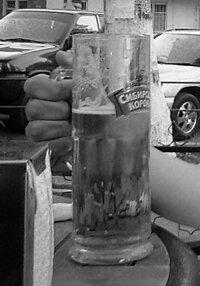
Cheers!
Sometimes, it seems to me that, “where Russia leads, Kyrgyzstan will soon follow”.
This is an oversimplification of course, and may be totally unfair, but every now andf again a story hits the headlines which create such an impression.
One interesting piece of news that hit the editors of several British media outlets, (and others around the world), as worthy of inclusion in their “Weird News” section was when President Medvedev of Russia signed a decree that recognizes beer as an alcoholic beverage.
Now, the Russians have a reputation as being “hard drinkers”. Their annual alcohol consumption, (30 liters of vodka according to the BBC, but just 15-19 liters according to the Russian Ministry of Health and another news website puts it at 12.5 liters), is already more that the “critical” level set by the World Health Organization. This normally relates to downing vodka, the Russian’s favourite tipple. Beer, on the other hand, has never been as popular, and was regarded as “foodstuff” because the alcohol content was less than 10%. This has meant that it was not subject to many of the regulations restricting it sale and as a result, consumption of beer has been soaring over the last ten years. Beer sales have risen by 40% whilst vodka sales have dropped by 30%
It is common to see people “taking a swig” in streets and parks, almost as they are drinking a soft drink like Coke, Pepsi or Kvas – a traditional Russian soft drink. Apparently Russian children start drinking beer as young as young as 12 or 13 years old.
A study carried out in 2009 and published in the British medical journal “The Lancet,” suggested that alcohol abuse accounts for something like 600,000 deaths in Russia each year and a total of half of all deaths among males between 15 and 54.
So, it might be understandable that there has been pressure on the Russian government to try and bring the matter under some form of control. Some people have apparently suggested that this pressure has been driven, or at least encouraged, by the Soft Drinks industry. A tax hike, (an increase of some 200% in the duty paid on the beverage), was introduced earlier this year. In addition, as a result of this new law, the threshold has been reduced to 0.5% – which could be a bit of a problem because Kvas is often as much as 1.2% and so would also have be affected, (but it seems as if a compromise has been worked out to exempt it.) From 2013 the sale of beer will be banned from unlicensed kiosks, there will be limits on the hours when it can be purchased, (sales will be forbidden between 11pm and 8 am – a measure which already operates for the sale of “hard liquor”), and new regulations governing its advertising.
The move has not proved popular – especially amongst the youth of the country. Some people in the industry have also expressed skepticism about the move, pointing out that people still smoke despite all the regulation against tobacco products.
It’s not the first time that similar measures have been introduced. The American experiment with Prohibition is well known and in the dying days of the former Soviet Union, Mickail Gorbachev also tried to introduce restrictions. (Two of the best jokes I have heard here relate to this period – but that’s another story.)
.
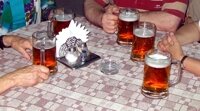
A round of drinks
Here in Kyrgyzstan, we have also enacted new legislation which will mean a sharp increase in the cost of beer, which comes into force on 2nd August. The excise base rate will be increased by 500%, from 5 som to 25 som. To be fair, it’s the first increase in 12 years – which seems pretty good when compared to the anxiety felt by the Brits every year as Budget Day approaches and the question on everyone’s lips is: “Will he, or Won’t he?” – Will the Chancellor of the Exchequer increase the excise duties on beer and cigarettes this year?
One local brewery, however, seems to have jumped the gun and increased their prices from about 35som for a half liter, (roughly a pint), to anywhere between 55 and 60 som. It seems to hit sales – with some Kiosks deciding not to stock the brand after the price rose so dramatically. At the moment, the price of other brands remains the same which means they are considerably cheaper … until after the weekend, presumably, when they will lose their price advantage as the new excise rates take effect, although they haven’t officially announced what the new levels will be, nor when they will be introduced.
The parliamentarians have been busy this year when it comes to regulating the liquor industry. The new excise rates are just one of the measures introduced to regulate the 13 or so companies that operate in this field. Most of them companies seem to be involved in the production of Vodka. On the other hand, there seems to be some 10 breweries producing beer throughout the country, (in: Bishkek, Belovodskoye, Djalal Abad, Kant, Kara Balta, Karakol, Osh, Talas and Uzgen) but most of the actual production comes from the Chui valley. Most are the breweries quite small and serve the local community.
There is a reason for that. When I first came here, I didn’t speak much Russian and one day I saw a notice “Svezhiye Pivo” and, not recognizing the first word, I reached for my Pocket English-Russian Dictionary that I took everywhere with me, and looked it up. I smiled to myself. “Fresh Beer”. How quaint. I could understand fresh vegetables, fresh fruit, and so on … but “fresh beer”. That evening I explained to a friend and he explained to me that most beers manufactured locally are sold “live”, or “fresh”, and need to be consumed within three days, or they “go off”.
As a result, there used to be many such small “local” breweries. Although razlivnoi, (draft or draught) beer is available, a lot of local production is in bottles. A café or bar has to have to have quite a turnover to beat that three day limit.
The largest brewery in the country is Arpa, (which is Kyrgyz for Barley) – which, at one point had some French investors – and which alone accounts for something like two thirds of the local production. You can even find websites that feature it, including one for bottle cap collectors which features a number of their designs.
Most of the breweries here are much smaller – what are sometimes called microbreweries. There is a trend, however, for the development of such “micro breweries” in the West as well. Small enterprises that produce enough for themselves and sales in the immediate neighbourhood, where they attract a loyal following. One of the newest in Bishkek, Steinbrau, is run by a German family using modern German technology. In their “pub” you can see the brewery equipment, clean, bright and sparkling through a window from the main hall.
There is another lopcal pub which brews it’s own beer – Blonder.
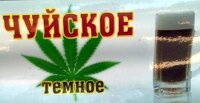
Why use marijuana as a selling point for beer?
Another local micro-brewery is worthy of note, Chuiskoye. Just 30 kilometers out of Bishkek, they brew a dark beer which, although is popular amongst the cognoscenti, can be difficult to find – I only know one place that stocks it. It is instantly recognizable however, as the badge on the beer pump displays a Marijuana leaf. In fact the name Chuiskoye was apparently a term that used to be used to describe a particular grade of marijuana which grew in the region, even in the days of the Soviet Union. Just why, however, the owners of the brewery decided to use a picture of a marijuana leaf as the symbol for their beer, is a mystery to everyone … except themselves.
Chuiskoye is a rarity in that it is a dark beer. Most of the local production is dominated by light beer, similar to “pale ale”. There is, however, a growing tendency to drink imported beers of the lager type.
One of the problems facing local breweries is that most of the ingredients, (malt, hops and barley), are not grown locally and so have to be imported, mainly from Germany and Kazakhstan.
In fact, beer production has a long history in Kyrgyzstan. The first brewery opened in Karakol in the 19th century. At the beginning of the 20th century there were five breweries. In 1914 the brewery in Bishkek made 10 times more money than the other 18 major enterprises in the city combined. At that time there was, apparently also a distillery in the city – but I haven’t found any comparative figures for that enterprise.
According to one report I have seen, back in the early days following Independence, local breweries produced less than 2 million dals, (a dal is a decaliter – 10 liters – so that’s about 20 million liters), and this fell considerably in the course of the decade to about a third of that, before staging something of a small recovery and now stands at somewhere about 15 million liters. This satisfies about a third of the demand for beer in the country (about 50 million liters), the balance being made up by importing from, mainly, Russia and Kazakhstan – although a number of up market places like to stock European brand names as well.
As the imported brands tend to cost about one and a half times as much as locally produced beer, it is easy to see why, sometimes, such local brands are considered “common”, and there is a growing tendency to drink imported beer.
According to the National Statistics Committee, apparently about one sixth of the adult population drinks beer regularly – but I don’t know how they arrive at that figure – and the average per capita consumption is just under 160 liters. (In neighbouring Kazakhstan, it is apparently just 26 liters.)
This might seem odd in a country in which most of the country is at least nominally Muslim, a religion which considers that drinking alcohol, even low alcoholic beverages, is a sin.
Even so, there are a number of traditional drinks which are at least “midly alcoholic”. I have seen some tourist sites which refer to Koumiss, (fermented mares milk), as a sort of “nomad’s beer” but there is another contender for this title: Bozo. In fact, the first time I came across Bozo, the young Kyrgyz guide referred to it as “Kyrgyz Beer”. It is a mildly alcoholic beverage, (2-3%), made from millet. It is not produced by any of the major commercial operations and is not bottled, but it is available at many bazaars around the country. It looks like a creamy drink although it is a little “mealy”. Some people say that it has a fairly bland taste – which can be deceiving – even if it is low in alcohol, it is easy to misjudge the effect. For the record, there are regional variations and so a bowl of bozo in Kochkor may taste quite different from one in Djalal Abad.





 Bishkek