Prospect Erkindik
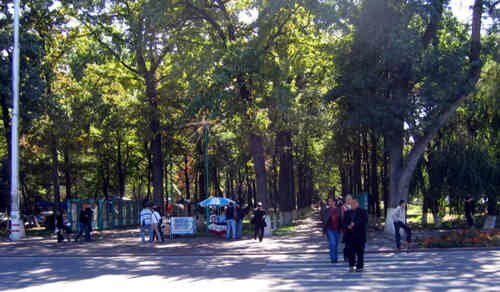
Prospect Erkindik is one of the main thoroughfares in Central Bishkek. It has been known by many names over the years:
- Until 1924 it was called ”The Boulevard“;
- In 1924 is was renamed Komsomolskaya;
- In 1933 it was renamed once again, this time as Dzerzhinsky Street after the Polish revolutionary and founder of the NKVD, the forerunner of the KGB;
- It was reclassified as a Boulevard - with the same name, Dzerzhinsky.
- it was reclassified once again 1979 as Prospect Dzerzhinsky.
- Finally, in 1991 it received its current name, Erkindik, in honour of independence of Kyrgyzstan.
A dual carriage, separated by a wide, tree lined central reservation which is a favourite spot for people to simply wander up and down - especially in the heat of the summer, or on balmy summer evenings.
 “Keep Off The Grass” … No matter how tempting .. it is NOT advisable to walk on the grass in the central reservation – there are some little signs (in Russian) announcing a 500 som fine for those who do.
The boulevard was based on a double row of silver poplar trees which were planted by the horticulturist Fetisov in 1883 on a covered in stream bed. After his death, some of his friends enlarged the area, planting more trees, and it was named “The Boulevard”. The original trees have long since disappeared and replaced by a double row of Oak trees – planted in about 1904. Between 1936 and 1956 it underwent further reconstruction and made wider.
The street has always been an expensive, “up market”, part of town.
- The first mayor, Terentiev, had a mansion, offices and a bookstore on the Boulevard
- Former President Akaev used to have an apartment here (between Moskovskaya and Toktogula). When he fled the country in 2005, he claimed that his only assets were an old car and an apartment – presumably this one.
- There is a fairly high concentration of memorial plaques along the street, (over 20 out of a total of 135 throughout the city), indicating that many important local people used to live here or have other associations with buildings here.
- Over the years many important buildings were erected – and offices installed.
Even today the street seems to exude an atmosphere of wealth, glamour, power, prestige and influence … either past or present. It is true that some of the older buildings are in need of restoration … but most of them still project an image of past glories.
At various places along the length of the central reservation there are children’s playgrounds with brightly painted swings, slides and climbing frames.
In 1932 – the Eastern side was dedicated as the first “paved” street in the city.
The entire boulevard is protected by government decree as a site of historic and cultural importance.
The avenue runs between the Railway station in the South down to Jibek Jolu - with parts on both sides of Oak Park. The original Dzerzhinsky street was longer – over three and a half kilometres long – and the continuation of the road, beyond the intersection with Jibek Jolu, is still called Dzerzhinsky street.
|
East |
South |
West |
||
|
One Way |
Central Reservation |
One way |
||
|
Railway Station (1938) |
 |
|||
|
Lineinaya Street |
||||
| The Building on the corner was theHotel Ala Too. The hotel was one of the major hotels in Bishkek – but it was closed for renovations shortly after independence. The contract was awarded to a German firm – but problems were encountered and the work was stopped. The hotel is still closed awaiting reconstruction, but is still listed on some internet booking sites. | Statue of M.V. Frunze on horseback – erected in 1967Mikhail Vasilievich Frunze (1885-1926) was born in Bishkek – which was then called Pishpek. A young revolutionary – he commanded the Red Guards, which occupied the Kremlin in October 1917. He was a “major player” in the civil war – responsible for campaigns in Siberia and the Caucasus Mountains and subduing Central Asia for the young Bolshevik regime. He replaced Trotsky as War Commissar and introduced a system of conscription requiring compulsory peacetime military service and moulded the Red Army into a formidable fighting force and revolutionary tool. After Lenin’s death, he survived several mysterious car accidents, but eventually died after submitting to a stomach operation at the order of the Politburo in 1926. His home town was renamed Frunze in his honour, (the name was changed to Bishkek in 1991). There is a statue of him standing outside Moscow and one of the leading Soviet Military academies was named after him. | The building on the corner is the offices of the State Agency for Geological and Mineral Resources.The pink building houses the offices of the Kyrgyz Red Crescent Society (Red Cross). | ||
|
Bokonbaeva Street |
||||
| The “shell” on the corner with Moskovskaya is the remains of the Bishkek Hotel. It was one of the largest in Bishkek but was closed in 2001 for renovations. The contract was given to a Malaysian company that started work – gutting the building – then withdrew, leaving the carcass as it now stands. The hotel is, obviously, still closed for renovations, but is still listed on some internet booking sites. | There should be a bust of Joormat Bokonbaev, (1910-1944) a Kyrgyz poet and playwright, on the plinth – but it is undergoing reconstruction after having being stolen for the scrap metal value in 2003. (The thieves were caught within days of the event.) | Hidden away amongst the trees is a bust of the war hero, Major General Ivan Panfilov who commanded a rifle brigade that halted a German tank advance on Moscow.On the corner is a Gymnasium (School) | ||
|
Moskovskaya Street |
||||
| Bust of Nasirdin Isanov - First Prime Minister of the Kyrgyz Republic in 1991. He died in a “mysterious” road accident – when a Zil rammed his Volga on the road from Djalal Abad to Osh. | The headquarters of Megacom – a mobile phone company30 – Building of the Geological Institute of the Academy of Sciences - built in 1936. This was the first “home” of the Academy of Sciences when it was established in 1943. | |||
|
Toktogula Street |
||||
|
39 – The building of the Constitutional Court, built in 1941. As well as flying the Kyrgyz flag on the central flagpole on the roof, just below it are the Soviet Hammer and Sickle.41 – The next building down from the Constitutional court is a house of the 1950′s which is protected by decree of the government as being of historical and cultural importance – although we are not sure why this particular has been singled out for such treatment.
The Kyrgyz ballerina Bubusara, who appears on the 5 som banknote, lived in the building on the corner |
Statue of Temirkul Umutaliev - a Kyrgyz author.Signs on the grass warning: “Keep off the Grass – 500 som fine” | Building of the The Diplomatic Academy.36 – Building of the Union of Theatrical Activities.The building on the corner of Kievskaya and Erkindik has four memorial plagues, indication that famous people once lived in the building. | ||
|
Kievskaya |
||||
| 45 – The Erkin Too building. Erkin Too was the name of the first Kyrgyz language newspaper published – and the government’s official Kyrgyz language gazette is still called Erkin Too. This building used to be called the “House of Printing” and during the Second World War it served as a barracks.On the corner is the “Fire and Ice” night club. | Signs on the grass warning: “Keep off the Grass – 500 som fine” |
44 – The Former Central Telegraph Office - now branch offices of Kyrgyz Telecom | ||
|
Prospect Chui |
||||
| The building on the corner is the Ala Too Cinema, built in 1938. In the 1960 it underwent a refit and was decorated with mosaics depicting heroes of the time, including cosmonauts.The octagonal Ak Suu Water Pavilionwas built in 1949 in honour of the mineral water of Ak Suu (which, in Kyrgyz means “White Water”). It now serves as a cafe. The unusual architecture is topped of with colourful tiles and a relief. | An open plaza, (pedestrian area), opens out.In the plaza is “Zero Point”, (from where all distances in Kyrgyzstan are supposed to be measured from), marked by a large circular metallic plaque inlaid into the pavement. | The square is subject to speed restrictions – is closed to traffic at night, weekends and holidays. | ||
| The two storey domed building isDom Druzhba(Friendship House). Built by the Czech Interhelpa Group in the 1932, it was the first Government House. There is a story of a nomad visiting the city from his high mountain pastures (Jailoo) who went back and told all his family and acquaintances what a wonderful city it was – with such tall building that if you bent over backwards looking upwards – with the top of your head on the ground behind you – then you still could not see the top of the building – it was this building he was describing. When the second Government house (currently the parliament) was built – this became the Historical Museum.There is a small, open-air, gallery in which local artists display some of their work. | ||||
| Continuation of Pushkin Street | Statue of Kurmanjan Datka – at the foot of the prospect, at the top of Oak park. A large plinth on this site once supported a statue of Lenin, then Dzerzhinsky – then Erkindik (Freedom) – but in 2004 the current statue of the Queen of the Alai, (who appears on the 50 som banknote) was erected. | The Alley of Statesmen – along the drive, behind Dom Druzhba, there are busts of some important statesmen including several who also have streets named after them in Bishkek. | ||
| The Russian Drama Theatre, built in 1972 on the spot of Bishkek’s first cinema – The Progress Cinema, built in 1914, and later renamed the Cholpon. A new building to house the Theatre was built in 1929 and replaced by the current building in 1972.The Red Guards Memorial – a red granite obelisk erected in 1960 over the graves of the Bolshevik casualties of the 1918 Belovodsk counter revolution. Their commander, Logvinenko, survived the uprising and when he died in 1933 he was also buried here. There used to be an eternal flame – but it was extinguished due to economies in the winter of 1994 although it is still lit on appropriate occasions. As well as recording the names of those interred here, the monument bears an inscription which reads: “Eternal glory to the fallen who fought for the power of the soviets.” Wedding parties, newly married couples and their entourages, often visit, placing flowers at the memorial after the weeding ceremony at the Palace of Weddings – on Sovietskaya. | Oak Park: (previously called Dzerzhinsky Square) between Prospect Chui and Abdumomunova, West of Sovietskaya – began as a grove of Oaks planted by Alexei Fetisov in 1890 and home to the Open Air Museum of Sculpture - proposed by the Kyrgyz monumental sculptor and established in 1984. On both sides, right and left, there are examples of sculptures placed in this unique, open-air, museum come art gallery. A total of 188 works were placed here by 87 sculptors. The eighty-odd bronze sculptures which were placed here, such as the bust of Yuri Gagarin, have long since disappeared – stolen for their scrap metal value.Bust of Muchtar Auezov | The area behind Kurmanjan Datka’s statue is a favourite place for strolling – especially by young courting couples. Sometimes, during the summer the fountains are turned on.Hidden by the greenery of the trees in the summer is St Nicholas’ Church - now an art gallery run by the Artists Union.On the far side of the The Oak Park Cafe is a small, two storey building which is now part of the American University of Central Asia – but was once the city’s Children’s Library. | ||
|
Abdumomunova |
||||
| Building of the Ministry of Foreign Affairs.At the back of the building, (facing Abdumomunova Street) is the Semetei Youth Center, which stands on the site of the original Circus – a wooden building which burnt down and was replaced with this complex which includes a theater auditorium and various other facilities. | Statue of Djumabek Ibraimov who was Mayor of Bishkek between 1993 and 1995, and Prime Minister of the Kyrgyz Republic between 1998 and 1999. He died in office of stomach cancer and is buried in Ala Archa cemetery. |
In the distance is Central Square, formerly the main square where parades were held.The first large building was the Council of Ministers, but it now houses the American University of Central Asia.Beyond it is the former Government House – now theJogorku Kenesh- the parliament.On the corner of Abdumomunova and Erkindik is the house of Terentiev, the first Mayor of Pishpek. It now houses the offices of UNICEF in Bishkek.
The pink building houses the Commission for the Protection and Promotion of the State Language. In the distance, on Frunze Street, behind the fountains, the large grey block with the frieze of soldiers is the building of theFrunze Museum. |
||
|
Frunze |
||||
| The small, two storey building with the date 1926 is a branch of the bankKyrgyzstan. It was one of the building erected by the Czech Interhelpa group. | Bust of the revolutionary leader Ivan Ivanitsyn | The building of The Ministry of Finance and the Economy.There are three small “stalinskiy dom” – and the middle one was once the former American Embassy - before it moved to its present location on the Southern outskirts of the city, on Prospect Mir.Building of the State Security Service - SNB, once known as the KGB. | ||
|
Ivanitsyn Street |
||||
|
Jibek Jolu |
||||
|
Stele with a portrait of Lenin on the central reservation of Jibek Joly |
||||
|
North |
||||





 Bishkek