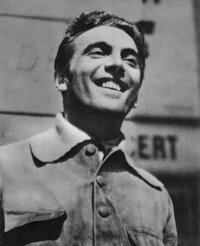
Julius Fuchik
A few years ago I was preparing an article about Bishkek’s reputation for greenery, enriched with trees and many parks and open spaces. All was going well, but I ran into a block with one particular park on the Western end of town: Fuchik Park.
It was constructed as a “workers’ park” in 1935/6 with the help of the Czech Cooperative Interhelpa, that answered Lenin’s call to come and help build a Socialist paradise in the newly established Soviet Union.
I knew that it was named for Julius Fuchik, a Czech communist who died at the hands of the Gestapo during World War II, but I couldn’t find out why he was deemed sufficiently important to have a park, (and a street), named after him. In the end I decided that it was probably simply because he was a Communist wartime hero.
And that’s more or less what I wrote in the article, and that’s where I left it.
However, for the record, here is what I learned about Juliou, based on some notes that I gathered when I was researching for the article:
For the record: Fuchik was born in Prague on 23rd February, 1903. At that time the city was part of the Austrian-Hungarian Empire. He was born into a working class family, his father being a steel worker. When he was ten, his family moved to Pilsen, where he attended school.
A somewhat precocious youth, he acted in the theatrical productions and showed an interest in both politics and literature. It is said that at the age of 12 he was already planning to start his own newspaper, Slovan, (The Slav). At seventeen he joined the Czechoslovakian Social Democratic Workers Party which formed the basis of the Communist Party of Czechoslovakia when it was founded a year later. He worked for the party writing for its publications and finding himself being arrested on numerous occasions.
Following the Munich Conference, the Prague government disbanded the Communist Party and, like many of his compatriots, he was forced to go underground. After the armies of Nazi Germany crossed into Czechoslovakia, he continued his clandestine work for the party, but also wrote articles for the mainstream press. The Gestapo were aware of his activities and searched for him but he managed to evade capture, at least for a time. They finally caught up with him, however, in 1942 when he and five others were caught… probably by accident … in a police raid.
There is a story that he had a gun with him at the time but he didn’t use it, despite “orders” that he should use it to kill himself rather than fall into enemy hands. It’s not clear, however, that he would have had the opportunity to do so, given the circumstances of the arrest. His account suggests he was behind a door, unobserved, and could easily have shot the police in the back, but they were outnumbered by nine policemen and that would mean certain death for his comrades. So he surrenders.
He was imprisoned in the Pankrak Prison in Prague where he was interrogated and tortured. There has been some suggestion that he may have been “turned” and given his captors valuable information, but some of his defenders say that there is evidence that the information he surrendered, even under torure, was in fact false information and may have saved lives by misleading the authorities. Eventually he was transferred to a prison in Berlin where he placed on trial for Treason, eventually convicted and executed, (some reports suggest that he was beheaded, others that he was hanged), on September 3rd, 1943.
It was during his imprisonment in Prague, that Fuchik managed to write a series of thoughts and “Notes” onto cigarette papers which were then smuggled out of the gaol by a couple of sympathetic warders. As he tells it, one day a guard whispered to him, ”… would you like to write? Not for present publication, you understand, but for the future. How you got in here, whether anyone betrayed you, how certain ones behaved. Just so what you know doesn’t pass out with you.” As a professional writer, a poet and journalist, of course he wanted to write and seized the opportunity.
For the next year he recorded the events in the prison, his thoughts and the optimistic hopes he had for the future.
After the war, his wife, who had been with him when he was arrested and was subsequently incarcerated in concentration camps, (Auschwitz and Ravensbruck), managed to retrieve the cigarette papers and arranged for their publication, (in a suitably edited format, removing some passages which were not deemed suitable as coming from the pen of a Communist hero).
It is for these “Notes from the Gallows“, (Reportáž psaná na oprátce, in Czech, which literally means Reports Written Under the Noose), that Fuchik is largely remembered. The book was required reading in Czech schools during the Communist period and helped to make him into an ideological icon for the party. It was also translated and published in almost a hundred languages.
.
To be honest, when I writing that article on Bishkek’s Parks, I was somewhat distracted in my research, because after looking in various books and conducted several internet searches, I eventually came across one link on Google which seemed to connect Bishkek, (or rather Frunze, as the city used to be called), with another Czech: Alexander Dubcek.
For the record: I wrote a postcard about Dubcek’s experiences here in Kyrgyzstan back in February. Briefly, his parents were members of the Interhelpa group that came to Kyrgyzstan in 1923, when Alexander was just three and a half. He was to spend his childhood in the city now known as Bishkek, before his father got a job in Gorky, in Russia, in 1932. He was to stay there until 1938 when Stalin’s government decreed that all foreign workers had to become Soviet citizens or leave. Alexander’s father decided that he didn’t want to give up his Czech passport, so they finally packed their bags, boarded a train and returned home.
.
So, when I came across the following quote from the letters of Joseph Fuchik to his parents last week, you can imagine my surprise:
.. I feel excellent. I eat for four; I don’t feel any difference between Central Asia and Middle Europe. Only the climate is different in Khirgizia. Today we had 18°C. My sunburn corresponds to this temperature. If I spend here another month, even a specialist will not be able to differentiate me from a Kyrgyz. I am absolutely happy and satisfied. And the most important thing is that it’s so calm and quiet here that we are in fact blossoming …
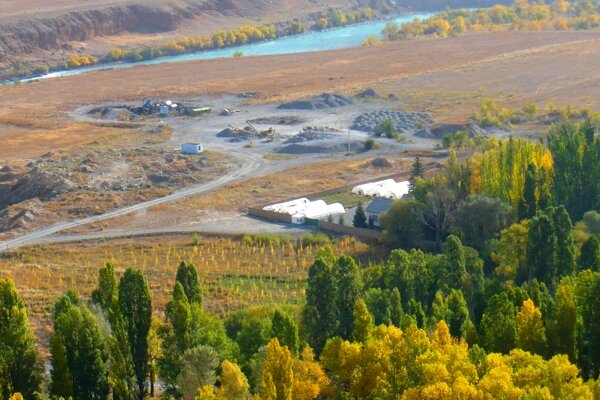
Intrigued, I wondered: ”What were the circumstances in which he wrote these letters?” So, I went back to my research and this time I was luckier and found out that Julius made several foreign trips as a journalist. He made two trips, for example, to the Soviet Union; the first in 1930, for four months, and the second in 1934, for two years. It was on the first that he visited Khirgizia, (as Kyrgyzstan was then known), and visited the Interhelpa volunteers. Apparently he wrote a very positive account of his experiences and impressions, (called, “In a Land, Where Tomorrow is Already Yesterday“), which was published in 1932.
In a way, it’s not surprising that he was so positive. He was a strong supporter of Joseph Stalin and his regime; arguing with the more progressive members of the Czech Communist Party who were more critical of developments under the “great man”, that their approach would be “fatal” to the Party.
His unquestioning trust and faith in the Party and the system that it ran may seem naive today, but the Notes from the Gallows are still a powerful read.
Now, I can think I understand why the Soviets decided to name a park after him.





 Bishkek