The French Connection
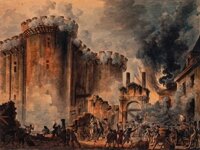
Today is Bastille Day, the French National Day. It is officially known as La Fête Nationale (The National Celebration) but more commonly referred to as le quatorze juillet (the fourteenth of July).
The word Bastille is a French word which means “castle”, “stronghold”, or “bastion”. When used with a definite article, (la in French and the in English), it refers to the fortress-prison in the center of Paris, on the Rue Saint-Antoine, which had often been used to incarcerate people jailed on the basis of lettres de cachet, (arbitrary royal indictments that could not be appealed), and had been known for holding political prisoners whose writings had displeased the royal government. It gained a special place in history on July 14th, 1789, when a group of about a thousand French citizens besieged and stormed the building, in what was one of the pivotal moments in the start of the French Revolution.
Now, Bastille Day provides us with the basis of a good Trivial Pursuits question, with a catch!:
- Take, for example, the question: Was the American Declaration of Independence signed on July 4th?, Answer: probably not. That is the date it was adopted by the Continental Congress. There is some doubt as to when it was actually signed and, although Thomas Jefferson, John Adams and Benjamin Franlin all later wrote that they signed it on that date, most historians now think it was actually signed almost a month later, on August 2nd, 1776.
- Then again, try this one: Did King John sign the Magna Carta at Runnymede? Answer: No, (and don’t fall for the old schoolboy joke and suggest it was signed at the bottom …), King John didn’t sign the document; he affixed the Royal Seal to it.
- So what about the question: Does Bastille Day commemorate the Storming of the Bastille on July 14th, 1789? Answer: No, technically Bastille Day commemorates the 1790 Fête de la Fédération which was held on the first anniversary of the storming of the Bastille on 14 July 1789, not the actual event itself.
This is just one of the surprising facts about the common understanding about the Bastille. For example, although it was seen as a symbol of absolute monarchy which housed opponents of the regime, on the day in question it housed just seven prisoners, and none of them were of any particular political importance: Four forgers, two “lunatics” and a “deviant”. (Another “deviant”, the Marquis de Sade, had been an inmate but was transferred out of the Bastille some ten days earlier.) Although some 98 of the assailants only one of the defenders died in the storming of the Bastille, there were many casualties after the fortress had been taken at about 17:30, including Bernard-René de Launay, the son of the previous governor who was actually born within the fortress. (Apparently, he was dragged to the Hôtel de Ville, (the Town Hall) where he shouted “Enough! Let me die!”, kicking a pastry cook named Dulait in the groin, before he was stabbed several times and fell; his head was sawed off and fixed on a pike and carried through the streets.)
As with all pivotal historical events, the storming of the Bastille should not be seen in isolation. It belongs in the stream of history with a context provided by a complex background including other events and influences which helped to shape this particular one, (such as the refusal of the nobility to pay taxes, the secession of the “Third Estate“ – representing the common people – to be joined by the other two states – representing the Catholic Church and the French Nobility – resulting in the “Tennis Court Oath”, which together with the storming of the Bastille are considered to have be the starting points of the French Revolution), and an aftermath which arose from it, (such as the adoption of the Declaration of the Rights of Man and of the Citizen which was a precursor to the Universal Declaration of Human Rights, the adoption of a Constitutional Monarchy in place of the preceding Absolute Monarchy, which was in turn to be replaced a Republic in 1792).
One of the outcomes of the French Revolution was the creation of the République Française, which was – and still is – a major power with strong cultural, economic, military and political influence in Europe and around the world. It is a leading member of many International organization of which she is a member, including the United Nations where she is a permanent member of the Security Council with the right of veto over resolutions. France has the third largest army in NATO and the second largest diplomatic corps in the world, (after the United States).
In Kyrgyzstan, France opened a diplomatic office in Bishkek in summer 2004, which was transformed into a full-service Embassy in December 2009. They also work in cooperation with other organizations such as the representative office of the European Union and the Organization of Cooperation and Security in Europe, (OSCE) and often organize cultural events together with the German Embassy. Although trade has increased significantly in recent years, Kyrgyzstan is still a minor trading partner for France, with less than a hundredth of the trade of neighbouring Kazakhstan. Kyrgyzstan has a surplus balance of payments with France, with most of exports being metals whilst it imports mainly capital goods, chemicals and medicines. The embassy and other organizations, (such as the Alliance Française), either support or arrange special cultural activities, such as language lessons, film festivals, art exhibitions, and concerts.
There are not many French companies established in Kyrgyzstan, and, at the moment, most of them are in the Energy sector. One of Bishkek’s main Breweries, however, had a French connection, there is a French bar in Bishkek, a French run guesthouse and a couple of French run tour companies.
One of the most high profile French connections with Kyrgyzstan is the Kyrgyz Ate Foundation, dedicated to preservation of the Kyrgyz breed of horse and the cultural traditions associated with it, which is led by Jacqueline Rippart. Amongst their activities, they organize the annual At Chabysh festivals and have published a handbook for horsemen and horsetrek guides.
Kyrgyzstan doesn’t have an embassy in France, they are served by the embassy in Brussels, Belgium. There is, however, the Association for Franco-Kyrgyz Cooperation which was established by some Kyrgyz students who were studying at the university in Grenoble. For several years they have organized an annual conference at the university about Tourism in Kyrgyzstan.
The French are very good travelers and, for some reason, have provided one of the largest contingents amongst our clientele. That has always surprised me, that so many French would chose a British owned and run company when there are others in Bishkek, including two French owned companies. After all, the French and the English have a record of not really getting on that well down through the centuries. It could have had something to do with Napolean, or the history of Calais, but I suspect that it has something to do with the fact that they once ruled most of Britain, whilst at another we ruled most of what is now France. To be perfectly frank, it is probably more to do with culture and language … and the all pervading influence of the English speaking world, especially as represented by the United States of America, crowding out French culture and language and putting the French national identity under pressure. Anyway, whatever the reason, the French and French speaking world are amongst our best customers.
.
This year, to commemorate Bastille Day, the French Embassy has organized a special day of activities dedicated to France and French literature in the Dom Russkoi Knigi, (the “House of Russian Books”), although it will be held a couple of days late, (on July 16th, starting at 4 p.m.). Admission is free, and everyone is cordially invited to participate. In the programme of activities will be:
- a chance to meet with the French Ambassador ;
- an “open lesson” in French language;
- a children’s drawing contest;
- live performances of French songs;
- a lesson in tasting French wines and the opportunity to get a bottle of this wine from the bar “U Frantsusa”, (At the Frenchman’s place”);
- competitions, in which anyone present would be able to win a book!;
- tea, coffee and presentation of novelties by the company “Kulikovsky Tort”, (Kulikov’s Cake).



 Bishkek