Bed and Breakfast
One of my biggest regrets about life here in Bishkek, is that I am too often bound to my desk and don’t get the oppotunity to get “out and about” as much as I would like. Once a month, of course, I go up to visit our guesthouse in Naryn and I like to take the chance, whenever possible, to combine this with a visit to somewhere.
At the end of May, for example, we decided to take extend our trip to include Karakol, in the Issyk Kul oblast. The idea was take Victor Rehemyae, who would take some photographs and prepare some panoramas for our site www.see.kg.
Now, visitors to “The Lake”, (as Issyk Kul, the “pearl of the Tien Shan”, is often referred here), have a wide choice of available accommodation to choose between: sanatoria, resorts, hotels and pensionats … but, even so, at the height of the season it can sometimes be difficult to find a place to stay if they haven’t booked well in advance. It is not surprising, therefore, to learn that, (as is the case in tourist destinations all over the world), many local residents let out rooms and take in guests.
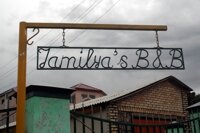
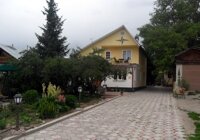
In Karakol, we decided to stayed in a small guesthouse that offered Bed and Breakfast, (B&B), Jamilya’s. As it happens, although as a company we have often used this particular guesthouse, I haven’t actually stayed there before, myself, and so I was interested to see it.
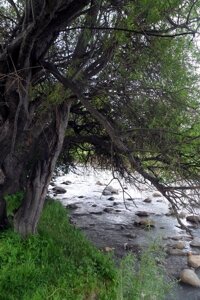
The guesthouse is on the outckirts of town, at the western end of town just off the main road which skirts the southern shore of the lake. Fortunately, Karakol is not that big and there was a sign on the main road, so it was easy to find. To be honest, the approach road from the main road was a bit rough, but the house itself was very well appointed and comfortable. Just across the road was a small river which flowed down from the mountains towards the lake, giving the feeling that we were almost in the countryside.
We were met by Jamilya, herself. She is a friendly woman who speaks good English. Some other members of the family also speak English or French. She showed us around the main building, which had seven bedrooms, a bathroom, a shower room with toilet and a sitting/dining room. As we chatted, I discovered that we had many acquaintances in common … not just our clients … whom she had accommodated.
Most of the rooms were spacious, (mine, in particular was a family room which had plenty of space and could sleep three), and warm – which is not unimportant bearing in mind that we were at over 2000 meters a.s.l. and nights can get distinctly chilly).
To be honest, not all guesthouses are so well appointed and modern, but one feature that is common, however, is the hospitality on offer.
Jamila takes in guests during the summer season and has been doing so for several years as a member of the local CBT, (Community Based Tourism), group, which operates as part of the KCBTA network (Kyrgyz Community Based Tourism Association “Hospitality Kyrgyzstan”, www.cbtkyrgyzstan.kg). The Association unites about twenty local CBT groups, and five “Shepherd’s Life” groups, offering accommodation and other services for tourists. They were originally supported by a Swiss project operated by the agency Helvetas – and have organized training for their members; published a handbook for those planning to offer accommodation to guests; established a standardized system of classification and quality control and operate a National Office which handles marketing and can make reservations. Indeed, some of the local groups also run offices with information on each of the participating homestays and the facilities they offer. I wrote a postcard about them last year.
.
Jamilya’s is often described as a guesthouse, but most of the accomation offered by CBT groups are known as Homestays. The difference between them is not always clear but it is usually one of scale. A guesthouse is like a small hotel with several rooms which are let to visitors with perhaps special facilities such as a dining room. A homestay, on the other hand, usually has only one or two rooms available for guests, and meals will be served in the same room as the family normally uses.
Homestays are popular with many tourists, partly because they are relatively inexpensive but they also give the visitor a chance to meet and interact with local people and see how they live.
They are not all the same – Kyrgyzstan is home to over 80 different nationalities and the architecture, the facilities, the decoration and the food – all can be different depending on the location and nationality of the host family. One feature that is common, however, is the hospitality on offer.
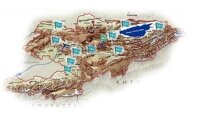
The CBT groups are found throughout the country, both in cities and rural areas, and there numbers are constantly increasing which means that there are a growing number of homestays and guesthouses available. Some of them are in more “off the beaten track” locations and this has meant that more of the country has been opened up for visitors.
Many of the host families can offer additional services for the individual traveler, such as offering souvenirs, organizing horses for riding, interpreters (mainly German and English), and concerts of traditional music and demonstrations of traditional crafts. Homestays which participate in the CBT network also have a small “Information Corner” which has information about the local neighbourhood and facilities.
.
Not all homestays and guesthouses in Kyrgyzstan, however, are members of a CBT group. To participate in the scheme the homestay is inspected annually and awarded a sign to display to show that they belong to a local CBT group. Each participating homestay is then awarded a grade, based on the level of comfort and facilities available: the Edelweiss. The three levels, (indicated by one, two or three Edelweiss – three is the highest) define the different price levels charged for accommodation.
Some of Kyrgyzstan’s more exotic providers of Bed and Breakfast are local shepherds in a high mountain pasture – a jailoo. Accommodation is in a yurt – a round felt tent, (also known as a “boz ui“) – the largest of which can accommodate up to ten people. Here it is possible to experience the centuries-old nomadic way of life, taste national dishes; see how goats, cows, horses are milked; drink a cup of koumiss, (fermented mare’s milk); and taste national dishes, home made bread and, in some places, fresh fish from a nearby lake.
.





 Bishkek