Invanitsyn
Alexey Illarionovich Ivanitsyn was a mechanic who participated in the 1905 revolution – and the Imperial authorities exiled him to Central Asia – where he arrived destitute and penniless.
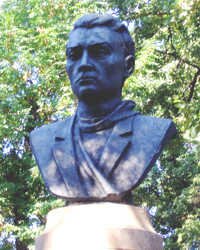
Bust of Ivanitsyn in Bishkek
A friend found him a job in Pishpek in 1917 – on the Chu valley Irrigation works. With 200 skilled Russian and over 2000 Kyrgyz and Kazakh employees, this was one of the biggest employers in the region at that time. The Kyrgyz and Kazakhs were “draftees” under the war-labour decree which had sparked off the events of 1916 and so, harbouring resentment over these events, were fertile material for someone with revolutionary zeal, such as Ivanitsyn. Speaking at private, secret, meetings at a house in Dubovny Park (Oak Park), he was able to pass on his enthusiasm for socialist revolution.
On New Year’s Day, 1918, Ivanitsyn led a party of Bolsheviks in a coup. Following a New Year’s party in Oak Park, they “arrested” the whole of the regimental command, and released the prisoners from the town jail. They then elected their own chairman of the Pishpek Soviet and proclaimed soviet power throughout the district. Ivanitsyn was elected chief of the city’s executive committee – and for two years he ran the administration from his office, in a one story building on the then Tashkent Road which still stands today (at 409 Jibek Jolu).
There was a street named after him – lying between and parallel to Frunze and Jibek Jolu (it’s now called Djumanbek) and where it crosses with Erkindik a bust of him was erected in 1957.





 Bishkek