Anniversary of the Great October Socialist Revolution – November 7th
Although in Soviet times, November 7th was a major holiday accompanied by parades and much merrymaking, in modern Kyrgyzstan it is a fairly subdued affair. Indeed, for several years following independence, the holiday was dropped from the list of official public holidays – being reinstated in 2004.
Although official parades are no more, the Communist Party in particular marks the day – but for most people it is just a welcome “non-working day”. This year, because the 7th fell on a Sunday, which is normally a non-working day, the holiday was marked on the day itself, but the Monday became a holiday – a non-working day.
The Great October Socialist Revolution was the official name for the events that took place in October 1917.
Actually, the uprising initiated by Lenin and his Bolshevik Party began on October 25th 1917, but this was according to the Julian calendar which still in use in Russia at the time, but in the rest of the world which used the Gregorian calendar the date was November 7th. When the USSR also adopted the Gregorian calendar – they continued to celebrate the anniversary … in November.
After Kyrgyzstan declared its independence from the Soviet Union, the anniversary was removed from the list of official holidays. In 2003, however, it was decided to reinstate it.
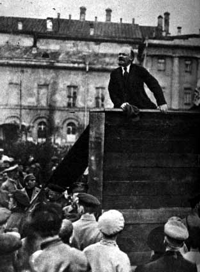
Imperial Russian was in a state of crisis in 1917. The war in the West with Germany and the Austrian Hungarian Empire was not going well – soldiers were refusing to obey orders and many had deserted. There was political, social and economic unrest at home with food shortages, strikes and land seizures. During 191
7, Russia experienced a revolution which can be characterized in two phases:
- The February Revolution of 1917, which displaced the autocracy of Tsar Nicholas II, the last of the Russian Tsars, and sought to establish in its place a liberal republic and
- The October Revolution, in which the Soviets, inspired and increasingly controlled by Vladimir Lenin’s Bolshevik party, seized power from the socialist coalition (that had replaced the liberal one), which formed the Provisional Government.
The impetus for the February Revolution was food shortages in Petrograd, the capital. In fact there was a growing disquiet about the conduct of the war and the autocratic nature of the Tsarist rule. It began with a strike in one of the major factories of the capital – which quickly spread to others – then to a series of meetings and rallies. A large battalion was sent to the city to quell the uprising, but many shot their officers or deserted and the soldiers joined the revolt instead. The result was the abdication of the Tsar and the installation of an alliance between liberals and socialists who wanted to instigate political reform, creating a democratically elected executive and constituent assembly. After a few months the Prime Minister, Lvov, resigned and was replaced by Kerensky, who faced pressure from both sides, right and left.
In July Kornilov, a right wing General – dissatisfied with the conduct of the war, marched his troops on the capital. At Kerensky’s request an army of an estimated 25000 came to the defence of the city – organized in part by the Bolsheviks under Lenin.
The October Revolution, which is also known as the Bolshevik Revolution, was led by Bolsheviks under the leadership of Vladimir Lenin, who had been forced into hiding, and was the first officially Communist revolution of the twentieth century, based upon the ideas of Karl Marx.
On October 25, 1917 Lenin and the “Red Guards” took over major government facilities with little opposition before finally launching an assault on the Winter Palace on the night from November 6th/7th. The assault was launched at 9:45pm by a blank shot from the cruiser Aurora. The Palace was guarded by Cossacks, a Women’s Battalion, and a cadet corps. It was finally taken at about 2am. Although many later accounts fierce fighting took place, in reality the revolutionaries faced little or no opposition, the defenders surrendering en masse, and were practically able to just walk into the building and take it over, seizing most of the cabinet – although Kerensky has escaped and was later to flee the country.
Meanwhile … in Moscow, Mikhail Vasilievich Frunze, the son of a Moldavian doctor’s assistant who was born in Pishpek – as Bishkek was then called – led an armed force of workers to aid in the struggle for control of the city and commanded the Red Guards, which occupied the Kremlin.
Whereas the February Revolution was largely a bloodless transfer of power from the Tsar to a democratically elected government, the October Revolution was different. Although in the capital it was swift and bloodless, the attempt to assert power in the rest of the country was met by strong resistance.
At first this was political. It had been planned to hand power from the Provisional Government to the “Second All-Russian congress of Soviets of Workers’ and Soldiers’ Deputies” which was due to begin the next day. Many of the delegates, (notably the Mensheviks), however, considered thought that Lenin had usurped power and walked out of the meeting.
An attempt to take over Moscow a month later was met with much more violent resistance, and the Bolsheviks did not seize full control of the city until March 1918.
A coalition of anti-Bolshevik groups attempted to unseat the new government in the Civil War that ensued from 1918 to 1920.
Meanwhile … in Kyrgyzstan … revolutionary forces were being stirred by the likes of Alexey Illarionovich Ivanitsyn, a mechanic who had participated in the earlier 1905 revolution for which the Imperial authorities had exiled him to Central Asia, where he arrived destitute and penniless. A friend found him a job in Pishpek (as Bishkek was then called) in 1917 – on the Chu Valley Irrigation Works. With 200 skilled Russian and over 2000 Kyrgyz and Kazakh employees, this was one of the biggest employers in the region at that time. The Kyrgyz and Kazakhs were “draftees” under the war-labour decree which had sparked off the events of 1916 and so, harbouring resentment over these events, were fertile material for someone with revolutionary zeal, such as Ivanitsyn. Speaking at private, secret, meetings at a house in Dubovny Park (Oak Park), he was able to pass on his enthusiasm for socialist revolution.
On New Year’s Day, 1918, Ivanitsyn led a party of Bolsheviks in a coup. Following a New Year’s party in Oak Park, they “arrested” the whole of the regimental command, and released the prisoners from the town jail. They then elected their own chairman of the Pishpek Soviet and proclaimed Soviet power throughout the district. Ivanitsyn was elected chief of the city’s executive committee – and for two years he ran the administration from his office, in a one story building on the then Tashkent Road which still stands today (at 409 Jibek Jolu).
The Counter Revolution
Over the next few months, they established control over the region, but in December they faced a counter-revolution. In the village of Belovodsk, about 30km west of Bishkek, the post office was seized by a curious group of anti-Bolsheviks who managed to take control of large parts of both Pishkek and Djambul regions. Within a week they were marching on Pishkek itself. The battle for the city lasted eight days, but the defenders (commanded by Logvinenko – who hurried to Pishpek with reinforcements from Almaty) – managed to overcome the attackers and the counter-revolution was defeated. The soldiers who died in the fight defending the revolution were buried and a memorial erected in Oak Park, near where the Russian Drama Theatre now stands. Logvinenko became a hero and had a street named after him. (When he died in, 1930, he joined the “Martyrs” in their communal grave). This ended the counter revolution in the North of the country, but during the civil war the Bolsheviks were threatened by the Basmachi movement which even “liberated”, for a time, the Pamir district in the South.
One man’s experience of the counter revolution:
In 1932, a new book hit the bookshops in Britain telling a remarkable story of one man’s escape from the clutches of the Cheka, (Lenin’s secret police) as they hunted him throughout Central Asia for two years. It was a great success and led to a sequel – telling of his escape from Kashgar to British India. The author, Paul Nazaroff, had been born into a rich family in Odenburg in the Urals where his father was a mine owner and the mayor of the town. Nazaroff studied Zoology in Moscow and later qualified as a mining engineer. He travelled extensively, eventually ending up in Tashkent where his father owned a cotton mill. Here he practiced his profession and opened several important mines. He was a man of many talents, and explored the region around Tashkent – making contributions to various branches of science – especially geology and horticulture. He was a keen hunter and a firearms expert, (he was sometimes called upon to act as an expert witness on matters relating to firearms). Then came the Bolshevik Revolution. Much of the Russia that he knew and valued changed dramatically. An ardent anti-Bolshevik, he was involved in organizing an abortive uprising in Tashkent in 1918. The role that he played is hinted in official British papers from the time … but in his book he plays down his role – concentrating on his experiences “on the run”. Escaping from Tashkent, he finds refuge with a wide range of people. From the foothills to the East of Tashkent, he travels to Pishpek, (modern day Bishkek), and then, sometimes only hours ahead of the pursuing Cheka, over the mountains to Naryn, and eventually to Torugart and Kashgar.
The revolution heralded the formation of the Soviet Union. In Central Asia, in the period that followed, moves were made to win over the nationalities, and power was assumed by the new central authorities, but more of that another time.
The success of the Soviet Revolution is still seen by many Kyrgyz as a forward step – bringing support to the nationalities in the face of the autocratic Tsarist rule, social and economic reform. Many of the Kyrgyz who fled over he border to China following the events of 1916 returned.
Despite declaring independence from the USSR the decision to reinstate the holiday is seen as a commemoration of an important event that helped to shape the future of Kyrgyzstan – even if it had occurred in a foreign land, a long way away – and a long time ago.




 Bishkek